Covered calls: the rules that matter
How to sell calls without sabotaging your own upside—or getting trapped in endless rolls.
Read →
Framework
I write and teach practical investing: options, portfolio construction, and risk management. If you want repeatable systems (not “signals”), start with the blog—or book a coaching session.
What I actually work on.
Short, direct, and tactical.
One session: clean up your strategy rules and failure modes.
Build a repeatable process for stocks/crypto/options that you can actually follow.
Monthly check‑in + async questions (lightweight accountability).
Clean reading + a usable archive.
How to sell calls without sabotaging your own upside—or getting trapped in endless rolls.
Most strategies fail the same way: size + stress + forced decisions. Fix those first.
Why your allocation matters more than your next trade, and how to make it survivable.
Coaching, partnerships, speaking.
| Macroeconomics | 23 seen

The Baltic states and Caucasus region both have unique economic landscapes that make for an interesting comparison.
Let's start by looking at the GDP in each of the six countries in 2012. Azerbaijan was the wealthiest country with 67.2 billion USD, followed by Lithuania with 42.25 billion USD, Latvia with 28.37 billion USD, Estonia with 21.85 billion USD, Georgia with 15.83 billion USD, and Armenia with 9.91 billion USD.
It's interesting to see that Azerbaijan was the clear winner when looking at GDP, however, when we compare the GDP per capita, the wealthiest country changes. In 2012, Estonia had the highest GDP per capita with 16,316 USD, followed by Lithuania with 14,150 USD, and Latvia with 14,000 USD. Meanwhile, in the Caucasus region, Azerbaijan had the highest GDP per capita with 7,227 USD, followed by Georgia with 3,500 USD and Armenia with 3,370 USD.
When we look at the total GDP of each region, the Caucasus region had a total of 92.94 billion USD in 2012, while the Baltic states had a total of 92.47 billion USD. So, when comparing the two regions based on GDP in 2012, the Caucasus region outperformed the Baltic states by 47 million USD.
Now, the question arises - which region will reach the 100 billion USD GDP mark first, and will it happen in 2013? It's difficult to say, as the economic landscape has changed significantly in the last decade. However, it's important to note that more than 50% of Azerbaijan's GDP is generated by oil, so it's possible that Azerbaijan could reach the 100 billion USD mark. On the other hand, Armenia and Georgia may not be able to catch up with Azerbaijan's GDP as they don't have the same natural resources.
As for the Baltic states, since they don't have any natural resources, it's interesting to see what will happen in the future. These countries may have to rely on other economic drivers such as technology, tourism, and service industries to grow their economies. In recent years, the Baltic states have been making significant investments in these areas, and it will be interesting to see how this affects their GDP in the coming years.
In conclusion, both the Baltic states and Caucasus region have unique economic landscapes that make for an interesting comparison. While Azerbaijan was the wealthiest country in 2012 when looking at GDP, Estonia had the highest GDP per capita. The Caucasus region had a higher total GDP in 2012, but the future of the Baltic states is uncertain as they don't have any natural resources. However, they have been making investments in other areas such as technology, tourism, and service industries, which could drive their economy in the future.
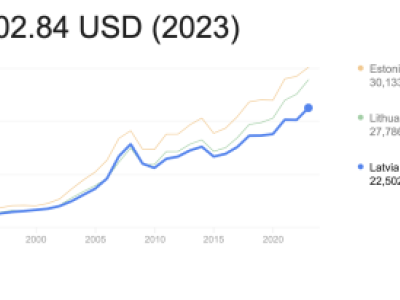
Between 2016 and 2025, the Baltic states—Estonia, Latvia, and Lithuania—have undergone significant economic transformations. This period…
As we usher in the new year, significant changes are on the horizon for the Baltic states, particularly in the realm of minimum wage. In…
In 2023 minimum wage is set to increase in all Baltic states. Estonia will have a minimum wage of EUR 725; Latvia - EUR 620 and…

Baltic Horizon Fund is a regulated closed-end contractual investment fund registered in Estonia. The fund is traded on Tallinn (Nasdaq…
It has been a great decade for all three Baltic states, and increasing minimum wages is just one good example of showing that. From humble…
Covered calls work when you treat them as an income layer, not as a lottery ticket. The strategy is simple; the rules are the edge.
If assignment breaks your plan, your plan wasn’t real. Size down until you can hold through stress.
Calls cap upside. If your thesis is “this can rip,” calls may be the wrong tool.
Boring strategies fail when rules are vague.
Want this as a worksheet? Book a coaching session and I’ll tailor it to your portfolio.
Markets don’t owe you clean outcomes. Your only reliable advantage is controlling how you can fail.
Write your max loss per position, max loss per theme, and max leverage. If it feels uncomfortable, that’s the point.
Survival first. Returns second.
Most “alpha” comes from not blowing up. A survivable allocation beats a brilliant trade that forces you out of the game.
A core of long-term holdings, a satellite of tactical positions, and a small layer for option income—only if you have rules.
When you don’t know what to do: reduce complexity.