Over the past several years, I have been building Terramatris, a small crypto hedge fund that relies heavily on options trading to generate income and manage exposure to Ethereum and other digital assets.
The strategy has gone through many different phases. In the early days, we experimented with aggressive 1 DTE put selling, higher deltas, leveraged positions, and relatively active trade management. Some periods worked exceptionally well, while others clearly demonstrated the risks of combining short-dated options with leverage.
Today, the approach is considerably more conservative. The Terramatris Ethereum strategy has largely transitioned to spot-only exposure, with most income generated by selling covered calls against Ethereum already held in the portfolio. These positions are usually structured with weekly expirations.
Nevertheless, based on my experience, 1 DTE options still appear to offer some of the highest potential annualized premium yields. That does not necessarily make them the safest or most reliable strategy, but it makes them worth continuing to study.
For that reason, I started building a 1 DTE ETH options trading bot for Bybit in April 2026. The architecture was designed with enough flexibility to eventually support Deribit and potentially any exchange offering an options chain and API access.
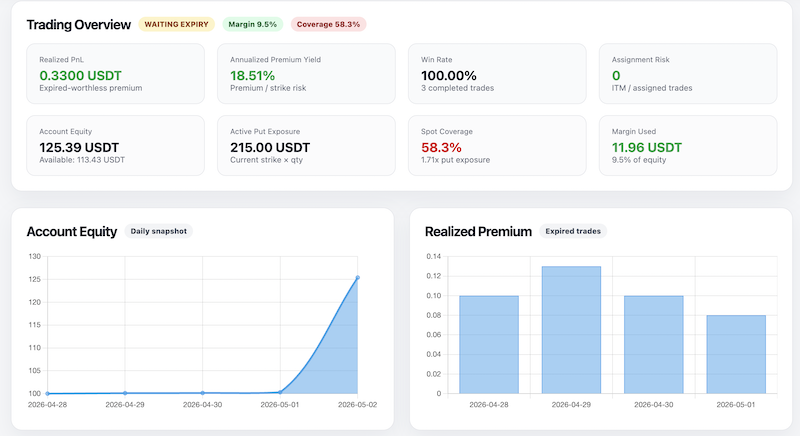
Bybit remains the primary focus because it is where most of the options trading for the Terramatris crypto hedge fund currently takes place.
After the initial development and testing phase, I switched the bot off for a while. The broader Ethereum strategy was changing, and I did not want the portfolio to become overly dependent on an experimental automated system.
I have now turned the bot back on, but its role is different from what I originally imagined. It is no longer intended to operate as the main Terramatris trading strategy. Instead, it is being used as a small supplement to the larger spot-based Ethereum strategy.
The core portfolio continues to rely primarily on spot Ethereum and covered calls. The bot manages only a limited allocation and is intended to generate additional premium without becoming a major source of portfolio risk.
From manual 1 DTE trading to automation
In the early days of Terramatris, the options strategy was entirely manual. I frequently traded 1 DTE Ethereum options, including both conservative far out-of-the-money puts and more aggressive positions with higher deltas.
At times, leverage was also used to increase position size and potential returns. Although the strategy generated attractive premium income during favorable periods, it also created considerably greater downside risk when Ethereum moved sharply.
Over roughly one year of more conservative manual trading, only around five or six put positions with delta below -0.10 were meaningfully challenged. That was encouraging, although the sample was still limited and market conditions were not constant.
These trades were not truly systematic. They were entered manually and influenced by judgment, market sentiment, position size, available margin, and occasionally emotion.
Some trades were conservative, while others were substantially more aggressive. Position sizes were occasionally increased after profitable periods, and the rules were not always followed consistently.
The bot is an attempt to remove at least part of that inconsistency by turning the strategy into a defined, repeatable process.
How the bot works
The application was built locally on my MacBook using Python, with substantial assistance from ChatGPT. Despite the growing use of the term “AI trading bot,” there is currently no artificial intelligence making trading decisions.
The execution logic is rule-based. The bot connects to Bybit, scans the available ETH options chain, filters contracts according to predefined conditions, ranks the remaining candidates, and selects a trade.
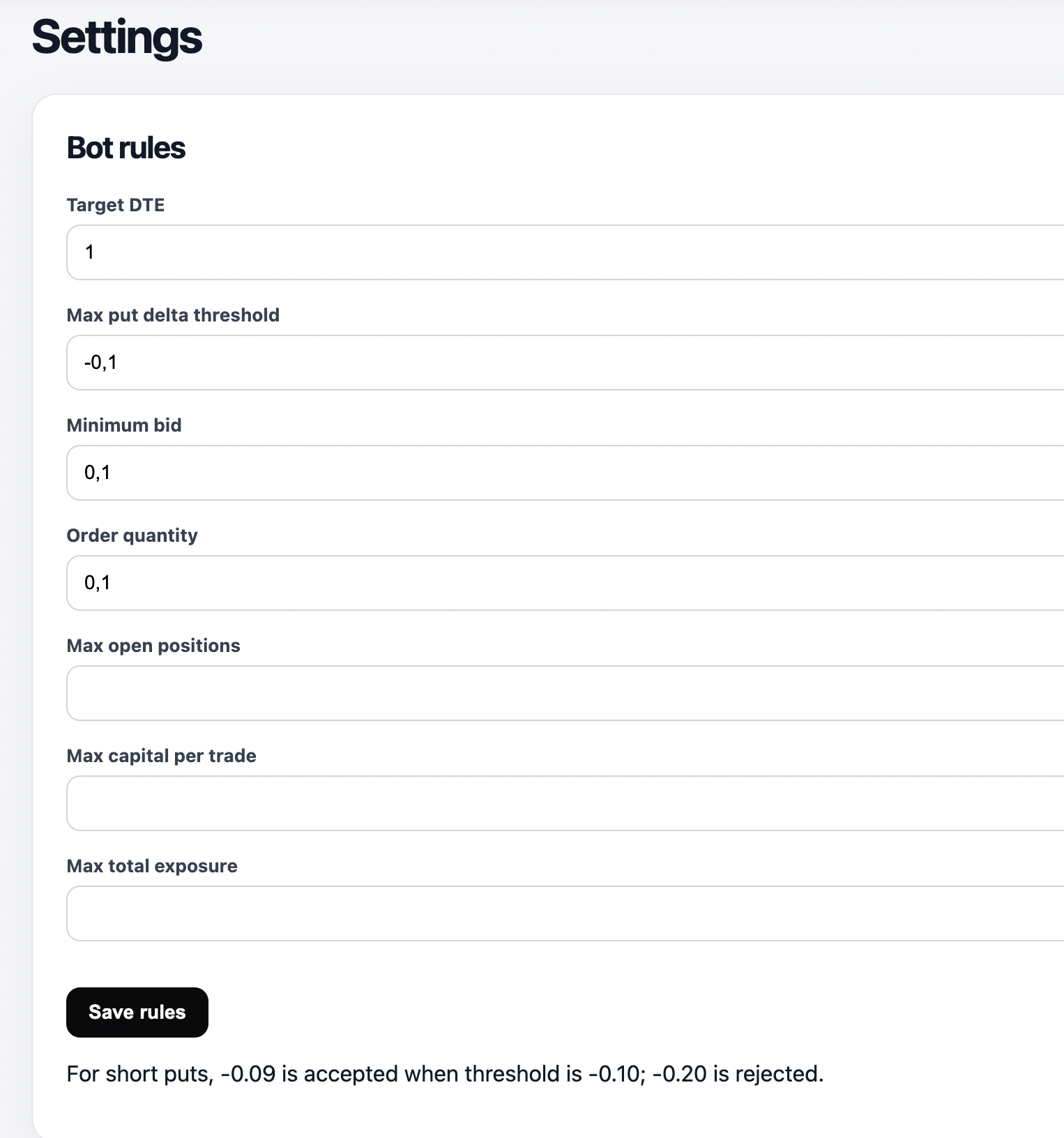
The parameters can be adjusted depending on whether I want the strategy to be more conservative or more aggressive. These settings include factors such as delta, distance from the current ETH price, premium yield, liquidity, and expiration time.
The current configuration generally favors 1 DTE ETH puts with delta below approximately -0.10, although the precise threshold can be adjusted.

Once suitable candidates have been ranked, the bot can automatically execute the selected trade.
The basic principle is straightforward: low-delta, short-dated options tend to expire worthless most of the time. The strategy is therefore based more on probability and disciplined risk selection than on predicting the exact direction of Ethereum.
However, a high win rate should not be confused with low risk. A strategy can produce many small winning trades and still suffer a significant loss when the underlying asset moves sharply.
This is particularly important with 1 DTE options, where gamma risk increases rapidly as expiry approaches. A position that initially appears far out of the money can become challenged very quickly.
Assignment and spot exposure
A basic hedging mechanism is currently in place. If a short put finishes in the money, the bot can buy the corresponding amount of Ethereum on Bybit, effectively approximating the economic result of assignment.
This fits more naturally with the current Terramatris structure because the main strategy is already based on holding spot Ethereum.
Instead of treating assignment as a complete failure, the acquired ETH can become part of the wider portfolio and potentially be used for future covered-call positions.
If a short put is challenged and finishes in the money, the bot automatically takes assignment by purchasing the corresponding spot ETH position. However, it does not yet automatically transition that newly acquired ETH into a covered call. The call-writing stage remains manual, although automating the full put-to-spot-to-covered-call cycle is one of the most logical future upgrades.
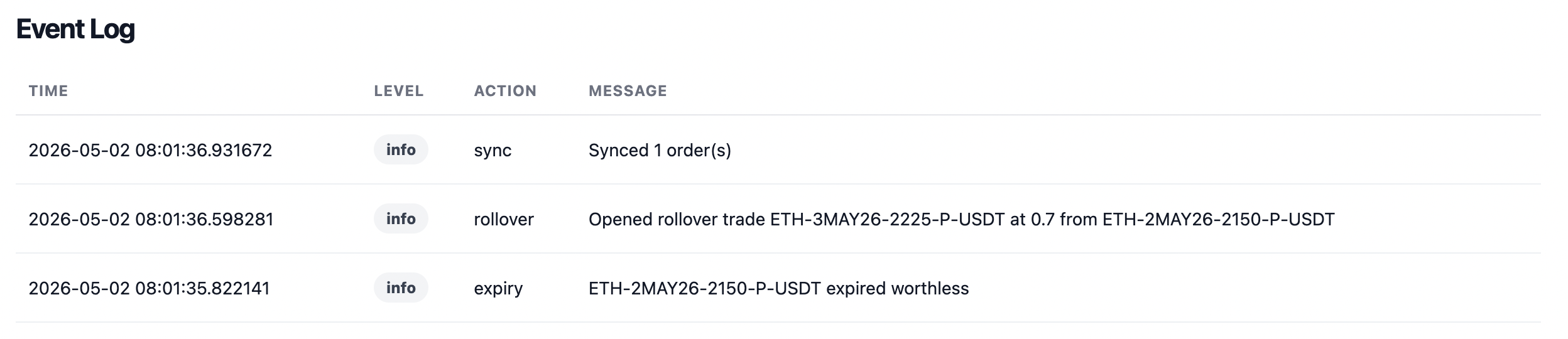
For now, the bot can continue scanning for new put opportunities while any acquired spot Ethereum is managed separately as part of the broader Terramatris Ethereum strategy.
Why 1 DTE remains interesting
Terramatris now relies mainly on weekly covered calls, which are generally easier to manage and fit better with a spot-only portfolio.
Weekly options provide more time to respond, roll positions, or adjust exposure. They also reduce the need to make trading decisions every day.
Despite those advantages, 1 DTE puts can offer substantially higher annualized premium yields. Even relatively small daily premiums can appear attractive when extrapolated over a full year.
This annualization should be interpreted carefully. It assumes that similar trades can be repeated consistently, that liquidity remains available, and that major losses or assignments do not erase months of accumulated premium.
Earlier testing suggested potential annualized yields of approximately 18%-28% from very deep out-of-the-money puts. Depending on volatility and the selected delta, the implied annualized yield can sometimes be significantly higher.
These figures are theoretical and based on limited observations. They are not reliable forecasts, and they do not fully account for tail risk, slippage, execution failures, changing volatility, or the cost of managing assigned positions.
A supplement, not the entire strategy
The most important change is how I now view the bot within Terramatris.
When development began in April 2026, it was tempting to imagine the system eventually becoming a largely independent automated strategy.
After stepping back and turning it off for a period, I concluded that a better use is as one component within a diversified Ethereum options framework.
The main strategy remains relatively straightforward:
- hold spot Ethereum without relying on portfolio leverage;
- sell mostly weekly covered calls;
- manage strike selection according to the portfolio’s cost basis and market conditions;
- use the 1 DTE bot only for a limited portion of the capital;
- treat any ETH acquired through challenged puts as part of the broader spot position.
This structure reduces the risk of depending entirely on one options strategy. The bot can contribute additional premium, but the portfolio should remain viable even if the automated strategy is paused or performs poorly.
Current priorities
This remains an early-stage, in-house project. There are no plans to offer public access in the near future.
The immediate priority is reliability rather than adding increasingly complicated trading logic. The bot must be able to scan, select, execute, monitor, and record trades without requiring constant manual intervention.
Before increasing the allocation, I want to see stable performance across different volatility environments rather than only during calm markets.
The core requirements include:
- stable execution across multiple trading cycles;
- strict position-size and risk controls;
- detailed logging and monitoring;
- handling of API failures, insufficient liquidity, rejected orders, and abnormal market conditions;
- safeguards preventing the bot from repeatedly increasing exposure after adverse price movements.
What comes next
The longer-term objective is to develop a more complete options engine with clearly separated strategy modules.
These could eventually include predefined 1 DTE, 7 DTE, and 30 DTE strategies, each with its own risk limits, allocation rules, and trade-management logic.
Another logical development would be a complete automated wheel structure. If a put becomes challenged, the system could acquire spot Ethereum and subsequently sell covered calls against that position.
Future versions may also adjust trade aggressiveness according to volatility, market trend, existing portfolio exposure, and the recent performance of the strategy.
Machine-learning elements may eventually be added, but only where they provide a measurable improvement over transparent, rule-based logic. Adding complexity for its own sake would not make the strategy safer or more profitable.
On the infrastructure side, Deribit support remains under consideration. Deribit generally offers deeper crypto-options liquidity, which could become important if the strategy grows beyond relatively small position sizes.
The bot now runs on a VPS, allowing it to operate continuously with more reliable execution, monitoring, and logging than a local MacBook setup.
There are no plans to make the source code public. However, later in 2026, I may give a small number of selected users access to the bot for testing and feedback before deciding whether to develop it into a broader product.
Starting small
Percentage returns from short-dated options become financially meaningful only when sufficient capital is deployed. At the same time, deploying too much capital before the system has been properly tested would be irresponsible.
For Terramatris, the bot is therefore starting with a small allocation. Additional capital can be contributed gradually from premium generated by the core Ethereum strategy.
This will not produce meaningful income in the short term, but income is not the primary objective at this stage. The purpose is to validate execution, identify operational problems, and observe how the strategy behaves across a large number of trades.
If the bot proves reliable over time, its allocation may gradually increase. If it does not, it can be paused again without creating significant damage to the wider portfolio.
Bottom line
Terramatris has evolved considerably since its early experiments with leveraged 1 DTE Ethereum puts. The fund now follows a more conservative spot-based structure, relying mainly on weekly covered calls.
However, 1 DTE options continue to offer potentially attractive annualized yields, which makes them worth testing under strict risk controls.
The revived trading bot is not intended to replace the main Ethereum strategy. It is a supplementary tool designed to automate a small, clearly limited part of the portfolio.
The objective is not to maximize the number of trades or chase the highest possible yield. It is to determine whether a disciplined 1 DTE strategy can add incremental returns without exposing the wider Terramatris portfolio to unacceptable risk.
If you're curious
The bot is not publicly available, but I plan to continue documenting its development, results, assignments, failures, and future improvements on ReinisFischer.com.
Anyone interested in following the development of Terramatris or the broader Ethereum options strategy can also get in touch here.