I have no precise idea how much material is there, but my rough estimate is around 100 loose cubic metres of bushes, branches and small trees. In Latvian, I would describe this as approximately 100 berkubi. Because branches contain a lot of empty space, this should not be confused with 100 solid cubic metres of timber.
Ādģēri: The 30K Mistake That Turned Into a Long-Term Experiment
The two guys arrived surprisingly quickly in a huge Volkswagen truck, wearing noticeable gold chains. They took a brief look around the property, inspected the access and the amount of vegetation, and soon agreed to do the job.
Their proposal was straightforward: they would cut the bushes, turn the material into wood chips and transport everything away—free of charge.
Sveaskog Baltfor is involved in buying and transporting roundwood, wood chips and fuelwood, primarily for industrial customers in Sweden. Therefore, what looks like an overgrown problem to me is still a usable source of biomass for them.
Is Free Land Clearing a Good Deal?
At first glance, this sounds like an excellent arrangement.
I do not have to hire people with chainsaws, supervise the work, rent machinery, arrange transport or find somebody willing to accept an enormous pile of branches. The company handles the whole process and keeps the resulting wood chips.
In some cases, forestry companies may even pay the landowner a small amount for the material. That depends on the volume, quality, accessibility, transportation distance and current biomass prices.
Naturally, the meeting made me curious. If somebody is prepared to clear the land for free, there must be some commercial value in those bushes. I therefore decided to investigate whether I could cut and process the material myself.
Could I Turn the Bushes Into a Business?
My original idea had been to hire somebody locally to do the cutting. However, that would mean paying workers, supervising the process and later solving the much bigger problem of what to do with the material.
Producing wood chips myself would require more than a chainsaw. For any meaningful volume, I would need a professional wood chipper, loading equipment, transportation and somewhere to store the finished product.
A realistic small commercial setup could easily require an initial investment of around €20,000–€30,000. It might become a viable business if operated at scale, especially if I could combine my own material with paid land-clearing jobs for other property owners.
For one property and approximately 100 loose cubic metres of bushes, however, the economics probably do not justify buying the machinery.
One potentially more profitable niche would be producing and selling retail garden mulch. Instead of selling unsorted wood chips as low-value biomass, the material could be screened, dried, graded and packed into bags for private customers.
Retail mulch would probably generate the highest revenue per cubic metre. But it would also require significantly more work: processing, storage, bags, branding, transportation, marketing and finding customers.
It is an interesting business idea and something worth keeping in mind. For now, however, I decided to return to an area I understand much better: the stock market.
Looking for Timber Stocks
My first instinct was actually to see whether I could simply invest in Sveaskog itself. Since I already have some exposure to the Swedish stock market, it seemed like the most natural way to turn today's experience into an investment.
Unfortunately, that turned out not to be possible. Sveaskog is not a publicly traded company. Instead, it is a commercially operated company wholly owned by the Swedish State, making it Sweden's largest forest owner. The Latvian company that visited my property, Sveaskog Baltfor SIA, is itself a wholly owned subsidiary of Sveaskog AB and is responsible for sourcing timber, wood chips and biofuels from the Baltic region.
With no listed Sveaskog shares available to buy, I expanded my search to other publicly traded forestry companies.
My research led me to several large US-listed forestry and wood-products companies.
- Weyerhaeuser (NYSE: WY) — one of the largest private timberland owners in the United States and probably the most obvious forestry stock for options traders.
- PotlatchDeltic (NASDAQ: PCH) — a timber real estate investment trust combining forest ownership with wood-products manufacturing.
- Rayonier (NYSE: RYN) — another timber REIT with extensive forest holdings.
- Louisiana-Pacific (NYSE: LPX) — a more cyclical manufacturer of engineered wood products, including oriented strand board and siding.
- UFP Industries (NASDAQ: UFPI) — a diversified producer of wood and wood-alternative products.
The US market provides more choices and generally much better options liquidity. Nevertheless, after spending the day walking around a Latvian property and thinking about Baltic timber, I wanted something closer to home.
Where Are the Baltic Timber Stocks?
I would be happy to see more Baltic forestry and timber-processing businesses listed on the stock exchange.
Latvia has a significant timber industry and is among the world's notable exporters of products such as softwood lumber, birch plywood, oriented strand board and wood pellets. Yet investors have very few practical ways to gain direct exposure through the Baltic stock market.
I initially remembered PATA Timber as a possible former Baltic exchange listing. The listed company was actually PATA Saldus, while PATA Timber itself is a privately held limited-liability company. Today, the PATA group remains one of Latvia's leading full-cycle forestry, timber production, logistics and trading businesses, but it does not provide the kind of liquid options market I was looking for.
In 2026, there is effectively nothing sufficiently liquid in the Baltic market for the options strategy I had in mind.
The Finnish market, however, offers several large regional forestry companies. That led me to Stora Enso.
Selling a Cash-Secured Put on Stora Enso
Stora Enso is a Finnish-Swedish company producing renewable materials for packaging, wooden construction, biomaterials and other forest-based industries.
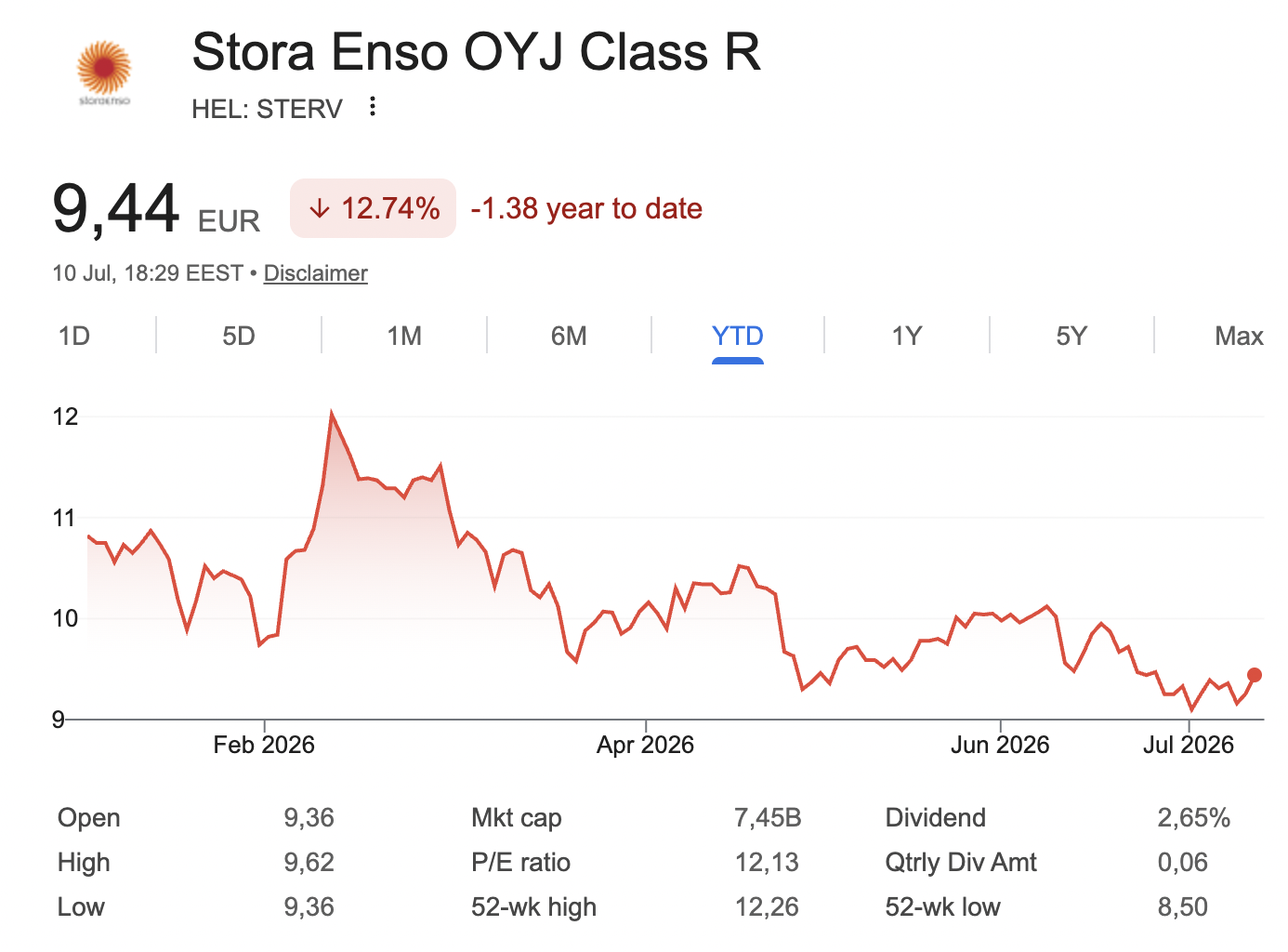
Its shares trade in Helsinki under two share classes: STEAV and STERV. The shares carry equal dividend rights, although their voting rights differ. The company is also listed in Stockholm.
After reviewing the company and its available options, I sold the following cash-secured put:
- Underlying: Stora Enso
- Expiration: September 18, 2026
- Strike price: €8.50
- Premium received: €0.19 per share
- Contract size: 100 shares
- Total premium: €19 before commissions
- Maximum secured capital: €850
- Break-even price: €8.31
The €19 premium represents a return of approximately:
€19 ÷ €850 = 2.24%
The position has approximately 70 days until expiry. That would produce a simple annualized return of roughly:
2.24% × 365 ÷ 70 = 11.65% annualized
The annualized figure is only a mathematical comparison. It assumes that similar trades could be repeated throughout the year under comparable conditions, which is never guaranteed.
What Happens if the Put Is Threatened?
My first choice would be to roll the put forward, preferably for an additional credit, if the share price approaches or falls below the strike.
Rolling is not automatically the right decision. It would depend on the company's fundamentals, the remaining extrinsic value, the available premiums and whether my original investment thesis remained intact.
If I were eventually assigned, I would buy 100 Stora Enso shares at an effective cost of approximately €8.31 per share, excluding commissions.
That would not necessarily be a bad outcome. Stora Enso is an established regional company and remains a dividend payer. Its shareholders approved a total 2025 dividend of €0.25 per share, payable in two instalments during 2026.
After assignment, I could potentially begin selling covered calls against the shares, provided the available strike prices and bid-ask spreads remained reasonable.
A Small Position for the Soul
This is not intended to become one of the portfolio's main positions.
I am not planning to build Stora Enso into an exposure comparable with NVIDIA, Bank of America or even my rather complicated Netflix position. European single-stock options can also be substantially less liquid than popular US options, so order execution and bid-ask spreads require additional attention.
This is instead a relatively small investment connected to something tangible that happened during my day.
I walked around an overgrown Latvian property, met forestry contractors, investigated the economics of wood chips and mulch, and ended the day by selling a put option on one of the largest forest-products companies in Northern Europe.
Sometimes an investment idea begins with an earnings report or a stock screener. This one began with approximately 100 loose cubic metres of bushes growing beside a ditch.
Bottom Line
Letting Sveaskog Baltfor clear, chip and transport the bushes free of charge is probably the most rational decision for this particular property. Attempting to process the material myself would only make financial sense if I intended to build a larger land-clearing, biomass or retail-mulch operation.
That business idea remains food for thought.
For now, I chose the lower-capital route: a cash-secured put on Stora Enso with an €8.50 strike, €19 in premium income and an effective potential acquisition price of €8.31 per share.
It is a small trade rather than a major portfolio commitment—but perhaps an appropriate way to finish a productive day spent working around the property.
Disclosure: This article documents my personal investment activity and is not financial advice. Options involve significant risk and may not be suitable for every investor.