Portfolio Value: $12,189
Weekly Change: +2.6%
YTD Return: +15.33%
Options Premium Collected: $46
As of April 17, 2026, the options income portfolio increased by +2.6%, closing at $12,189. This was the first time the portfolio crossed the $12,000 mark.
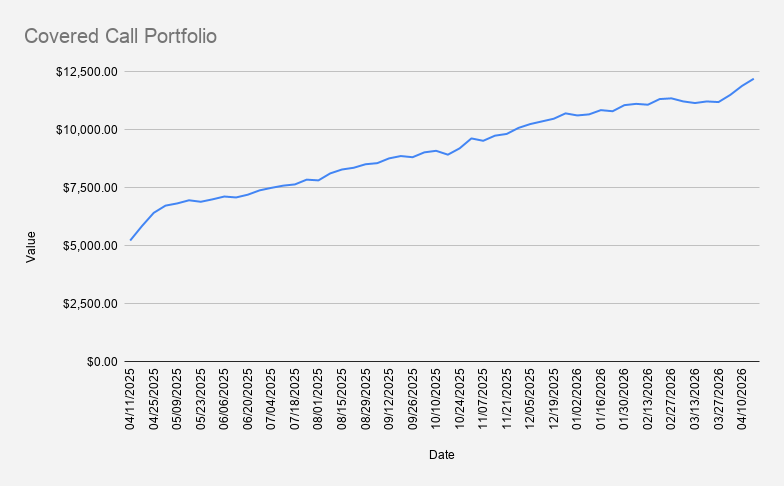
On a year-to-date basis, the portfolio is up 15.33%, outperforming both the S&P 500 (+3.88%) and NVIDIA (+6.06%) over the same period.
NVDA Rally Makes Put Selling More Difficult
This week I was traveling in Berlin and paid relatively little attention to the stock market.
I did notice, however, that NVIDIA (NVDA) was moving toward the $200 level. This is positive for the long-term stock position, but it also makes opening new options trades more difficult.
Strong rallies can create a challenge for put sellers. Put premiums often become less attractive, while the risk of a sharp pullback increases. This makes it harder to sell cash-secured puts or bull put credit spreads at strike prices that still provide a reasonable margin of safety.
Despite this, NVDA remains the anchor position in the portfolio, and I continued using defined-risk credit spreads to generate additional premium income.
Current Options Positions
- NVDA Apr 24, 2026 190/180 Bull Put Credit Spread
- 2x BMY Jun 18, 2026 50/46 Bull Put Credit Spread
- PFE May 15, 2026 25 Cash-Secured Put
- DBK FRA Jun 19, 2026 24/20 Bull Put Credit Spread
- NVDA Nov 20, 2026 $120 Covered Call
The main position to monitor remains the NVDA 190/180 bull put spread. If the position comes under pressure, the plan is to roll it forward when appropriate, preferably while collecting an additional net credit.
Adding a Deutsche Bank Credit Spread
While in Berlin, I also opened an opportunistic credit spread on Deutsche Bank shares traded in Frankfurt.
The position was:
DBK FRA Jun 19, 2026 24/20 Bull Put Credit Spread
This was not part of a major strategic shift. It was more of an impromptu trade that generated approximately €63 in additional euro-denominated options income.
Since the portfolio already holds Deutsche Bank shares listed on the NYSE, this trade added incremental exposure to a company already familiar to the portfolio.
Credit Spreads vs Cash-Secured Puts
This week provided another example of why I often prefer bull put spreads over cash-secured puts when working with limited capital.
Cash-secured puts can be useful, particularly when the objective is to acquire shares at a lower price. However, they require substantially more buying power because enough capital must be reserved to accept a potential assignment.
Credit spreads require less capital and keep the maximum potential loss defined. This allows the portfolio to generate premium income while preserving more buying power for other positions and future opportunities.
The trade-off is that credit spreads can still produce meaningful losses if the underlying stock falls sharply. Lower capital requirements should therefore not be confused with lower risk.
Reinvesting Premium Into NVDA Shares
Using premium collected from NVDA credit spreads, I added another 0.1 shares of NVDA.
The approach remains consistent: use options income not only for short-term cash flow, but also to gradually compound the underlying stock position over time.
This remains one of the central ideas behind the portfolio. Options premium can help finance additional stock purchases while the portfolio continues building long-term ownership in selected companies.
Weekly Premium Income and Margin Debt
This week generated approximately $46 in options premium income.
One of the portfolio's main objectives is to gradually reduce margin debt while maintaining a core holding of at least 100 NVDA shares.
Current margin debt stands at approximately -$3,444.
At a sustained pace of $46 per week, it would theoretically take around 75 weeks to eliminate the entire margin balance, assuming no interest costs, withdrawals, new borrowing, or changes in the weekly premium collected.
This makes it increasingly clear that reducing the margin balance to zero during 2026 may be difficult without either increasing risk or extending the timeline.
I prefer extending the timeline.
Taking additional risk simply to accelerate debt reduction could create larger problems later. The priority remains long-term portfolio stability rather than meeting an arbitrary short-term deadline.
Covered Call Position Remains Important
The portfolio continues to hold a long-term NVDA covered call:
NVDA Nov 20, 2026 $120 Covered Call
This position remains an important part of the overall strategy, but it also illustrates one of the major trade-offs of covered call investing.
Covered calls can generate income and provide limited downside protection through the premium received. However, they also restrict upside participation if the underlying stock rises significantly above the strike price.
This is one reason I continue balancing covered calls, credit spreads, and cash-secured puts rather than relying exclusively on a single options strategy.
Looking Ahead
Next week, the primary position to monitor is:
- NVDA 190/180 Bull Put Spread
If this position comes under pressure, the plan remains unchanged:
- Roll the position forward when appropriate
- Prefer collecting an additional net credit
- Prioritize portfolio stability over short-term premium targets
Bottom Line
This week marked an important milestone as the portfolio crossed the $12,000 level for the first time.
More importantly, it reinforced a recurring lesson: rising stock prices are not always easy for options sellers.
Strong rallies benefit long stock positions, but they can also make new premium-selling trades less attractive and increase the temptation to chase overextended market moves.
The goal remains consistent: generate options income, reinvest part of that income into long-term holdings, gradually reduce margin debt, and avoid taking unnecessary risks simply to reach short-term targets.
Disclaimer
This trade journal reflects personal portfolio activity and is provided for educational and informational purposes only. It should not be considered investment advice, financial advice, tax advice, or a recommendation to buy or sell any security, option, derivative, or financial instrument. Options trading involves risk and may not be suitable for all investors. All investments involve the possible loss of principal.