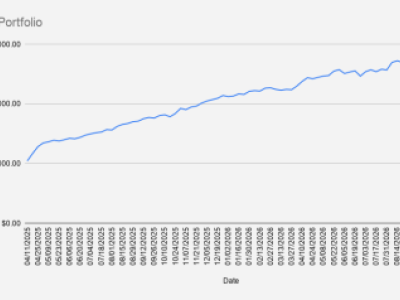
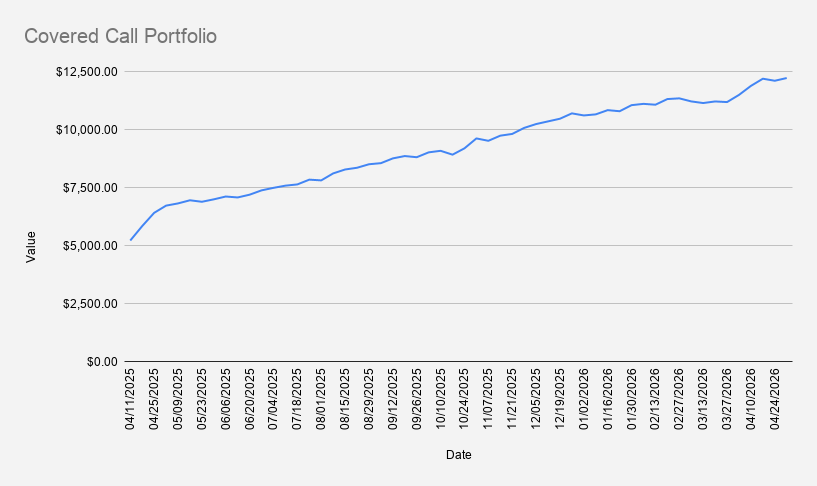
Portfolio Value: $12,218
Weekly Change: +0.97%
YTD Return: +15.48%
Options Premium Collected: $58
As of May 1, 2026, my options portfolio increased by 0.97%, closing the week at $12,218.
While many investors dislike seeing their holdings decline, this week served as another reminder that selling options often changes the way market pullbacks are viewed.
After rallying above $210, NVIDIA (NVDA) retreated below $200. From an options seller's perspective, that wasn't necessarily negative. Strong rallies tend to compress option premiums, making it harder to establish attractive new trades. Moderate pullbacks often improve premium levels while reducing the temptation to chase momentum.
This is one of the reasons why options trading can produce a very different mindset from traditional buy-and-hold investing.
Year-to-date, the portfolio has returned 15.48%, outperforming both the S&P 500 (+5.71%) and NVIDIA (+5.87%) over the same period.
Opening a New NVDA Bull Put Spread
Following the pullback, I opened a new position:
NVDA May 8, 2026 187.5/177.5 Bull Put Credit Spread
The objective remains simple: generate consistent premium income while keeping portfolio risk defined.
Rather than attempting to predict short-term price movements, I prefer opening high-probability positions and managing them if market conditions require adjustments.
Bull put spreads are an efficient strategy because they allow premium collection while requiring significantly less capital than traditional cash-secured puts.
Current Options Positions
- NVDA May 8, 2026 187.5/177.5 Bull Put Credit Spread
- 2× BMY Jun 18, 2026 50/46 Bull Put Credit Spread
- PFE May 15, 2026 25 Cash-Secured Put
- DBK FRA Jun 19, 2026 24/20 Bull Put Credit Spread
- NVDA Nov 20, 2026 $120 Covered Call
Reinvesting Premium Into Ownership
Premium collected from the new NVDA spread was immediately reinvested by purchasing an additional 0.1 shares of NVIDIA.
This reflects one of the core principles behind this portfolio.
Rather than viewing options income purely as cash flow, I prefer using a portion of the collected premium to gradually increase ownership of quality businesses.
The portfolio now holds approximately 102.1 shares of NVDA.
Individually these purchases may appear insignificant, but over many years they compound into meaningful long-term ownership.
Weekly Income and Risk Management
During the week the portfolio generated approximately $58 in options premium.
Although this is below my long-term objective of averaging roughly $100 per week, I deliberately avoided forcing additional trades simply to reach an arbitrary income target.
One of the most common mistakes options traders make is increasing position size solely to generate more premium.
Higher premium almost always comes with higher risk.
In this case, adding more trades would have increased portfolio exposure without offering significantly better opportunities.
Sometimes the best trade is the one you decide not to make.
Margin Debt Update
One of my ongoing portfolio objectives is reducing margin debt while maintaining a long-term position of more than 100 NVIDIA shares.
Current margin debt stands at approximately -$3,357.
Assuming an average of around $58 per week in options premium, the balance could theoretically be eliminated in about 58 weeks.
In reality, premium income varies from week to week, markets change, and positions require adjustments. Because of that, I am comfortable extending the repayment timeline into 2027 if necessary.
Preserving capital and maintaining flexibility remain higher priorities than aggressively paying down leverage.
Lessons From This Week
- Market pullbacks often create better opportunities for premium sellers than strong rallies.
- Risk management is more important than chasing weekly income targets.
- Reinvesting premium steadily increases ownership of productive assets.
- Patience is one of the greatest advantages an options trader can develop.
Looking Ahead
Next week my primary focus will be monitoring the NVDA 187.5/177.5 bull put spread.
I will also need to decide how to manage the Pfizer cash-secured put as expiration approaches.
If market conditions change, my process remains unchanged:
- Roll positions when appropriate.
- Whenever possible, collect additional credit.
- Prioritize long-term portfolio stability over maximizing short-term returns.
Key Takeaway
This week reinforced one of the most valuable lessons I have learned through options trading.
The objective is not to maximize premium every single week.
The objective is to build a repeatable investment process that balances income generation, disciplined risk management, and long-term capital growth.
Some weeks that means opening new positions. Other weeks it means waiting patiently for better opportunities.
Over time, both decisions contribute to long-term success.
Disclaimer
This trade journal documents activity within my personal investment portfolio and is provided solely for educational and informational purposes. Nothing presented here should be interpreted as investment advice, financial advice, tax advice, or a recommendation to buy or sell any security, option, or other financial instrument. Investing involves risk, including the possible loss of principal.