This was not a random trade. I have been selling options and investing with Bank of America stock at least since 2020, and over the years BAC has become one of those names I keep returning to. It is not the most exciting stock in the market, and it will probably never behave like NVIDIA or some fast-growing technology company, but that is exactly part of the reason I like it.
Bank of America is a large, established banking stock. It pays a dividend, it has enough volatility to generate options premium, and it can be a decent candidate for covered call writing once shares are owned.
For my style of investing, this combination matters.
I am not looking at BAC as a quick trade only. I am looking at it as a long-term asset — something I could hold for 5–10 years at least, and ideally much longer, while collecting dividends and generating additional income from options along the way.
Buying BAC After Selling a Cash-Secured Put
The latest BAC purchase came after selling a cash-secured put.
That is one of my preferred ways to enter dividend-paying stocks. Instead of simply buying shares at market price, I can sell a put option at a strike where I would be comfortable owning the stock. If the option expires worthless, I keep the premium. If I am assigned, I buy the shares at the agreed price, while the premium received helps lower my effective entry cost.
In this case, BAC fits well into that strategy.
It is a stock I do not mind owning. It pays a dividend. It has active options. And because bank stocks can be volatile enough, the premiums are usually more interesting than on very slow-moving dividend names.
That does not mean the trade is risk-free. Bank stocks can fall hard during recessions, credit stress, interest-rate shocks, or market panic. BAC is not a bond. It is still an equity. But compared with some of the more speculative names I have traded, BAC feels like a more reasonable long-term holding.
Why BAC Works for My Portfolio
There are three main reasons I like BAC.
First, it pays a dividend. The dividend is not huge, but it adds a real income component to the position. For a long-term investor, this matters. I like the idea of being paid while waiting.
Second, BAC has enough volatility for options selling. Some dividend stocks are too quiet. They may be good long-term holdings, but the options premiums are too small to make weekly or monthly option selling worthwhile. BAC is different. As a large bank stock, it moves enough to make cash-secured puts and covered calls more interesting.
Third, BAC is a stock I can understand. Banks are cyclical, and they are not without risk, but the business model is not some mystery. Bank of America earns money from lending, deposits, fees, investment banking, wealth management, and other financial services. It is tied to the broader U.S. economy, interest rates, consumer credit, and business activity.
That makes BAC a different type of holding compared with NVDA or NFLX.
A Long-Term Holding, Not Just an Options Trade
When investing in BAC, I am not trying to catch the perfect bottom.
My plan is to accumulate slowly. At the moment, that means buying even 0.1 share at a time. It may sound small, but I like this approach. It keeps me involved, it builds the position gradually, and it reduces the pressure of trying to make one perfect decision.
Over time, these small purchases can add up.
This is especially important because I am still cautious. Our stock portfolio already has exposure through NVDA credit spreads, and recently I also tried selling weekly puts on NFLX. That NFLX trade did not turn out as cleanly as planned, and I have now rolled that position all the way to June 2027.
That experience is a good reminder: weekly options can look easy until the trade moves against you.
So with BAC, I want to be more patient. I do not want to over-leverage. I do not want to force trades just for premium. I want BAC to become a long-term income-producing position, not another problem to manage.
BAC as a Covered Call Candidate
If I slowly build enough BAC shares, the next step could be covered call writing.
This is where BAC becomes even more interesting for me. A dividend-paying bank stock with active options can work well for a long-term income strategy. The idea is simple: hold the shares, collect dividends, and occasionally sell covered calls when the premium looks attractive.
Of course, the risk is that the stock rallies and shares get called away. That is why strike selection matters. If I want to hold BAC for many years, I should not sell calls too aggressively. The goal is not to squeeze every dollar from the position. The goal is to enhance long-term returns without constantly risking the loss of the shares.
For me, BAC is not a stock I want to trade nervously every week. It is a stock I want to own calmly.
The 2020 Lesson
I have been involved with BAC since at least 2020, and looking back, that was a good reminder of how powerful long-term investing can be.
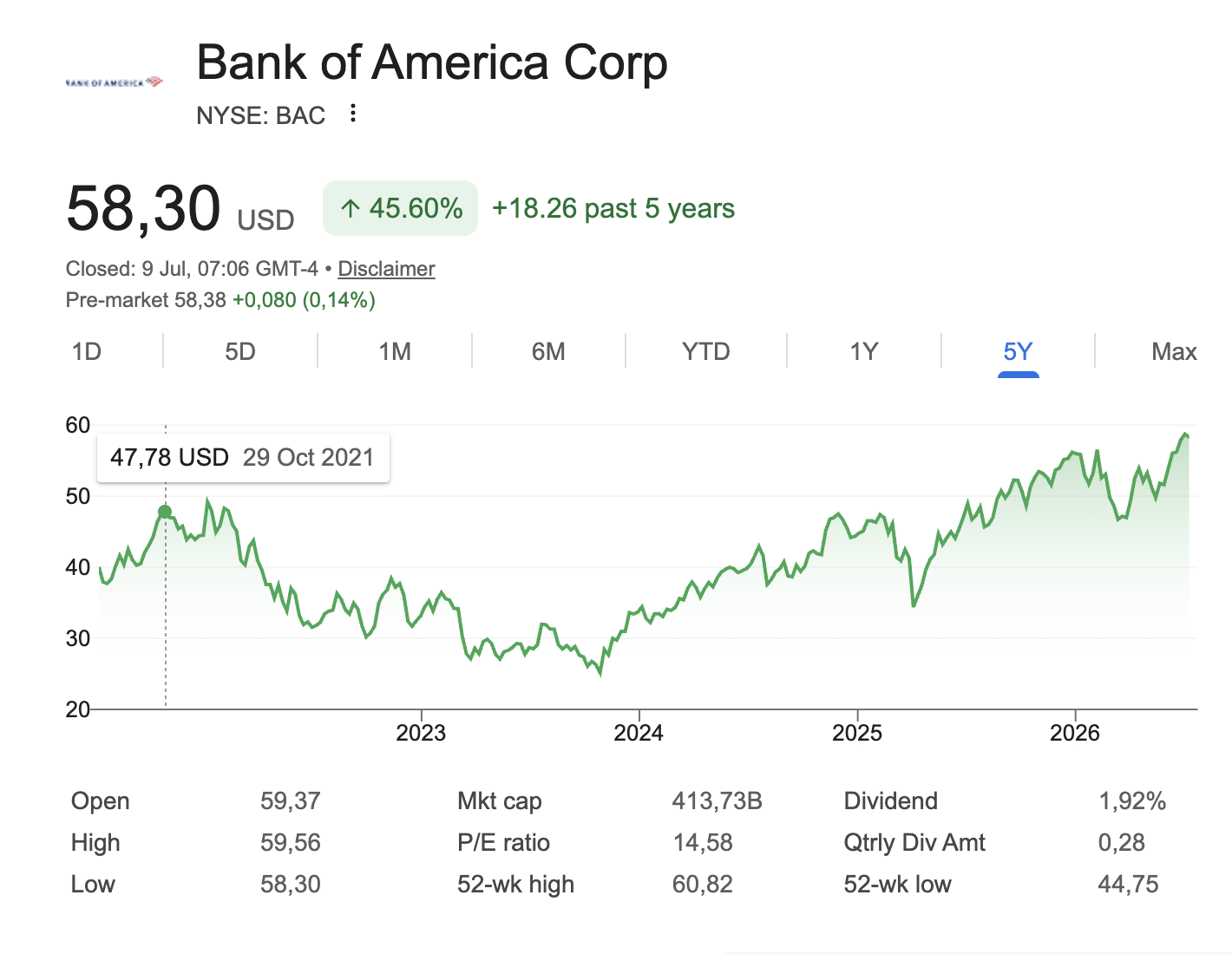
During the 2020 market panic, bank stocks were under pressure. BAC traded much lower than it does today. Since those lows, the stock has more than doubled, while continuing to pay dividends along the way.
That does not mean the next five years will look the same. They probably will not. But it shows why I like buying quality dividend stocks when they are unpopular or reasonably priced.
With BAC, I am not looking for a 10x return. I am looking for something more practical: a stock that can appreciate over time, pay dividends, and provide opportunities for options income.
Final Thoughts
Buying BAC after selling a cash-secured put fits my current investing style.
I want to build long-term positions slowly. I want to collect dividends. I want to sell options where it makes sense. And I want to avoid chasing only high-volatility names that can quickly become difficult to manage.
BAC is not risk-free. No bank stock is. A recession, credit problems, lower margins, or another banking panic could hurt the stock. But as part of a diversified portfolio, I like BAC as a long-term income and options candidate.
For now, I am accumulating slowly, even 0.1 share at a time.
This BAC position later became more complicated: the short put was rolled, and I subsequently documented managing the later BAC short-put adjustment with a bear call spread.
The plan is simple: build the position, collect dividends, sell options carefully, and hopefully hold BAC for many years — maybe for life.