Over the past couple of months, I've been slowly rebuilding my Bitcoin position. The plan is simple enough: buy around 0.01 BTC every month, gradually reach 0.1–0.12 BTC, and perhaps one day own a full Bitcoin. I'm in no particular hurry, and I don't want to sell my holdings every time the market gets nervous. At the same time, I like the idea of earning some options premium while I accumulate.
For roughly two months, I've been selling weekly covered calls against my BTC. It has worked reasonably well, although not every week has been straightforward: I've sometimes had to roll up and out, giving the position more time to recover. Weekly expirations are still my preferred rhythm, but this week's sharp move made me reconsider whether seven days is always the right duration. On November 6, I decided to experiment with 1 DTE (one day to expiration) Bitcoin covered calls instead.
This is a personal Bitcoin experiment, separate from TerraM Token, the Solana-based project I'm building around crypto options strategies and treasury development. Bitcoin currently isn't part of TerraM's premium-generating strategy, but the questions I'm exploring here—how much risk to accept, how to manage challenged positions, and whether shorter expirations are worth the effort—are closely related.
When a Sensible Weekly Roll Stops Looking Attractive
Going into November 6, I held approximately 0.02 BTC against covered calls expiring that day. Just a day earlier, a roll to an $83,000 strike for the following week looked sensible. I generally favor weekly options because I can collect premium, reassess the market, and make adjustments without committing the position for too long.
Then Bitcoin fell towards $75,000 amid broader weakness in technology stocks and crypto. The calls weren't being challenged—quite the opposite, because the price had moved well below their strikes. My problem was that keeping an $83,000 strike for the next weekly expiration produced very little premium. From $75,000, that strike was roughly 10.7% out of the money, and I didn't want to lower it aggressively just to collect a few extra dollars.
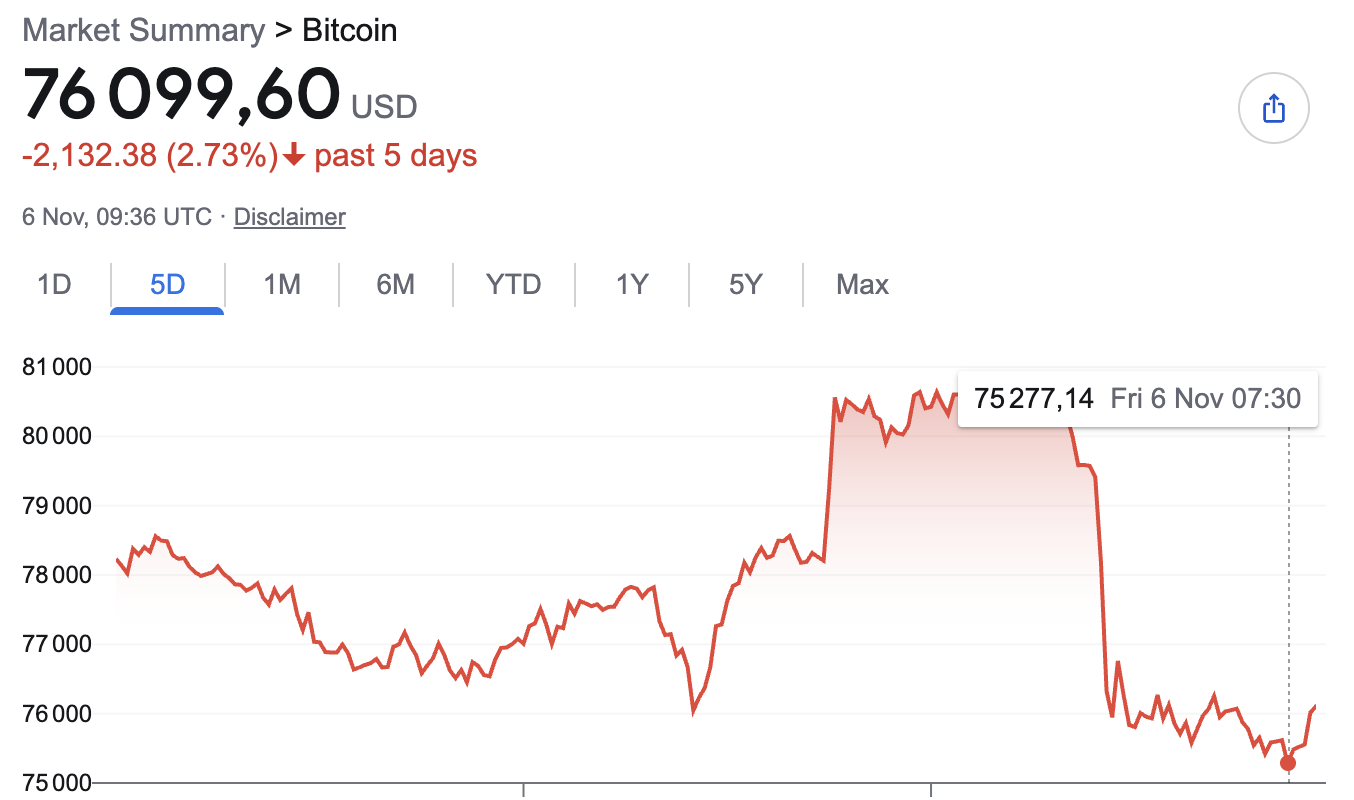
I could have rolled further out—two weeks, a month, or longer—to find a more meaningful credit. I've done that before, and there's nothing inherently wrong with it. But the trade-off is clear: more time to expiration means keeping the Bitcoin committed for longer. That got me thinking about a different approach: instead of selling one weekly call, what if I sold a sequence of one-day calls?
Borrowing an Idea From My ETH Put Bot
This isn't entirely new territory for me. I've spent quite a bit of time selling 1 DTE puts on Ethereum and even wrote a small bot to help execute that strategy. The approach has been to sell low-delta puts, collect modest premiums, and repeat when market conditions allow. Before the first assignment, I had recorded 93 successful expirations out of 94 trades. That's an interesting track record, but not proof that the approach is safe or consistently profitable: when ETH moved against the position, I still had to manage the resulting exposure.
The experience taught me to focus less on any one premium and more on the trade's complete risk profile. Short expirations offer fast time decay, but they also leave little room to react to sharp price moves. Those lessons also inform how I think about options risk at TerraM, which uses a separate strategy involving crypto puts and covered calls, with discretionary allocation of realized profits towards token buybacks and liquidity development.
Why 1 DTE Calls Might Work—and Why They Might Not
With a 1 DTE covered call, I sell an option that expires the next day. If Bitcoin remains below the strike at expiration, I keep the premium and can consider another call the following day. If the price rallies towards the strike, I have to decide whether to accept the possibility of selling my BTC, close the call, or roll it to a later expiry. The attraction is Theta, or time decay, which generally becomes more pronounced as expiration approaches.
But it would be a mistake to look at Theta without considering Gamma. Gamma describes how quickly delta changes as the price of Bitcoin changes, and near expiration it can become especially sensitive around the strike. A call that starts the morning looking comfortably out of the money can suddenly become an uncomfortable position after a fast rally. In other words, rapid time decay is not free income; it comes with concentrated short-term risk.
Seven Daily Calls Versus One Weekly Call
Here's the question I'm actually trying to answer with this experiment. On the same 0.02 BTC holding, does selling seven consecutive 1 DTE calls produce more net premium than selling a single weekly covered call at an acceptable strike? The daily approach gives me more opportunities to reassess delta and strike selection, while the weekly approach reduces transactions and the need for constant monitoring. Neither is automatically better.
In theory, adding up seven short-duration premiums can beat one weekly premium. In practice, though, those seven trades won't have identical strikes, volatility, or market conditions. Some days the premium may not justify a trade at all, and one rapid rally can force an expensive adjustment. Trading fees, spreads, and any debit paid to roll also belong in the calculation. This is why I want to compare actual results rather than assume that more frequent expirations mean more income.
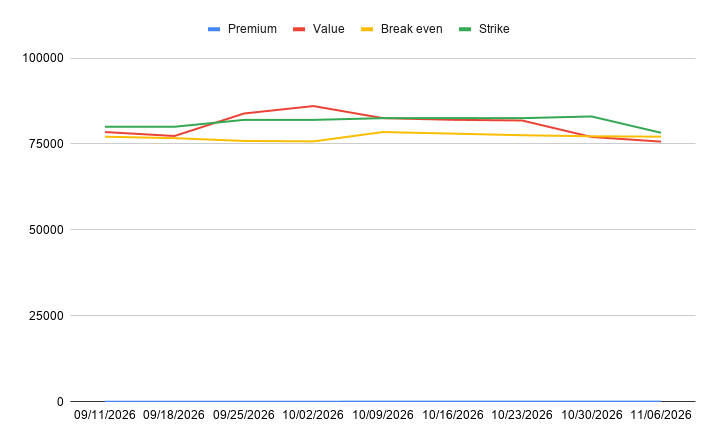
I'll use the Bitcoin premium chart above as a reference point for the experiment, but the important comparison will be what I actually receive after execution costs and any adjustments. Quoted premiums can look attractive on a chart; realized returns are what count, especially when the objective is to keep accumulating Bitcoin rather than trade it away.
How I'm Thinking About Delta, Strike, and Rolling
I generally prefer low-delta calls, because I want some distance between the current Bitcoin price and the strike. Delta can provide a rough, model-dependent sense of the chance of expiring in the money, but it is no guarantee. I also want the strike to remain above a selling price I'm willing to accept. A few dollars of premium aren't particularly attractive if they put my longer-term BTC accumulation plan at risk.
If a call gets challenged, my usual first thought is whether I can roll it up and forward for a net credit: buy back the current option and sell a later-dated call at a higher strike. Sometimes that combination is available, sometimes it means extending the expiry much further than I'd like, and sometimes moving the strike higher requires paying a debit. A roll doesn't erase a loss or guarantee that Bitcoin won't be called away. It's simply another trade, and it needs to make sense on its own terms.
What I Changed on November 6
Rather than automatically extending the November 6 covered calls into another weekly expiry, I opted to test a one-day duration. My underlying BTC position remains about 0.02 BTC, and the larger plan remains unchanged: continue buying approximately 0.01 BTC a month and grow the holding over time. The new variable is how frequently I sell calls against it, and whether I can find a better balance between premium, delta, and the risk of being called away.
I'm not going to force a trade every day. If the offered premium is too low, if the strike is too close, or if the market is moving too quickly, doing nothing is a perfectly reasonable choice. That may be the most important lesson from the ETH put experiment: repeated small premiums can feel routine until the one move that isn't routine.
What I'll Measure Next
Over the coming weeks, I want to record the premium collected, entry delta, strike, expiration, fees, and any cost of closing or rolling. I'll compare those realized results with what a weekly covered call would have offered at a similarly acceptable selling price. I'll also keep an eye on how much effort the daily approach requires, because spending seven days babysitting an extra few dollars would not be a particularly compelling improvement.
For now, this is an experiment rather than a new rule. If 1 DTE covered calls prove useful, I'll keep them in the toolbox. If longer expirations are more practical, I'm happy to go back to weekly calls. The objective hasn't changed: accumulate Bitcoin, generate some incremental premium where it makes sense, and avoid giving up the underlying position too cheaply.
Growing TerraM Alongside These Experiments
Separately, I'm working on growing TerraM Token towards an ambition of $100,000 in project capital and liquidity. It's still an early-stage effort built around options trading, transparent reporting, treasury management, and developing token liquidity. There's plenty to learn, and I intend to keep sharing the good trades, the awkward adjustments, and the occasional mistake rather than pretending every strategy works perfectly.
To be clear, my Bitcoin covered calls are personal trades and aren't part of TerraM's current premium-generating strategy. Nor does buying TerraM give anyone ownership of my BTC portfolio or the premiums described in this article. But if you enjoy learning about these approaches and are curious about following or potentially participating in a project as it grows, you can explore the strategy, tokenomics, treasury information, and risks at terramtoken.com.