I've been trading cryptocurrency options for years, primarily selling puts and covered calls on Ethereum, Bitcoin, and Solana. The objective has always been relatively straightforward: generate recurring income from crypto markets without relying exclusively on prices going up.
Recently, I've been revisiting another strategy that looks quite interesting: collecting funding fees from perpetual futures while hedging the underlying cryptocurrency price exposure.
On October 18, 2026, I opened a small experiment on Bybit, buying approximately 150 EGLD on the spot market and simultaneously shorting 150 EGLD through perpetual futures.
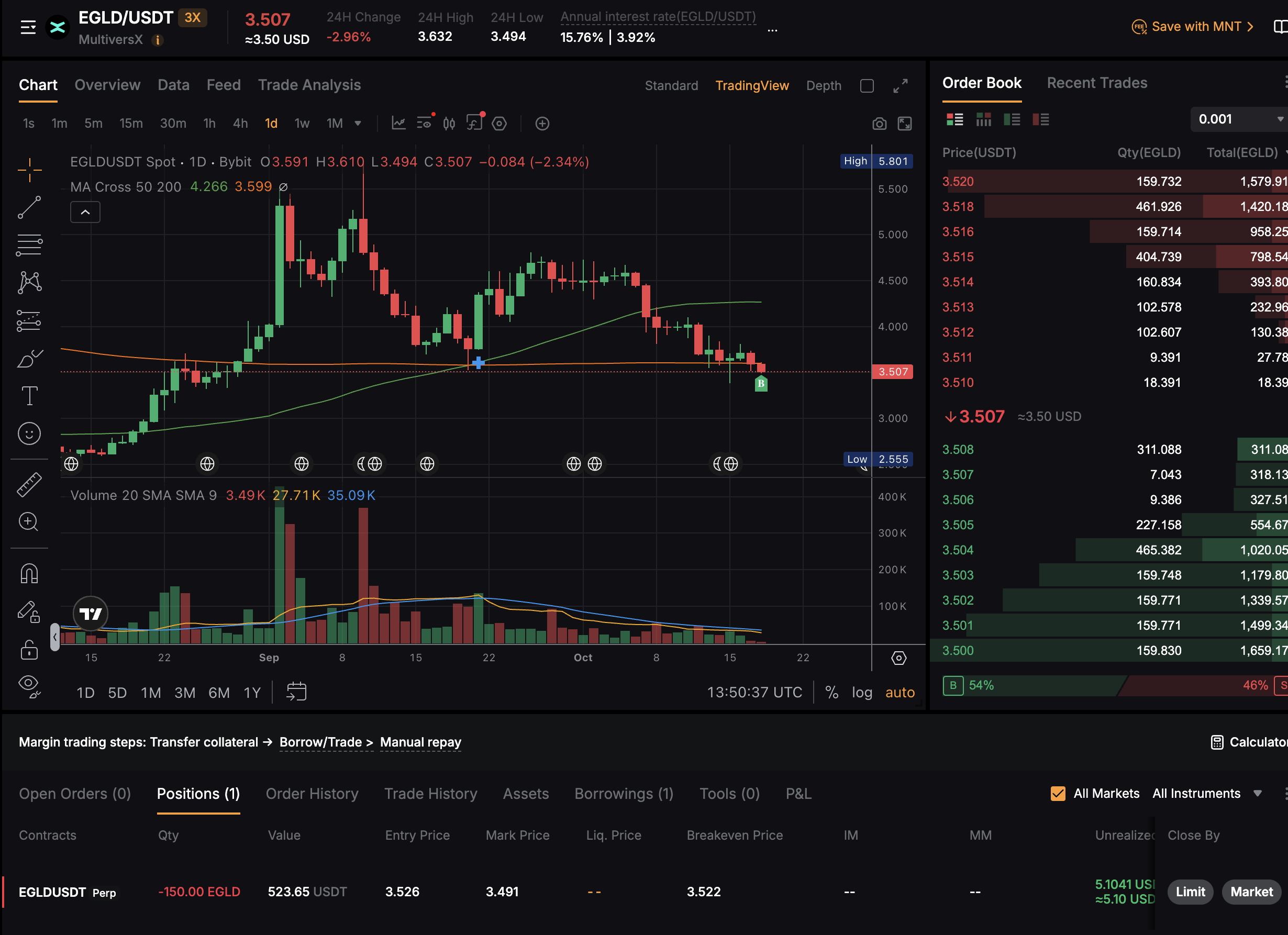
The idea? Collect positive funding payments while keeping the position approximately market-neutral.
At the time of entry, the indicated gross annualized funding yield was approximately 16%, compared with a USDT borrowing rate of 3.91%. On paper, that gives us a fairly attractive spread. But as usual with crypto, there's considerably more to the story.
Let's look at how perpetual funding works, how I established the position, and whether collecting these relatively small payments makes economic sense.
What Are Crypto Perpetual Funding Fees?
Unlike traditional futures contracts, perpetual futures don't have an expiration date. Instead, exchanges use a funding mechanism designed to keep perpetual contract prices relatively close to their underlying spot markets.
Funding payments are exchanged between traders holding long and short positions.
When the funding rate is positive, traders holding long positions pay traders holding short positions. When funding turns negative, the opposite happens.
For example, suppose an exchange offers a positive funding rate of 0.01% every eight hours.
If you're holding a $10,000 short perpetual position, you could receive approximately $1 at each funding settlement, assuming the position value and funding rate remain unchanged.
With three settlements per day, that's roughly $3 daily, or about $90 over 30 days.
Sounds interesting, right?
But here's the problem. Simply shorting Bitcoin, Ethereum, or any other cryptocurrency leaves you exposed to price appreciation. A relatively small funding payment means very little if the underlying cryptocurrency suddenly rallies 20%.
That's where funding rate arbitrage comes into play.
How to Collect Perpetual Funding Fees Without Betting on Crypto Prices
The basic strategy involves opening two opposing positions:
- Buy the underlying cryptocurrency on the spot market.
- Open an equivalent short position using perpetual futures.
For example, if I buy 150 EGLD on the spot market, I simultaneously short 150 EGLD through an EGLDUSDT perpetual contract.
If EGLD appreciates, my spot holdings increase in value while my short perpetual position loses approximately the same amount.
If EGLD declines, the opposite happens.
In theory, these two positions largely offset each other, leaving me with the opportunity to collect funding payments whenever the perpetual funding rate is positive.
This is commonly referred to as a delta-neutral funding rate arbitrage strategy.
Importantly, delta-neutral doesn't mean risk-free. The spot and perpetual prices may diverge, financing costs may increase, and the short position can still face liquidation if margin isn't managed properly.
The objective isn't to eliminate every risk. It's to isolate funding income from as much outright cryptocurrency price exposure as reasonably possible.
Step 1: Find a Cryptocurrency With Attractive Funding Rates
Before opening any positions, the first task is identifying cryptocurrencies with consistently positive funding rates.
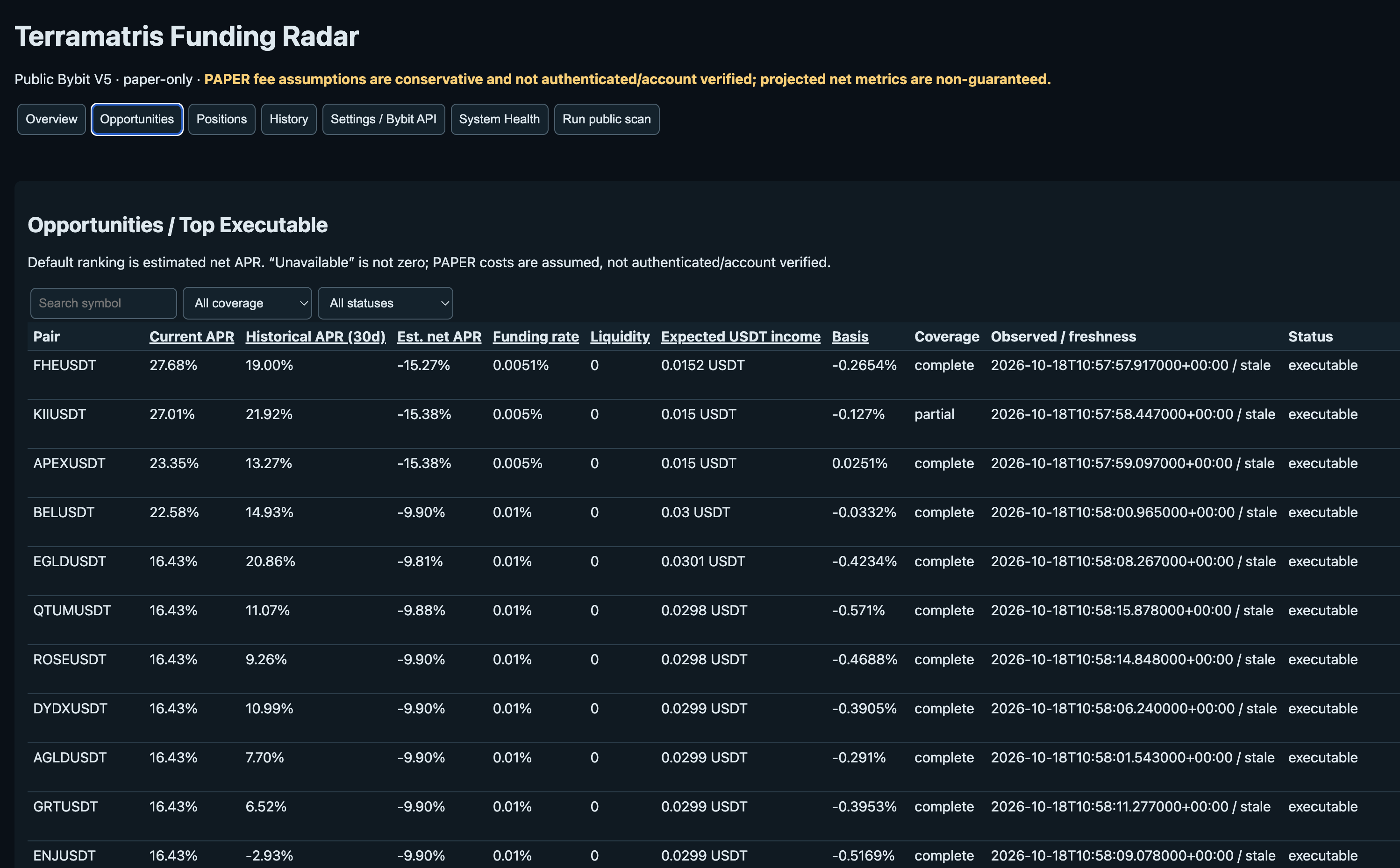
Initially, I wanted to develop a fully automated, AI-assisted scanner capable of monitoring hundreds of cryptocurrency pairs on Bybit.
With the help of AI agents, I actually made considerable progress. We developed a local application capable of analyzing historical funding rates, identifying opportunities, estimating annualized yields, and accounting for trading commissions and financing expenses.
The original idea was eventually to automate the entire process, including opening positions and monitoring risk.
But somewhere along the development process, I arrived at a rather practical conclusion.
The actual trade is so simple to establish manually that building a sophisticated execution bot may be unnecessary, at least at my current scale.
AI is still useful for research, identifying opportunities, and monitoring funding conditions. But buying an asset and opening a corresponding short perpetual position takes only a few actions.
Interestingly, it was one of these AI-assisted market scans that brought EGLD to my attention.
And here comes the slightly embarrassing part: before identifying this opportunity, I knew practically nothing about EGLD.
Probably not the strongest foundation for conventional investment advice. Ha!
But there's an important difference between buying a cryptocurrency because you believe in the project and buying it as part of a hedged funding strategy.
I'm not buying EGLD because I expect the token to appreciate. I'm buying it to offset a corresponding short position, with the intention of collecting funding payments.
Nevertheless, liquidity, exchange support, collateral requirements, and the risk of unexpected market disruptions still matter.
Step 2: Buy EGLD and Open an Equivalent Perpetual Short
On October 18, 2026, I established the following position on Bybit.
| Metric | Spot long | Perpetual short |
|---|---|---|
| Market | EGLD/USDT | EGLDUSDT |
| Quantity | 150 EGLD | 150 EGLD |
| Entry price | $3.5447 | $3.5260 |
| Execution value | $531.70 | $528.90 |
| Opening commission | 0.15 EGLD | 0.2909 USDT |
The spot position provides ownership of the underlying cryptocurrency, while the perpetual short offsets most of the price exposure.
One small detail worth mentioning: the spot trading commission was deducted in EGLD, leaving approximately 149.85 EGLD against a 150 EGLD short.
That means the hedge isn't absolutely perfect. I'm slightly net short EGLD.
At the current position size, the difference is relatively small, but it's still something worth accounting for.
The perpetual short also opened at a slightly lower price than the spot purchase.
My average spot entry was $3.5447, compared with a perpetual short entry of $3.5260.
That represents a negative basis of approximately 0.53%, or about $2.79 across the position.
If the two prices eventually converge, that initial difference works against the trade.
This is one reason why simply looking at funding APR isn't enough when evaluating potential profits.
Step 3: Understand the Cost of Borrowing USDT
For this particular experiment, I decided to finance the spot purchase using borrowed USDT rather than exclusively my own stablecoin capital.
The indicated borrowing rate was 3.91% annualized.
Assuming approximately $531.70 in borrowed principal, the estimated financing costs are:
| Period | Borrowing interest |
|---|---|
| Daily | $0.057 |
| 7 days | $0.40 |
| 30 days | $1.71 |
| Annualized | $20.79 |
These amounts assume a constant borrowing rate and principal balance.
Of course, borrowing introduces additional risk. I still need sufficient collateral to support the position, and the exchange may change financing rates or margin requirements.
The most important question is whether the funding payments consistently exceed the borrowing expenses.
For this strategy to work economically, positive funding income needs to cover financing costs, trading commissions, basis-related losses, and the risks associated with maintaining the hedge.
Step 4: Calculate How Much Funding Income You Can Collect
Let's use the EGLD position as an actual trading example.
At the time of entry, I was evaluating an annualized gross funding yield of approximately 16%.
Using the perpetual position value of $528.90, the projected income looks like this:
| Metric | Daily | 30 days |
|---|---|---|
| Gross funding income | +$0.232 | +$6.96 |
| USDT borrowing interest | −$0.057 | −$1.71 |
| Net funding carry | +$0.175 | +$5.25 |
In other words, I'm potentially collecting approximately $5.25 over 30 days before trading commissions and changes in the spot-perpetual basis.
Not exactly life-changing money.
But that's not the point of this experiment.
I'm interested in whether recurring funding payments can become another source of crypto trading income, particularly when combined with my existing Ethereum and Bitcoin options-selling strategies.
There's also an important distinction between the advertised annualized funding yield and actual realized profitability.
For example, suppose we include approximately $1.65 in round-trip trading commissions and another $2.79 in losses from an adverse basis movement.
That would reduce the illustrative 30-day economic profit from $5.25 to approximately $0.81.
And that's assuming the funding rate actually averages 16% annualized throughout the period.
Funding rates are variable. They can decline, approach zero, or turn negative, in which case the short position would pay funding rather than receive it.
This is why I prefer evaluating the strategy using actual funding settlements rather than extrapolating an attractive headline APR indefinitely.
Step 5: Monitor Funding Payments and Maintain the Hedge
Unlike some of my short-dated crypto options experiments, I haven't established a predetermined closing date for this EGLD position.
The intention is to keep the hedge open while the funding economics remain attractive and the margin requirements remain manageable.
That could mean several weeks, months, or potentially longer.
What matters isn't the duration itself, but whether the position continues generating positive net carry.
For monitoring, I'm particularly interested in:
- Confirmed USDT funding payments received or paid.
- Changes in annualized funding rates.
- Actual USDT borrowing interest.
- Spot and perpetual price differences.
- Trading commissions and eventual exit costs.
- Margin utilization, liquidation risk, and the quality of the hedge.
I'm also working on dedicated monitoring tools to automate some of this accounting.
Rather than automatically executing trades, I believe AI agents can provide more immediate value by collecting market data, comparing opportunities, and identifying situations where an existing position may no longer be economically attractive.
For example, if funding falls to 2% annualized while the borrowing rate remains at 3.91%, the expected funding carry turns negative even before accounting for commissions.
At that point, maintaining the position would require a different economic justification.
Can You Make $100 per Month Collecting Crypto Funding Fees?
Here's where the strategy becomes more interesting.
Suppose we could maintain a gross funding yield of 16% annually, with USDT borrowing costs of 3.91%.
That leaves an approximate 12.09-percentage-point annualized spread before fees and other expenses, assuming equally sized funding and borrowing notionals.
Under those simplified conditions:
| Position size | Approx. monthly carry |
|---|---|
| $500 | $5.04 |
| $1,000 | $10.08 |
| $5,000 | $50.38 |
| $10,000 | $100.75 |
| $25,000 | $251.88 |
These are illustrative figures, not projected realized profits. They exclude trading costs, basis changes, variable funding, and the additional collateral required to support the positions.
Still, they help demonstrate the economics.
To collect around $100 monthly under these assumptions, we'd need approximately $10,000 in hedged exposure.
Whether that would be worthwhile depends on actual funding persistence, collateral efficiency, borrowing conditions, and the risks involved.
Personally, I'm not rushing to scale this strategy.
I've previously experimented with funding arbitrage and eventually abandoned it because the available returns didn't justify the capital and effort required.
This time, with improved monitoring and the possibility of combining multiple income streams, I believe it deserves another experiment.
Combining Funding Income With My Crypto Options Strategies
My primary focus remains selling cryptocurrency options, particularly Ethereum and Bitcoin puts and covered calls.
Funding rate arbitrage offers a potentially complementary approach.
Rather than relying on options premiums, it attempts to collect payments generated by the perpetual futures funding mechanism.
The income may be considerably smaller on individual positions, but the underlying economic drivers are different.
I'm also interested in whether realized funding-strategy profits could contribute to TerraM Token, a DEX-traded token project connected to our broader crypto options and treasury activities.
The proposed framework is to allocate up to 90% of realized net funding-strategy profits toward TerraM-related treasury activities, subject to profitability, available capital, and risk requirements.
This could potentially support discretionary token buybacks or liquidity provision, but it's important to emphasize that these allocations are not automatic and don't guarantee token appreciation or returns to holders.
At the current EGLD position size, we're talking about relatively small amounts of USDT. Nevertheless, I find the idea of combining several modest income sources quite interesting.
Rather than expecting one strategy to generate extraordinary returns, the objective is to gradually develop multiple sources of trading income that can be evaluated, monitored, and potentially scaled.
Risks of Collecting Crypto Perpetual Funding Fees
Despite the relatively straightforward mechanics, I wouldn't describe funding rate arbitrage as a safe or guaranteed income strategy.
The biggest risks aren't necessarily everyday cryptocurrency price movements. They're the events that can cause the hedge or financing structure to stop working as expected.
An exchange hack, withdrawal suspension, unexpected margin requirement change, collateral shortfall, or liquidation of the perpetual position could produce losses far greater than several months of funding payments.
There's also the risk of funding rates turning negative, borrowing costs increasing, or insufficient liquidity making it expensive to close both sides of the trade.
And when dealing with smaller cryptocurrencies such as EGLD, token-specific liquidity and market structure deserve particular attention.
An approximately delta-neutral position is not the same thing as a risk-free position.
For that reason, I'm keeping the initial allocation relatively small and focusing on measuring actual performance before considering whether to increase exposure.
Final Thoughts: Is Funding Rate Arbitrage Worth It?
My initial EGLD experiment involves approximately $532 in spot exposure, a corresponding perpetual short, an indicated 3.91% USDT borrowing rate, and an assumed 16% gross annualized funding yield.
The potential income is relatively modest, particularly after trading fees and financing expenses.
Nevertheless, I find the mechanics interesting.
Instead of betting on whether EGLD, Bitcoin, or Ethereum will appreciate, I'm attempting to collect payments generated by activity in the perpetual futures market while hedging most of the underlying price exposure.
The biggest question is whether those payments remain consistently positive and large enough to compensate for all the associated costs and risks.
For now, the objective is simple: collect the funding payments, monitor the position carefully, and evaluate actual results.
If the economics work, I can consider gradually increasing the allocation or exploring additional cryptocurrency pairs. If they don't, there's no reason to maintain the position simply because the headline APR once looked attractive.
And perhaps the most important principle remains unchanged:
Boring is good. Exciting is dangerous.
Disclaimer: This article documents my personal trading experiment and is not investment advice. Funding rates and borrowing costs are variable. Hedged cryptocurrency positions remain exposed to execution, basis, financing, margin, liquidation, and counterparty risks.