Portfolio Value: $12,323
Weekly Change: +0.86%
YTD Return: +16.51%
Options Premium Collected: $89
As of May 8, 2026, the stock and options portfolio increased by 0.86%, reaching a total value of $12,323.
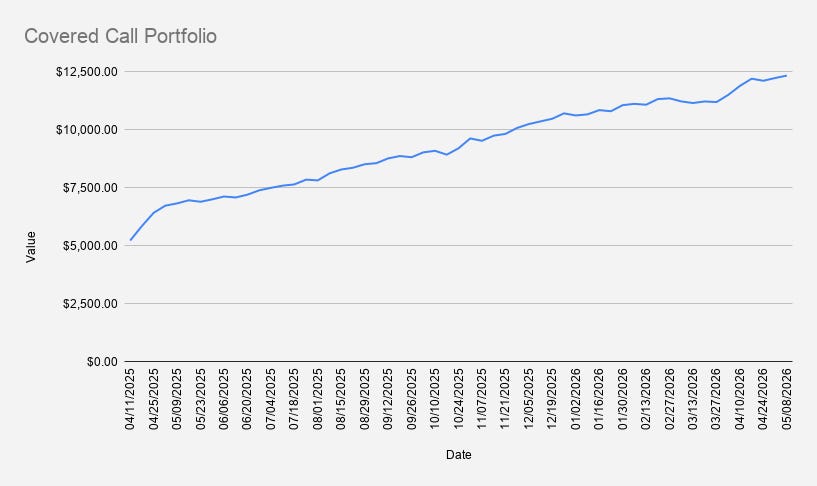
On a year-to-date basis, the portfolio is now up 16.51%, outperforming both the S&P 500, which has gained 7.88%, and NVIDIA, which has gained 13.98% over the same period.
Continuing the NVDA Credit Spread Strategy
NVIDIA continued its impressive rally this week, trading above $215 per share. As a result, the previous week's bull put credit spread expired worthless, allowing the portfolio to retain the entire premium collected.
Despite the strong move higher, I decided to continue the strategy and opened a new NVDA bull put credit spread for the following week's expiration.
One of the challenges of selling option premium after a significant rally is that the probability of a short-term pullback may increase. The longer-term trend can remain bullish, but option sellers must still balance premium collection against the risk of a sudden decline.
This is one reason I generally prefer defined-risk strategies such as bull put spreads rather than relying entirely on cash-secured puts. A credit spread limits the maximum possible loss while still allowing the portfolio to benefit from time decay and a stable or rising share price.
The Goal: Consistent Weekly Premium Income
One of the long-term goals of this portfolio is to generate approximately $100 per week in options premium while maintaining reasonable risk levels.
At the current portfolio size, that target appears achievable, but it requires careful position selection and disciplined trade management.
The main challenge is not finding stocks with liquid options. The challenge is finding companies I would also be comfortable owning or managing through difficult market conditions.
For smaller portfolios, capital efficiency and risk management often matter more than maximizing the premium collected from any individual trade.
A single aggressive position can generate an attractive premium, but it can also erase several weeks or months of income if the underlying stock moves sharply against the trade.
Adding ARCC Through a Cash-Secured Put
This week, I introduced a new position in Ares Capital Corporation (ARCC).
ARCC is primarily known as an income-oriented stock with a relatively high dividend yield. I previously owned shares in a dividend-focused portfolio and have generally viewed the company as a cash-flow investment rather than a traditional growth stock.
Because ARCC also has tradable options, I decided to sell a cash-secured put with a September expiration.
Unlike the weekly NVDA credit spreads, this position is designed to generate income while potentially creating an opportunity to acquire additional ARCC shares at a lower effective purchase price.
This highlights one of the main differences between bull put spreads and cash-secured puts.
A bull put spread offers defined risk and generally requires less capital. A cash-secured put requires more capital but can result in the investor acquiring shares if the option is assigned.
Because I am comfortable owning additional ARCC shares, assignment would not necessarily be an undesirable outcome.
Current Options Positions
- NVDA May 15, 2026 202.5/192.5 Bull Put Credit Spread
- 2x BMY Jun 18, 2026 50/46 Bull Put Credit Spread
- PFE May 15, 2026 25 Cash-Secured Put
- DBK FRA Jun 19, 2026 24/20 Bull Put Credit Spread
- ARCC Sep 18, 2026 16 Cash-Secured Put
- NVDA Nov 20, 2026 $120 Covered Call
Reinvesting Premium Into Ownership
Using part of the premium collected from the NVDA credit spread and the ARCC cash-secured put, I purchased:
- 0.1 shares of NVDA
- 1 share of ARCC
This remains one of the central ideas behind the portfolio.
Options income is not used only for short-term cash flow. A portion of the premium is regularly reinvested into long-term holdings, allowing the portfolio to compound gradually over time.
As a result of these additions, projected annual dividend income increased to approximately $63.43.
That amount remains relatively small, but the objective is to create a system in which options premium helps finance portfolio growth without requiring constant new capital contributions.
Over time, the combination of additional shares, dividend income, and option premium could gradually strengthen the portfolio's income-generating capacity.
Weekly Premium Income and Margin Management
This week's trades generated approximately $89 in options premium income.
That result brought the portfolio closer to the long-term objective of generating approximately $100 per week on a relatively consistent basis.
However, one lesson I have learned repeatedly is that increasing premium income by taking excessive risk rarely ends well.
Options trading rewards consistency and disciplined position sizing far more than aggressiveness.
At the current margin balance of approximately -$3,324, maintaining an average pace of $89 per week would theoretically eliminate the balance within roughly 38 weeks.
In practice, the process is unlikely to be that predictable. Market conditions change, option premiums fluctuate, positions require adjustments, and occasional losses are unavoidable.
For that reason, I am comfortable extending the debt-reduction timeline into 2027 if necessary.
The priority remains preserving capital while steadily improving the portfolio's financial position.
Looking Ahead
Next week's primary focus will remain the NVDA 202.5/192.5 bull put credit spread.
If the position comes under pressure, the trade-management plan remains unchanged:
- Roll the position forward when appropriate
- Prefer adjustments that generate additional premium
- Maintain disciplined position sizing and risk management
If the Pfizer cash-secured put expires worthless, I may reallocate the released capital into another liquid weekly options candidate.
One stock currently under consideration is Netflix, which could potentially become a second weekly premium generator alongside NVIDIA.
The objective is diversification rather than simply collecting more premium.
Adding another underlying could reduce dependence on NVDA, but any new position must still meet the same requirements for liquidity, manageable risk, and long-term investment quality.
Key Takeaway
This week reinforced an important lesson for income-focused investors.
Generating options premium is only one part of the process. Long-term success depends on balancing income generation, portfolio growth, diversification, margin management, and downside risk.
Whether the portfolio uses bull put spreads, cash-secured puts, or covered calls, the objective remains the same: build a repeatable process capable of producing income while gradually increasing long-term ownership.
The $100 weekly premium target remains important, but it should never come at the expense of capital preservation.
Disclaimer
This trade journal reflects personal portfolio activity and is provided for educational and informational purposes only. It should not be considered investment advice, financial advice, tax advice, or a recommendation to buy or sell any security, option, derivative, or financial instrument. All investments involve risk, including the possible loss of principal.