As of October 2, 2026, my latest portfolio snapshot stood at $13,546, representing another decrease of -1.36% compared with the previous week.
This week, the portfolio came under pressure as both BAC and NFLX declined. In addition, the U.S. dollar strengthened against the euro, which reduced my EUR-reported portfolio value by a few additional dollars due to exchange-rate movements.
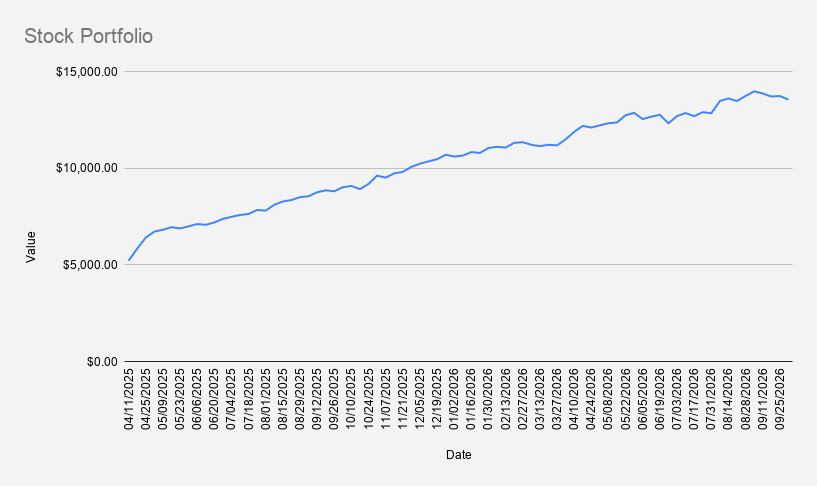
The portfolio is now up 33.46% year to date. For comparison, the S&P 500 is up roughly 12.3% in 2026, while NVDA is up around 24.12%.
This week was quite interesting. I started with a small accidental day trade after mistakenly buying 100 shares of McDonald’s for the portfolio. Fortunately, I closed the position the same day for a small profit. It was a useful reminder that not every trade deserves to become a position simply because it has been opened.
BAC: Managing a Challenged Short Put
The more important issue was BAC. The position was already under pressure after I rolled the BAC short put in Week 77 from $57.50 down to $55 and out to March 19, 2027. The lower strike and extra time improved the terms, but they did not erase the earlier loss or the capital commitment.
BAC has been under pressure for a combination of reasons rather than one clean company-specific event. Earlier caution around investment-banking fees and capital-markets activity weakened the near-term earnings picture, while the banking sector was also dealing with concern about a flatter yield curve, elevated long-term rates and whether technology could disrupt fee-based financial businesses. The decline during this week therefore looks like a mix of BAC-specific expectation resets, banking-sector sentiment and the macro backdrop—not a signal that I know where the share price goes next.
My March 2027 $55 cash-secured put remains bullish exposure. If BAC is below $55 at expiry, assignment would mean buying 100 shares at the strike, less the premiums received over the life of the position. That could be acceptable only if I am comfortable owning the shares, financing them without creating an unhealthy margin problem, and potentially using covered calls later. It is not a painless outcome: a large further fall could leave me owning stock above its market value and with capital tied up for much longer than planned.
To generate some incremental premium while the put remains challenged, I sold the shorter-dated BAC $60/$62.50 bear call spread expiring October 16.
I documented the structure and its separate risk in my BAC bear-call-spread case study. The call spread can collect additional premium if BAC stays below the short-call strike through expiry, including a period in which the short put is still under pressure. It is position management, not a forecast and not a hedge against a falling BAC share price. The call spread does not protect the $55 short put from further downside; it adds its own defined upside risk if BAC rallies sharply above the call strikes.
There are several realistic paths from here:
- BAC stabilizes or rebounds: the $55 put should become less pressured, but a strong enough rally can challenge the short-dated bear call spread.
- BAC stays weak but above $55: time can work in favor of the short put, while carefully selected call spreads may add modest premium; neither result is guaranteed.
- BAC falls significantly: the short put can continue to lose value and the small call-spread credit will do very little to offset that exposure. Assignment risk and margin capacity become much more important.
- March 2027 approaches with the put still challenged: I would have to compare closing, accepting assignment, or a possible roll against the prices and buying-power requirements available at that time. Rolling for a credit may eventually be considered if conditions allow, but a credit, an attractive strike or a sensible extension will not necessarily be available.
Why the NFLX Comparison Matters
When I wrote, “Let’s hope this one goes a little more smoothly than the similar—and still ongoing—trade with NFLX,” I was referring to the management process, not claiming that the two positions are identical. The NFLX trade began as put credit spreads, evolved into more direct short-put exposure and has since been pushed out to a December 2027 $64 cash-secured put. It also has a separate November $85/$105 bear call spread. The BAC structure is different: its long-dated short put is at $55 and the new call spread is much shorter dated.
Still, the NFLX position is a useful example of how an options adjustment can remain open far longer than expected. As I described in the NFLX losing-short-put case study and earlier in Week 63’s NFLX roll, selling additional premium can soften the economics of a difficult position, but it does not magically repair the underlying loss. Management can become a long process in which liquidity, timing, expiration and strike selection matter as much as the credit received. That is the lesson I want to carry into BAC rather than assume that another adjustment will solve it.
NVDA: Cushion, but Not Immunity
Our weekly NVDA credit spread expired worthless, allowing me to keep the full premium. I then opened another NVDA $225/$215 bull put credit spread expiring next Friday for roughly $40 in premium. With NVDA trading around $235 in the context of this update, the $225 short put sits about $10 below the share price. That provides a reasonable cushion for a one-week bullish credit spread if the stock stays firm or simply avoids a meaningful pullback.
But a weekly spread is not low risk simply because several recent weeks have worked. NVDA can gap down on a market shock, a company headline, a change in AI or semiconductor sentiment, or a broader move in rates. Volatility can also expand quickly as the share price falls, making an open spread more expensive to close or adjust before expiry. The long $215 put defines the maximum loss on this individual spread, but one poorly managed loss can still offset several successful $30–$40 weeks.
For now, small, defined-risk weekly NVDA spreads are one of the few new positions I am intentionally allowing. The stock’s relative strength and liquidity make the setup easier to assess than opening unrelated new trades while BAC and NFLX already require attention. That is not a reason to force a new spread every Friday; it is a reason to keep the size modest and let risk/reward decide whether there is a trade at all.
Current Options Positions
- NVDA OCT 9, 2026 225/215 Bull Put Credit Spread
- BMY OCT 16, 2026 57.5/52.5 Bull Put Credit Spread
- BAC OCT 16, 2026 60/62.5 Bear Call Spread
- NFLX NOV 20, 2026 85/105 Bear Call Spread
- LHA FRA DEC 18, 2026 7 Cash-Secured Put
- BAC MAR 19, 2027 55 Cash-Secured Put
- NFLX DEC 17, 2027 64 Cash-Secured Put
- NVDA JAN 21, 2028 $130 Covered Call
What the Current Positions Are Telling Me
Viewed together, these positions say that capital preservation now has to share the stage with income generation. The BAC and NFLX puts are long-dated, directional bullish exposure; the shorter bear call spreads can collect offsetting premium but do not remove that downside. The weekly NVDA spreads are defined-risk income trades, yet they still concentrate a meaningful part of the active option activity in one volatile semiconductor name. The long-dated NVDA covered call adds another layer of stock-specific exposure.
The practical danger is trying to earn back losses too aggressively. More contracts or more unrelated positions might produce a larger weekly premium number, but they could also use more margin, increase concentration and reduce the room needed to manage an existing challenged trade. My priority is to keep position sizes manageable, avoid unnecessary new positions and continue reducing margin debt gradually. The Trading Journal is useful precisely because it records this trade-off over time rather than treating every credit as a fresh win.
Premium Income and Margin
Total options premium collected this week was $51.92, which is a respectable weekly result relative to the size of this portfolio. The margin balance also decreased slightly to approximately −$2,493. From this week’s premium, I bought an additional 0.1 MCD, 0.1 BAC and 0.1 NVDA shares.
At approximately $51 per week, it would theoretically take about 49 weeks to eliminate $2,493 of margin if every dollar of option premium went toward reducing margin, there were no trading losses, no additional margin usage and weekly premium remained constant. This is only a simple illustration, not a forecast. My more realistic expectation for the coming weeks is around $40 per week or less, which means full margin elimination may take considerably longer.
Premium collected is also not the same thing as economic profit. Realized losses, assignment, underlying share-price movements, commissions, foreign-exchange effects and future adjustments can all materially change the outcome. A large credit from a roll can be useful for cash flow while still extending risk and time in a troubled position.
What I Am Watching Next Week
- BAC: I will watch whether the share price stabilizes or whether the March 2027 $55 put deteriorates further. Another bear call spread would need to offer enough premium for its separate upside risk; it is not automatic.
- NFLX: The priority is continued management of the existing long-dated put and November call spread, not creating activity just for the sake of a new credit.
- NVDA: I will monitor the October 9 weekly spread as expiry approaches. Only if the next setup still offers acceptable risk/reward will I consider another small spread; a strong prior week is not itself a trade signal.
- Margin and portfolio pace: I will keep the overall margin balance in view, avoid unnecessary new positions and aim for sustainable weekly premium around $30–$40 rather than forcing trades to chase a larger number.
This is how I want to approach a difficult portfolio period: keep the record honest, let the existing positions tell me where the risk is, and avoid pretending that a small amount of new premium can undo a larger problem overnight.