What an accidental $23,572.50 MCD position taught me about position sizing, covered calls and knowing when to simply reverse a trade.
Every time my daughter and I visit McDonald’s, we have a small family rule: we buy 0.1 share of McDonald’s stock.
The idea is uncomplicated. We are customers, but we can also own a very small piece of the business. Over time, those fractional purchases have built a position of roughly 4.5 MCD shares.
After the Tbilisi Marathon, I took her to McDonald’s. Later that evening she remembered the rule.
“Dad, we forgot to buy McDonald’s stock.”
The market was already closed. The next trading day, I told her we could make the usual purchase. My 8-year-old daughter entered the trade herself, under my supervision, as she has done with our small MCD purchases before.

Instead of 0.1 share, she entered 100.
That is not a typo in this article. It was a typo in the order ticket.
The good part is that she already understands the basic idea: a share is a tiny ownership claim on a business. McDonald’s is useful for explaining that idea because she knows the product, sees people buying it and can connect spending money there with owning a piece of the company. It is also a practical way to learn that the numbers on an order ticket matter.
That is a Peter Lynch-style starting point, not an investment conclusion. Understanding a business is an invitation to research it. It does not settle valuation, debt, margins, competition or how much money belongs in one stock.
Our 0.1-Share McDonald’s Tradition
This has never been a grand MCD accumulation strategy. It is a practical way to make investing concrete.
A child can understand that a burger is a product, a restaurant is a business and a share is ownership. She is mathematically strong and increasingly interested in how investing works. That makes the exercise useful.
But a useful investing lesson can still produce a very expensive order-ticket mistake.
Then She Bought 100 Shares
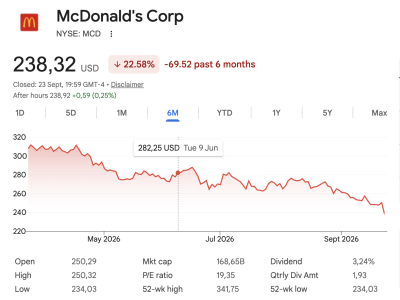
On September 28, 2026, the intended 0.1-share market order filled at $236.19. Thirteen seconds later, a separate 100-share MCD limit order filled at a displayed gross amount of $23,571.50. We had intended to put roughly $24 to work; we had committed about $23,572.50
My First Thought: Could I Turn It Into a Covered Call?
When I realised we owned 100 shares, I did not immediately panic-sell. My options brain went to the obvious mechanical possibility: sell one short-dated covered call.
The trade I considered was one MCD $230 call expiring the nearest Friday, October 2, 2026. With MCD around $235.72–$235.90, the $230 strike was in the money.
A covered call is simply 100 shares plus a short call against those shares. The stock covers the delivery obligation if the call is assigned. In this case, selling the call would have generated a premium while setting up a likely sale at $230 if the option remained in the money at expiry.
I was seeing roughly $6.50–$7.00 per share of premium for that nearest-expiry $230 call.
Before doing the arithmetic, I mentally framed it as perhaps finding another $1.50–$2.00 per share. The actual calculation is closer to $0.79–$1.29 per share before commissions, option costs, margin interest and any tax effects. That is exactly why the number should be calculated rather than remembered into existence.
The premium sounds like income, but a deep ITM call premium is not all income. Much of it is simply the stock’s existing value above the strike. At a $230 strike, at least roughly $572 of a 100-share call premium was intrinsic when MCD traded near $235.72. Only the amount above intrinsic was extrinsic value — the actual time value being paid for the option.
That distinction matters. Calling the whole premium “yield” would make the trade look better than it really is. At a $235.72 stock price, roughly $5.72 of the $6.50–$7.00 remembered premium was intrinsic value. The economically interesting time value was therefore only about $0.78–$1.28 per share, before costs.
Options Can Improve an Exit. They Cannot Justify an Unwanted Position.
My instinct as an options trader was to optimise the mistake: can I sell a call and squeeze another $100 or $150 out of this?
That instinct is not automatically wrong. A covered call can improve the economics of a planned exit. But optimisation can be inferior to simply fixing the mistake. If the underlying position should not exist, adding an option does not automatically make it rational.
The reason was more serious here than a normal short-term stock swing. The 100 MCD shares were bought using margin — borrowed buying power — rather than $23,500 of idle cash deliberately allocated to McDonald’s. I had accidentally created a roughly $23,500 leveraged stock position that I had never intended to own.
The purchase created a margin debit. The MCD shares were collateral against it. If MCD fell, the collateral value would fall while the debit remained, so account equity would decline faster from my perspective. Margin interest would continue accumulating. A large enough decline, depending on the broker’s maintenance requirements and the rest of the account, could reduce excess liquidity and eventually produce a margin call or forced liquidation. A decline does not create a new $25,000 debt; it makes the existing borrowed position less well supported.
This was the “bagholder” tail I did not want. A covered call could offer roughly $650–$700 of gross premium, but much of that amount was intrinsic value rather than new economic return. The estimated incremental improvement over the $235.715 stock basis was only about $78.50–$128.50 before costs if assignment occurred. Was that worth retaining an accidental, leveraged $23,500 position for several more days? For me, no.
Illustrative MCD decline from the approximately $23,572.50 initial position
Approximate stock loss before premium, commissions, margin interest or other account positions
5%
$1,178.62
10%
$2,357.25
20%
$4,714.50
A $650–$700 option premium would cushion those losses, but it would not turn a 10% or 20% decline into a safe trade. And if MCD fell far enough below $230, the ITM call would no longer provide the planned automatic exit. It could expire worthless and leave me still holding the 100 shares. That was precisely the tail I did not want.
What an ITM Covered Call Would Actually Do
An ITM covered call can economically resemble a planned exit near the strike plus the premium. It is often more sensible than an out-of-the-money call when the owner genuinely wants to reduce or leave a stock position.
If MCD stayed above $230 at October 2 expiry, the call would normally be exercised or assigned and the 100 shares would be sold at $230. Any further stock upside above $230 would belong to the call holder, not to me.
If MCD fell below $230, the call could expire worthless and I would keep the premium. But I would still own 100 MCD shares. The premium would cushion the loss by P per share; it would not remove the risk of a much larger decline.
MCD at October 2 expiry
100 shares only
100 shares + short $230 call
Sell shares immediately
Above $230
Participates fully in upside
Upside effectively capped at $230 plus premium; likely assignment
No further stock exposure
Below $230
Loss continues dollar-for-dollar below stock basis
Same stock decline, offset only by premium; shares likely remain
No further stock exposure
Far below $230
Large loss
Large loss minus premium
No further stock exposure
That is why a covered call is not a magic risk-removal tool. Until it is closed or assigned, it is still an oversized long-stock position with a short option attached.
There are other details that matter:
- Assignment: a call that is in the money at expiration is likely to be assigned. Assignment can also occur before expiration, although it is generally less attractive for the call holder while meaningful extrinsic value remains.
- Dividends: early exercise becomes more plausible just before an ex-dividend date when the dividend is larger than the remaining extrinsic value. That was not a near-term issue here: MCD’s next announced $1.93 dividend was payable December 15 to shareholders of record December 1, well after the October 2 expiry. The company’s announcement says this was its 50th consecutive annual dividend increase.
- Costs and taxes: stock commissions, option commissions, bid/ask spreads and jurisdiction-specific tax treatment can change the result. A short holding period and an option assignment can matter for tax reporting. That is a question for the account statement and, where appropriate, a tax professional — not a reason to pretend the numbers are simpler than they are.
For more on the trade-off between premium and capped upside, see my earlier piece on managing an NVDA covered-call roll after earnings. Rolling can change terms; it does not make the underlying concentration disappear.
Six Ways to Deal With an Accidental 100-Share Position
1. Sell the shares immediately
This is often the cleanest answer. It removes exposure that was never chosen, returns the portfolio closer to its intended allocation and frees the cash for its original purpose. It also stops an operational error from quietly becoming an investment thesis.
The disadvantages are real but limited: the stock could rise after the sale, the spread and commissions exist, and selling can feel like admitting defeat. Those are not strong reasons to keep a $23,500 position that was not wanted in the first place.
2. Keep the shares as a long-term investment
This could make sense if I had independently decided that MCD deserved this size in the portfolio. McDonald’s is a real global franchise business, not a random ticker. Approximately 95% of its restaurants are operated by independent local business owners, which makes franchise fees and rent a major part of its economics rather than leaving the company to operate every restaurant itself.
The latest reported operating facts were respectable but not a blank cheque. In the second quarter of 2026, global comparable sales rose 1.3%, U.S. comparable sales rose 0.8%, revenue rose 4% to $7.099 billion and diluted EPS was $3.32. For the first six months, revenue was $13.616 billion, up 6%, while diluted EPS was $6.10. The 2025 annual report reported a 46.1% operating margin, and the company repurchased 6.7 million shares for $2.0 billion during 2025.
Using the $235.90 exit price and trailing GAAP EPS of $12.31 — Q3 2025 through Q2 2026 — MCD traded at roughly 19.16 times trailing earnings. The newly declared annualised dividend of $7.72 implied a forward indicated yield of about 3.27% at that price. Those are useful snapshots, not a target price and not a forward P/E. The denominator is trailing reported earnings; the dividend is the newly declared annualised rate.
There are strengths here: a global brand, franchise economics, recurring demand, a long dividend record, buybacks and international exposure. There are also risks: valuation can compress, consumer traffic can weaken, value offerings can pressure franchisee economics, wages and food inputs move, competition is relentless, currencies matter outside the U.S., and a debt-heavy capital-return model has less room for complacency when rates rise.
“I like McDonald’s” and “I want $23,500 of my portfolio in McDonald’s at this valuation” are different statements. The first was easy. The second required a portfolio decision I had never made.
3. Sell a covered call
A covered call can generate premium and establish a potential exit price. An at-the-money call offers more premium and more chance of assignment than a slightly out-of-the-money call; a slightly OTM call leaves a little upside; an ITM call provides more immediate premium but much of it is intrinsic value and it leaves little upside.
In this specific case, the $230 ITM call was interesting because I did not want to turn the error into a long-term 100-share holding. It could have created a likely exit at $230 plus whatever verifiable premium was available.
But “likely exit later” is not identical to “exit now.” With only days to expiry, a sharp drop could have left me holding the shares. A covered call can be a deliberate exit structure. It should not be used as a sophisticated-looking excuse to postpone a simple correction.
My cash-secured-put article on Lufthansa makes the other side of that distinction: selling an option works best when the possible resulting stock position is one I actually want at the stated effective price.
4. Sell the shares and keep only the intended position
This is essentially what happened. We sold the accidental 100 shares and retained the tiny position that belongs to the original tradition.
Portfolio management starts with allocation. A child’s 0.1-share purchase should not turn into a five-figure single-stock allocation merely because an order form accepted three extra digits.
5. Partial exit
A compromise would have been to sell 90 to 99 shares and retain one to ten shares. That can make sense when someone wants a small starter position, wishes to keep the learning experience tangible or has completed enough research to want modest exposure.
It can also be a psychological halfway house. There is nothing wrong with that if the remaining number is chosen deliberately. “I kept ten shares because I meant to” is different from “I kept ten shares because I could not decide.”
6. Hedge the position
Protective puts and collars can limit downside. They also cost money, add moving parts and can create another set of execution decisions. A collar could have combined a long put with a short call; a protective put could have placed a floor under the 100 shares.
For an accidental position, complexity is not automatically prudence. Buying options to repair an order error can be less rational than simply reversing the error. A hedge is a tool for a position one chooses to retain, not an obligation after every uncomfortable fill.
One More Thing: Does This Count as a Day Trade?
The 100 shares were bought and sold in the same trading session. Under the former U.S. margin-account framework, that would ordinarily be one day trade: the position was increased and then decreased on the same day. The separate 0.1-share purchase does not by itself turn this into several day trades, although the broker’s own trade-counting and tax-lot systems are authoritative for the account.
The familiar four-day-trades-in-five-business-days / $25,000 Pattern Day Trader rule is not a complete 2026 answer. FINRA’s new intraday margin standards, approved by the SEC, became effective June 4, 2026 and replace the PDT count and $25,000 minimum-equity framework. Under the new approach, there is no PDT designation based on counting trades and no $25,000 day-trading minimum; firms monitor intraday margin deficits instead.
There is an important transition caveat. FINRA permitted firms to phase in the new system through October 20, 2027. On September 28, 2026, a particular broker could therefore still have been operating the former PDT controls, or could already have migrated to the new intraday-margin approach. Broker-specific rules may be stricter in either case. For an example of a broker’s transition disclosure, see Interactive Brokers’ current PDT FAQ. The screenshot does not establish the account’s broker legal entity, margin classification or migration status, so it cannot prove which framework governed this transaction.
In a former-PDT margin account, one day trade alone would not normally trigger the historical four-in-five-days designation, but it could matter if there had already been other day trades in the rolling window. In a cash account, PDT rules do not apply in the same way because no borrowing is allowed. That does not mean unlimited frictionless trading: securities must be paid for with settled funds, and the SEC’s Investor Bulletin on cash accounts notes that freeriding can lead to a 90-day account freeze. Settlement and good-faith rules are separate from margin rules.
The practical lesson is boring but useful: “just reverse it immediately” can have account-rule consequences. Check the broker’s current day-trading and cash-settlement notices before acting, especially during a regulatory transition.
Is McDonald’s Worth Owning Long Term?
Probably — at the right price, in the right size, after doing the work. That is intentionally less exciting than “yes.”
The business has obvious qualities. It operates in more than 100 countries, has more than 45,000 restaurants, and is overwhelmingly franchised. That supports high margins and cash generation. Management reported $5.222 billion of operating cash flow and $1.516 billion of capital expenditures in the first half of 2026, or roughly $3.706 billion before financing decisions.
The counterargument is not that burgers disappear next week. It is that an excellent business can be a mediocre purchase if valuation, growth expectations, debt service, capital allocation or position size are wrong. Second-quarter U.S. comparable-sales growth of 0.8% is a reminder that mature consumer businesses still need to defend traffic, value and franchisee returns.
I am not trying to manufacture a bullish or bearish verdict from one accidental order. The relevant conclusion was narrower: MCD may deserve a place in a long-term portfolio, but the size of that place should be decided before the buy button is pressed.
The Real Question Was Position Size
The most useful question after the error was not, “How can I turn this into a winning trade?”
It was this:
If I had $23,500 in cash right now, would I deliberately borrow or use margin to put that amount into McDonald’s at $235–$236?
For this account, the answer was clearly no.
Keeping the shares just because we already owned them would have been anchoring. The purchase price becomes psychologically important even though the market does not care about it. The same logic creates sunk-cost thinking: a person treats an already-made decision as a reason to make another decision in the same direction. The endowment effect adds a further nudge: once the shares are in the account, they start feeling more valuable simply because they are ours.
None of those are investment theses.
The opportunity cost was also obvious. $23,500 could remain cash, fund other planned investments or stay available for family needs. A single name at that size also brings concentration risk, even when the name is McDonald’s and even when the story starts with a Happy Meal.
Why We Sold
I was not bearish on McDonald’s. I was not desperate to exit because I thought McDonald’s was about to collapse. I simply did not intentionally choose this position size, this timing, this use of margin or this concentration.
If I want that much McDonald’s, I should arrive there through valuation work, portfolio planning and a decision about concentration. I should not arrive there because somebody entered 100 instead of 0.1.
So we sold the 100 shares. The short holding period may eventually look clever or foolish on a chart. That is not how I want to judge it. Even if the reversal had cost $20, $50 or $100, removing an unintended five-figure exposure could still have been the rational decision.
The execution record’s unresolved realized-P/L figure makes the point even more clearly: do not tell yourself a comforting story about a trade before reconciling the account. First decide whether the exposure belongs in the portfolio. Then make the accounting match the decision.
Maybe I’ll Regret This in 2036
Ten years from now, MCD may have compounded spectacularly. Those 100 shares may look painfully cheap in hindsight.
That is possible. It does not make the original decision wrong.
A good decision can have a bad outcome. A bad decision can have a good outcome. The only honest way to judge an investing decision is against the information, objectives and risk limits available at the time, not against a chart ten years later.
For now, returning the account to the original plan felt right. Next time we go to McDonald’s, we will probably buy another 0.1 share.
But I will be checking the quantity before she presses Buy.
Disclosure: This is an educational record of a real trade, not personalised investment, tax or options advice. Options and individual stocks can lose money; confirm your own objectives, risks, costs and tax treatment before trading.