The Original NFLX Position
In May 2026, I opened NFLX put credit spreads. The initial plan was to collect premium while retaining a defined maximum loss through long protective puts. As the shares weakened and those spreads came under pressure, I removed the protective legs and treated the remaining position as a cash-secured put. That change collected more premium and gave the position more time, but it also materially increased the downside exposure.
The contemporary record identifies the resulting core position as one short NFLX put, with a December 2027 expiration after a later roll. It does not preserve the original or rolled strike, original premium, or a complete trade ledger. I have therefore not reconstructed figures that the record does not establish.
Why the Position Became a Problem
Netflix weakened after its July 2026 earnings report. The historical note records NFLX closing on 17 July at approximately $68.95, down 7.26% for the session. I responded by rolling the short put farther out and to a lower strike. The roll reduced immediate pressure, but did not eliminate the underlying loss; it exchanged near-term risk for a longer commitment.
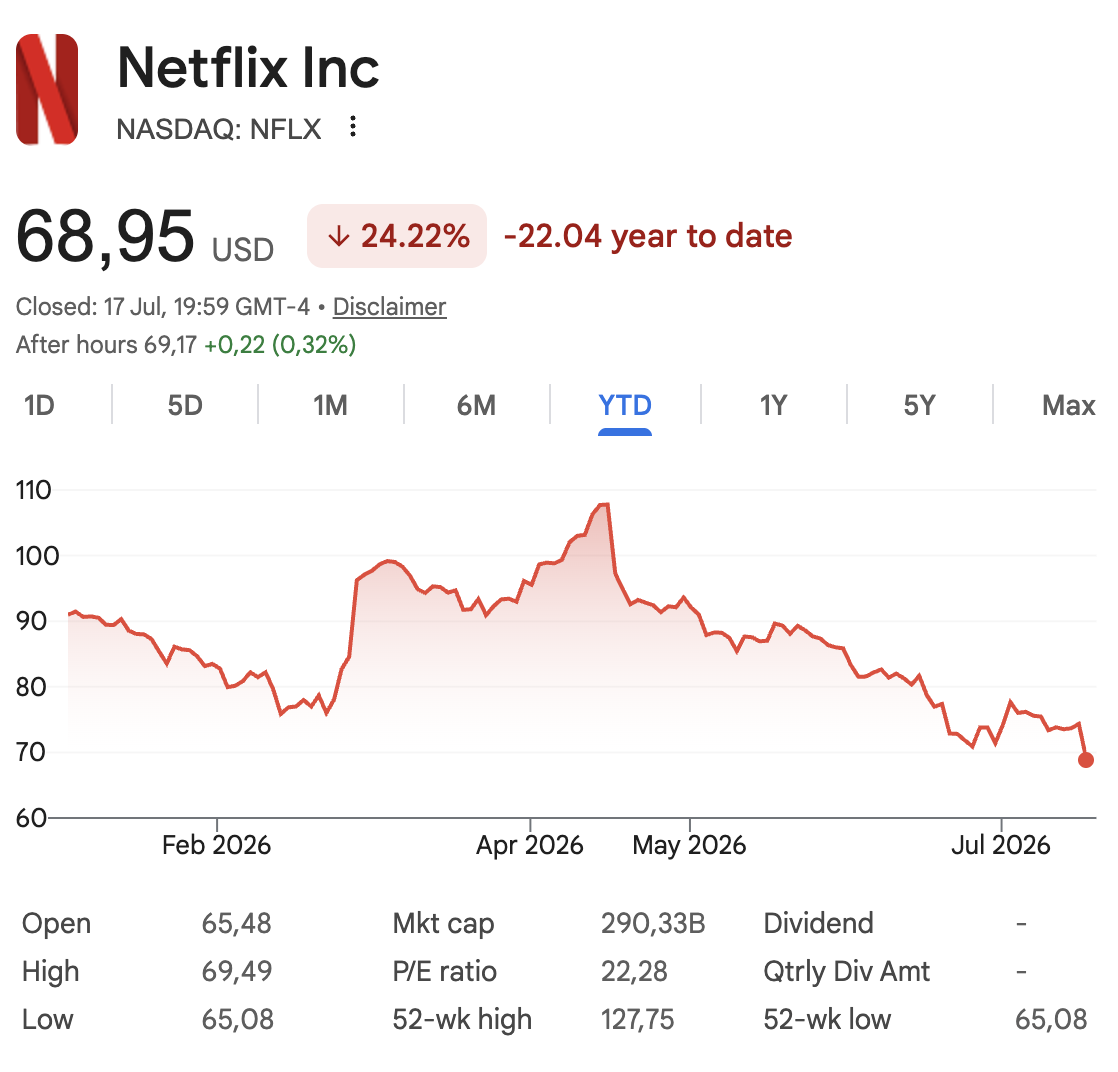
For related context from that period, see my contemporaneous note on NFLX and weekly options premium.
Why I Considered a Bear Call Spread
My idea was to sell shorter-dated bear call spreads against the long-dated short put. The rationale was not that a call spread would repair the loss. It was to collect additional credit while NFLX rebuilt confidence or traded below carefully selected call strikes. Any credits could only partially offset the cumulative cost of the troubled put position.
A bear call spread is bearish to neutral, while a short put is generally bullish. The proposed overlay could benefit from a broad range: NFLX remaining above the short-put danger area but below the short-call strike, with time decay working on both positions. It would not directly protect the short put from a severe decline.
How the Bear Call Spread Would Have Been Structured
The contemplated overlay was a shorter-dated vertical: sell an out-of-the-money NFLX call, buy a higher-strike call with the same expiry, and collect a net credit. The working timeframe was approximately 30–60 days to expiry, rather than very short-dated calls, to allow a larger management window.
No specific short-call strike, long-call strike, expiry, credit, width, or maximum loss was recorded for an executed NFLX bear call spread. The earlier discussion used examples of fixed-width spreads to explain defined risk; those examples were not this trade and are not presented here as trade facts. Without documented strikes and credit, there is no honest basis for calculating this position’s maximum loss.
What Risk the Adjustment Added
The long call would cap the loss of each individual bear call spread, but defined risk is not the same as no risk. If NFLX rallied strongly, the short call could be challenged and the spread could lose up to its defined amount. A sharp recovery could therefore make the adjustment worse even as it relieved concern about the short put.
The two layers also did not hedge one another symmetrically. If NFLX fell further, the proposed call spread might profit, but its gain could be small beside the loss on a deeper in-the-money short put. If NFLX rallied sharply, the short-put pressure could ease while the bear call spread became the new problem. Managing both legs also added timing, liquidity, assignment and decision-making complexity.
What Happened
The historical record documents the put roll to December 2027 and the consideration of bear call spreads. It does not document that a specific spread was opened, any credits received, subsequent rolls, expiry, assignment, realized P&L, or a final outcome for the combined position. The adjustment must therefore be treated as a proposed recovery overlay, not a documented successful offset.
What the Adjustment Did — and Did Not — Achieve
The proposed approach could have created a second, defined-risk premium position. It did not remove the original short put’s downside exposure, guarantee a better break-even, or turn the loss into a hedge. At most, carefully sized credits could have partly offset the position’s cumulative cost if the market behaved within the selected range. The price for that potential income was new upside risk and a more complex portfolio.
What I Learned
This position showed me how quickly an initially defined-risk credit spread can drift into a much more involved trade. Removing protection, extending the expiry, and then considering an additional spread were separate decisions, but together they changed the original thesis. “Offsetting losses” is not the same as removing risk. A defined-risk call spread can control one new risk, yet it can still add a second loss source to a position already under pressure.
For me, the practical lesson was to judge any adjustment by the additional loss I can tolerate, rather than by how much premium I want to recover. If the recovery structure requires constant rolling or increasingly aggressive strikes, closing or simplifying the position may be more honest than defending the original idea indefinitely.
Bear Call Spread vs Iron Condor
A bear call spread is one call-side vertical spread. An iron condor combines a put spread and a call spread, creating a different range-bound structure and a different set of risks. This NFLX case concerns a contemplated call-side overlay on an existing short-put problem, not an iron-condor setup.
Related Trading Strategies
For broader context, see the Trading Strategies archive and my cash-secured-put stock-selection framework. Those pages explain their own setups; this article remains a bounded record of one NFLX adjustment decision.
Disclosure: This article records my personal trading process and is not financial advice. Options involve substantial risk and are not suitable for every investor.
\n
For a later weekly journal entry that records the related NFLX bear-call-spread context, see Week 76 of my Trading Journal.