Once a month, after the rent payment comes in, I buy a little more JPMorgan Chase stock (NYSE: JPM). My position is still relatively small, but the idea is to build my portfolio around JPM over time. The first milestone is 100 shares, which would give me enough stock to sell one covered call.
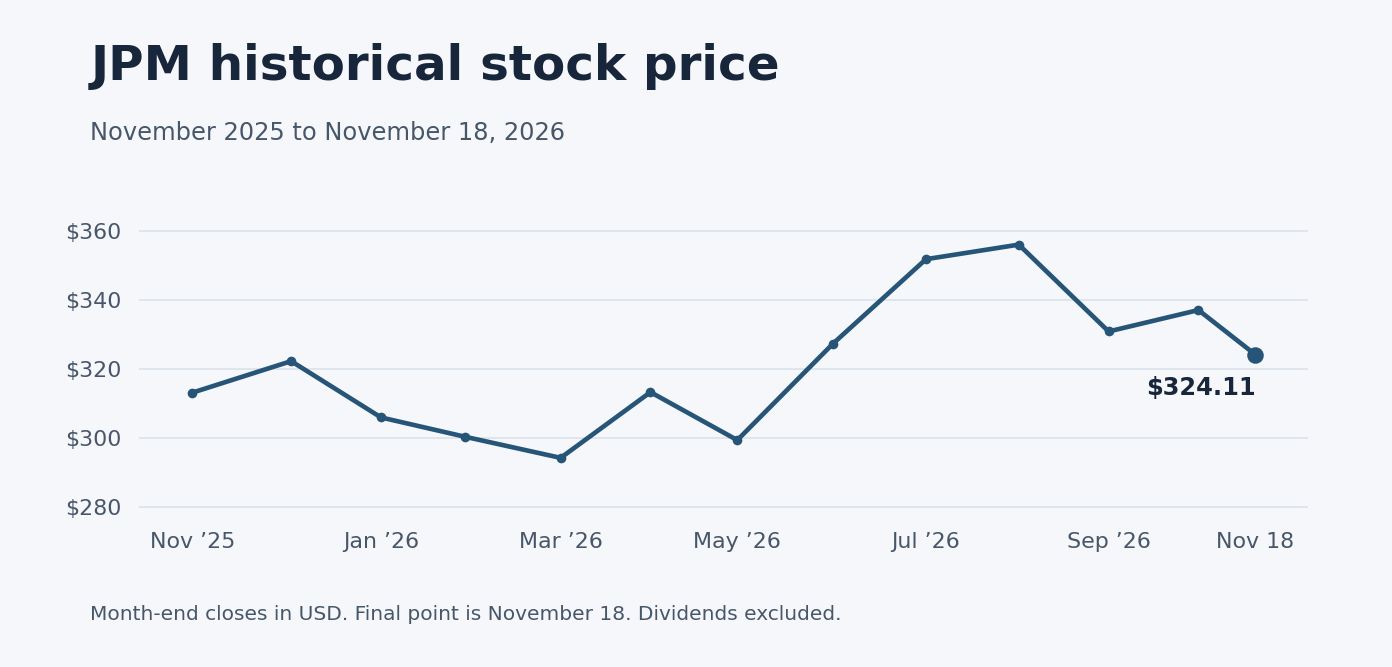
JPM closed at $324.11 on November 18. At that price, I’m comfortable building the position gradually. I’d be happier buying closer to $300, assuming the business is still performing well. The monthly rent gives me a simple routine for dollar-cost averaging, and the valuation gives me a way to decide how much I’m willing to pay.
Why I’m buying JPMorgan stock
JPMorgan traces its roots to 1799. The bank we know today took shape in 2000, when Chase Manhattan merged with J.P. Morgan. Bank One followed in 2004, then Bear Stearns and Washington Mutual in 2008, and First Republic in 2023. What I like about the bank those deals built is how many ways it makes money. Chase brings in deposits and earns money from lending and cards. J.P. Morgan earns money from investment banking, payments, trading, and managing money. I’m buying into several businesses that can contribute at different points in the cycle.
JPMorgan reports a 13.4% annualized total return from the Bank One merger in 2004 through the end of 2025, compared with 10.8% for the S&P 500. That’s a good record. For my next purchase, the question is how much of that performance the share price already assumes. 2025 shareholder letter
JPMorgan Balance Sheet and Earnings
In the third quarter of 2026, JPMorgan earned $15.3 billion on $50.2 billion in reported revenue. Earnings per share rose 10% to $5.57, or $5.75 excluding a significant investment-securities loss. The number that caught my eye was expense growth. Expenses rose 12% while revenue rose 8%. Profit before setting aside money for credit losses grew just 3%. I’ll be watching whether that gap closes over the next few quarters.
| Balance sheet | September 30, 2026 | December 31, 2025 |
|---|---|---|
| Total assets | $5.09 trillion | $4.42 trillion |
| Deposits | $2.78 trillion | $2.56 trillion |
| Gross loans | $1.58 trillion | $1.49 trillion |
| Common shareholders’ equity | $351.3 billion | $342.4 billion |
| Tangible book value per share | $112.64 | $107.56 |
| Standardized CET1 capital ratio | 14.0% | 14.6% |
The 14.0% capital ratio is the first number I’d look at in a downturn. It measures the bank’s core equity capital against the risks on its books. JPMorgan was 2.5 percentage points above its 11.5% regulatory requirement, including buffers. That gives it room to absorb losses, though the cushion was smaller than at year-end. The credit card net charge-off rate also fell to 2.90% from 3.15% a year earlier. That’s encouraging, and it’s a number I’ll keep an eye on if the economy weakens. JPMorgan Q3 balance sheet and credit disclosures
JPM Stock Valuation and Price Targets
At $324.11, JPM trades at about 12.7 times the consensus estimate of $25.57 in earnings per share for 2027. That looks reasonable at first glance. On tangible book value, the stock looks more expensive. I’m paying $2.88 for every $1 of tangible book, compared with about $1.66 for Bank of America and $1.82 for Wells Fargo. A bank can earn that premium by making more money on each dollar of shareholder equity. The question is whether JPMorgan can keep doing it.
JPMorgan earned a 20% annualized return on tangible common equity in Q3. Management targets 17% through a full cycle. Applying 17% to today’s tangible book value of $112.64 gives roughly $19 per share in annual earnings on the current equity base. At that level, the stock is closer to 17 times earnings. It’s a rough check, but it shows why the shares can look reasonably priced on next year’s estimates and still leave limited room for disappointment.
As of November 18, the average 12-month JPM stock price target was $373.48, about 15% above the closing price. Published targets ranged from $312 to $425. My own scenarios use 2027 earnings and show what happens when both earnings and the multiple change. Analyst price targets
| My 12-month scenarios | 2027 EPS | P/E | Implied price | Move from $324.11 |
|---|---|---|---|---|
| Bear — credit losses rise and the stock loses some of its premium | $20.00 | 11.5× | $230 | −29% |
| Base — earnings come in near consensus | $25.00 | 14× | $350 | +8% |
| Bull — earnings beat estimates and investors pay a higher multiple | $28.50 | 15× | $428 | +32% |
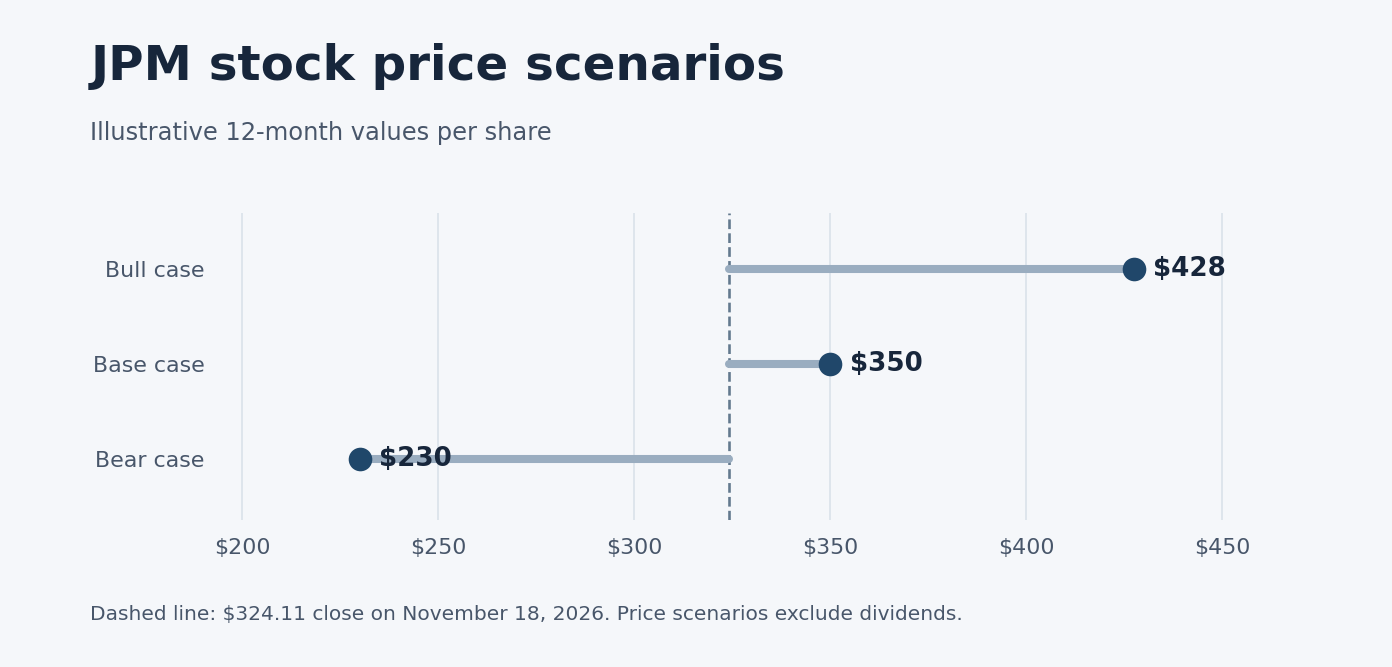
My $350 base case gives me about 8% upside before dividends. The $230 bear case is the figure I’d keep in mind as the position grows. If earnings weaken in a downturn, investors may also be willing to pay less for each dollar of those earnings. That’s how a stock can fall even further than the drop in earnings suggests.
Over five years, if earnings start at $25 a share and grow 6% annually, they reach about $33.46. At 12× earnings, that implies a share price of about $401. At 14×, it’s about $468. Assuming the current dividend stays flat and I take it in cash, those two outcomes work out to roughly 6% and 9% annualized, respectively, before taxes. That’s the range I’d use to think about what I’m getting for $324 today under those assumptions.
How Much Dividend Do 100 JPM Shares Pay?
JPMorgan’s latest quarterly dividend was $1.65 per share. At that rate, 100 JPM shares would pay $165 per quarter, or $660 per year before tax if the dividend stays the same. That’s an indicated yield of about 2.0% at the November 18 closing price. JPMorgan dividend announcement
My Plan to Buy 100 JPM Shares and Sell Covered Calls
I’m still early in the process. At $324.11, buying 100 shares all at once would cost $32,411. My approach is to build the position one rent payment at a time and see how it grows.
Once I have 100 shares, I can sell one standard covered call. The premium would add some income, but before I sell that first call, I’ll ask myself one question. Would I be happy selling my JPM shares at that strike? If I’m assigned, those 100 shares can be called away at the agreed price. If the stock falls, the premium only offsets a small part of the loss. I’ve written about managing that trade-off with NVDA, and the same question applies to JPM. My NVDA covered-call journal
So, is JPMorgan a good long-term investment? For me, yes, at a price that gives me room for a bad year. At $324, I’m happy to keep buying in small amounts. Around $290–$300, I’d be more interested in adding, provided the capital cushion and credit quality still look good. For now, the next step is the same as last month. When the rent comes in, I’ll buy a little more JPM. Let’s see how long it takes to get to 100 shares.
Disclosure — I own shares of JPMorgan Chase (JPM).