Recently, I opened an in-the-money buy-write on Bristol Myers Squibb. I bought 100 shares and immediately sold a call with a strike below what I paid for the stock. I was happy to sell the shares at that strike, which made it a different trade from some of my NVIDIA covered calls. With NVIDIA I wanted to keep the shares, and I spent a long time rolling the strike higher. That experience changed how I look for the best stocks for covered calls. I start with the stock I’m willing to hold and the price at which I’d be happy to sell it. Then I look at the premium. My trading journal report on the BMY buy-write.
I pulled three dividend-paying stocks from one November options snapshot. Bristol Myers had the smallest 100-share commitment in this group. ExxonMobil offered the most premium at the strikes I looked at. Coca-Cola showed why I might leave a good business uncovered. These are three examples of how I screen a trade, using actual quoted bids and asks.
Three dividend stocks for covered calls using real option quotes
A covered call means I own the shares and sell someone the right to buy them at a specified price, the strike. One standard equity contract generally covers 100 shares. I get the option premium up front. If I’m assigned, I deliver the shares at the strike. If the shares fall, I still own the downside, less the premium I collected.
I used November 18, 2026 quotes for December 18 calls, 30 calendar days out. All three strikes were above the share price. I used the displayed bid to estimate opening credit, which makes the exercise reproducible. An actual limit order could fill at another price or fail to fill. These are alternative stock-and-call examples, without any assumed execution or reinvestment.
| Stock | Cost of 100 shares | Call strike | Bid / ask per share | Call delta | Premium per contract | Premium / share cost |
|---|---|---|---|---|---|---|
| Bristol Myers Squibb (BMY) | $5,956 | $65 | $0.60 / $0.72 | 0.21 | $60 | 1.01% |
| Coca-Cola (KO) | $9,809 | $105 | $0.31 / $0.35 | 0.12 | $31 | 0.32% |
| ExxonMobil (XOM) | $16,058 | $170 | $2.18 / $2.35 | 0.29 | $218 | 1.36% |
Historical Optionistics records for BMY $65, KO $105, and XOM $170. Premium divided by share cost describes the opening credit relative to the stock purchase, before costs. The stock’s gain or loss determines the ultimate return alongside that credit. The deltas differ, so this is a comparison of three sample strikes I could evaluate, with different levels of upside participation.
Bristol Myers Squibb (BMY) · The smaller 100-share commitment
This is the name I’ve actually traded. I know why it belongs on my watchlist, and I can buy 100 shares for less capital than either of the other examples. At $59.56 a share, I’d still be tying up $5,956 before premium. The business question I care about is whether newer drugs can replace revenue as older products lose exclusivity. A disappointing trial, a regulatory decision, or pressure on a major drug can move the shares much more than one month’s call premium. I start with the latest company results and the drug calendar.
The $65 call offered $60 at the bid and showed open interest of 16,039 contracts. The 12-cent spread was still meaningful against a 60-cent bid. If I sold at the bid and immediately bought back at the ask, I’d give up $12 before fees. Moving down to the $62.50 strike in the same snapshot would have brought in $117 at its $1.17 bid. In exchange for $57 more premium, I’d give up $250 in stock-sale proceeds if assigned. That $57 only makes sense if I’m comfortable selling at $62.50. BMY $62.50 quote.
Here’s how my actual BMY buy-write worked. I bought 100 shares at $59.57 and immediately sold a $59 call for $1.31 per share. The call was in the money from the start. The position could make at most $74 before expenses if the shares were called away. Using the stock fill as the reference, $57 of the $131 credit was intrinsic value because the strike was $0.57 below the stock purchase price. The other $74 was time value. That’s the figure I pay attention to when comparing an in-the-money buy-write with the out-of-the-money calls above.
Coca-Cola (KO) · A business I’d screen and a call I might skip
Coca-Cola gives me a consumer-staples business to compare with pharma and oil. I’d look at the balance between unit volume and pricing. Coca-Cola reported 5% unit case volume growth and 1% price/mix growth in the third quarter. I’d also ask whether I’m paying a price the business can grow into. A resilient brand can still be an expensive stock.
The $105 call was a 0.12-delta contract, farther out in relative option terms than the other two. At the bid I’d collect $31 against a $9,809 stock purchase. The company had also declared a $0.53 quarterly dividend, equivalent to $53 on 100 eligible shares. I’d be willing to skip the option at that price. If the shares rallied and the short call went in the money before the ex-dividend date, I’d compare the dividend with the remaining time value. When the dividend exceeds the call’s remaining time value, early exercise can become more attractive. If the shares are called away before the ex-date, I can miss the dividend.
ExxonMobil (XOM) · The largest credit and the largest stock position
I still remember looking at Exxon around $80. At $160.58 in this snapshot, writing one covered call meant owning $16,058 of stock. I’d review cash flow at lower oil prices and how much the company needs to invest before committing that much of my portfolio. Exxon’s third-quarter report put operating cash flow at $25.7 billion for the quarter. That is one data point in a cyclical business.
The $170 call offered $218 at the bid with a $2.35 ask. It traded 1,084 contracts that day and showed 9,059 in open interest. I’d use a limit order and check the live spread. Most importantly, I’d decide whether $170 is a sale price I like if crude rebounds. The 29-delta call is more sensitive to a move in the shares at this point than the 12-delta Coca-Cola call. Delta can change quickly, and I use it for comparing exposure rather than treating it as a precise probability of assignment.
How much can the covered-call premium actually protect?
On the same assumptions, I calculated what each buy-write would do at expiration if the stock fell 10%. I also calculated the most each position could make at expiration if the stock reached or exceeded its strike. This assumes I keep the shares and call together until expiration, with no earlier assignment, and excludes commissions, borrowing costs, dividends, and taxes.
| Stock | Break-even at expiry | Effective sale price if assigned | Maximum gross gain | P&L if shares fall 10% |
|---|---|---|---|---|
| BMY $65 call | $58.96 | $65.60 | $604 | −$536 |
| KO $105 call | $97.78 | $105.31 | $722 | −$950 |
| XOM $170 call | $158.40 | $172.18 | $1,160 | −$1,388 |
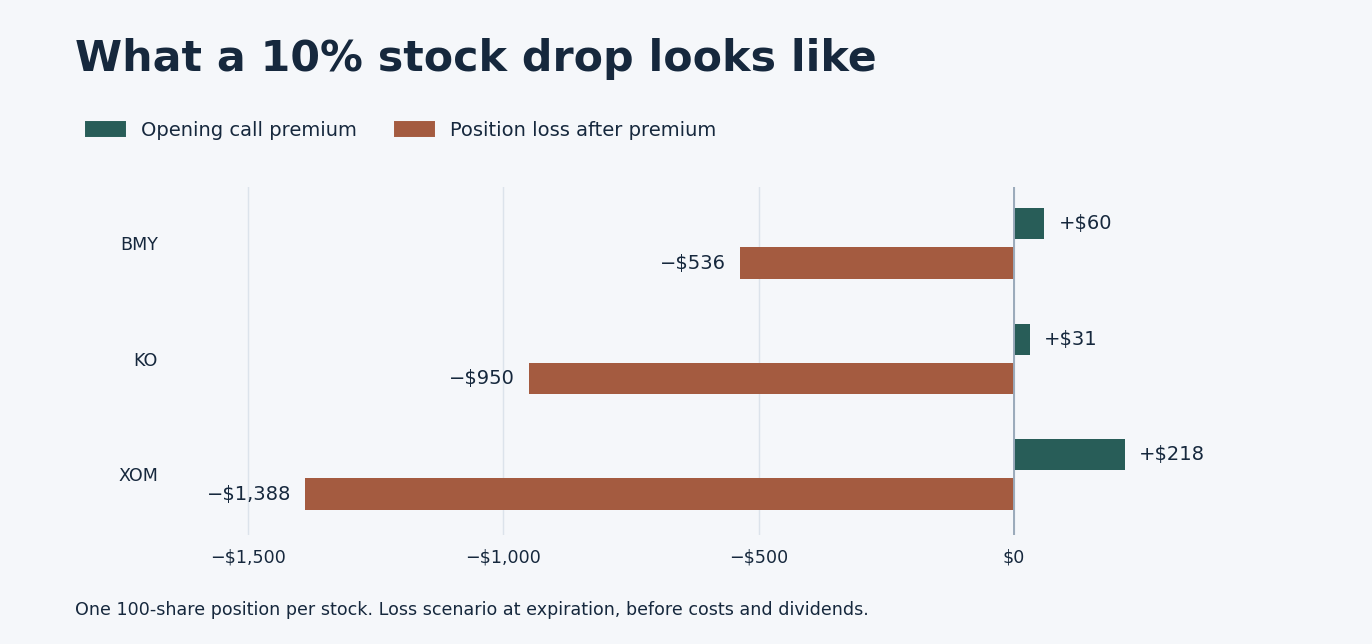
Exxon makes the trade-off easy to see. If XOM fell 10%, the shares would lose about $1,606. The $218 premium would leave a loss of about $1,388. If XOM rallied 20%, the shares alone would gain about $3,212, while the covered call would cap the example at $1,160. My first question is whether I can live with that spread of outcomes.
How I choose stocks for covered calls
- Start with a business I’d own through a bad quarter. I write down why I want it, what would change my mind, and how big I’m willing to let it get in the portfolio. If the stock is only attractive because the option pays a lot, I pass.
- Check what 100 shares cost and pick a strike I’d sell at. I assess exposure at the whole-lot price even if I already own the shares. A smaller account can still be concentrated in one ticker. I work out the effective sale price as strike plus premium, and the expiration break-even as purchase price minus premium.
- Compare similar expiries and deltas. I start with the same expiry, then look at comparable deltas when asking which stock has the richer option. The three quotes above show different choices about how much upside to leave. I’d check out-of-the-money distance, the bid–ask spread, volume, and open interest before placing an order.
- Decide what I’ll do if the stock moves. Check earnings and dividend dates, then decide whether I’d accept assignment, buy back the call, or roll it. If a proposed roll extends the commitment by months, I ask whether I’d sell that replacement call as a fresh trade.
For this snapshot, BMY would be my first name to examine if capital were tight and I already understood the drug risks. I’d look at Exxon only if the position fits my cash budget and I’d be comfortable owning it through an oil downturn. With Coca-Cola, I’d be comfortable holding the shares uncovered when the call pays as little as it did here. The next quote can change. I still need a reason to own the stock and an exit price I can live with.
Business figures are from Bristol Myers Squibb’s, Coca-Cola’s, and ExxonMobil’s third-quarter 2026 materials. The Options Industry Council’s covered-call guide covers the payoff and early-assignment mechanics.