JPM Coin (JPMD) is J.P. Morgan’s way of putting US dollar deposits on a blockchain. Eligible institutions can use it to move cash and settle transactions. If you’re wondering where to buy JPM Coin, the bank offers it through Kinexys to institutional clients and has no retail purchase route.
I took a closer look after a reader saw my LinkedIn post about buying JPMorgan Chase stock each month and thought I meant JPM Coin. I use part of my rental income to buy JPM shares and work toward 100 shares. I also invest in digital assets, so I wanted to understand what the bank had put on-chain, who could use it, and what it might mean for the payments business.
What is JPM Coin?
JPM Coin is a tokenized bank deposit. A tokenized deposit represents money held at a bank in a form that can move on a blockchain. If an eligible institution converts part of its dollar balance to JPMD, it can use the tokens to transfer funds to an approved counterparty or settle a transaction. The recipient can convert the tokens back into a dollar deposit through the bank.
Think of a fund buying a tokenized security. The security might be ready to transfer on a Saturday, but the fund still needs a way to deliver the cash. A deposit token gives eligible institutions a way to settle the cash side on the same network. That can matter when the alternative involves waiting for a payment window, moving funds between accounts, and matching the two sides of the trade afterward.
J.P. Morgan launched the public-chain JPMD product for institutional clients on Base in November 2025 and announced Ethereum mainnet support on October 19, 2026. Both are public networks. Access to the deposit token runs through the bank’s institutional banking setup. J.P. Morgan’s Ethereum launch announcement
Can you buy JPM Coin, and does JPMD have a price?
For an individual investor, there’s no official JPMD purchase through a retail brokerage, crypto exchange, or wallet swap. Eligible institutions get the token through J.P. Morgan’s Kinexys platform using their bank deposits.
People searching for the JPM Coin price are usually looking for a market quote. JPMD is denominated in US dollars and represents dollars held on deposit. Its dollar value comes from the underlying bank deposit, so a price chart like the one you’d use for JPM stock would answer the wrong question. The ticker alone also tells you little about a token you find online. J.P. Morgan publishes its official contract details and says tokens at other addresses using the same or a similar name have no affiliation with the bank. J.P. Morgan’s JPM Coin product page
JPM Coin vs. JPM stock
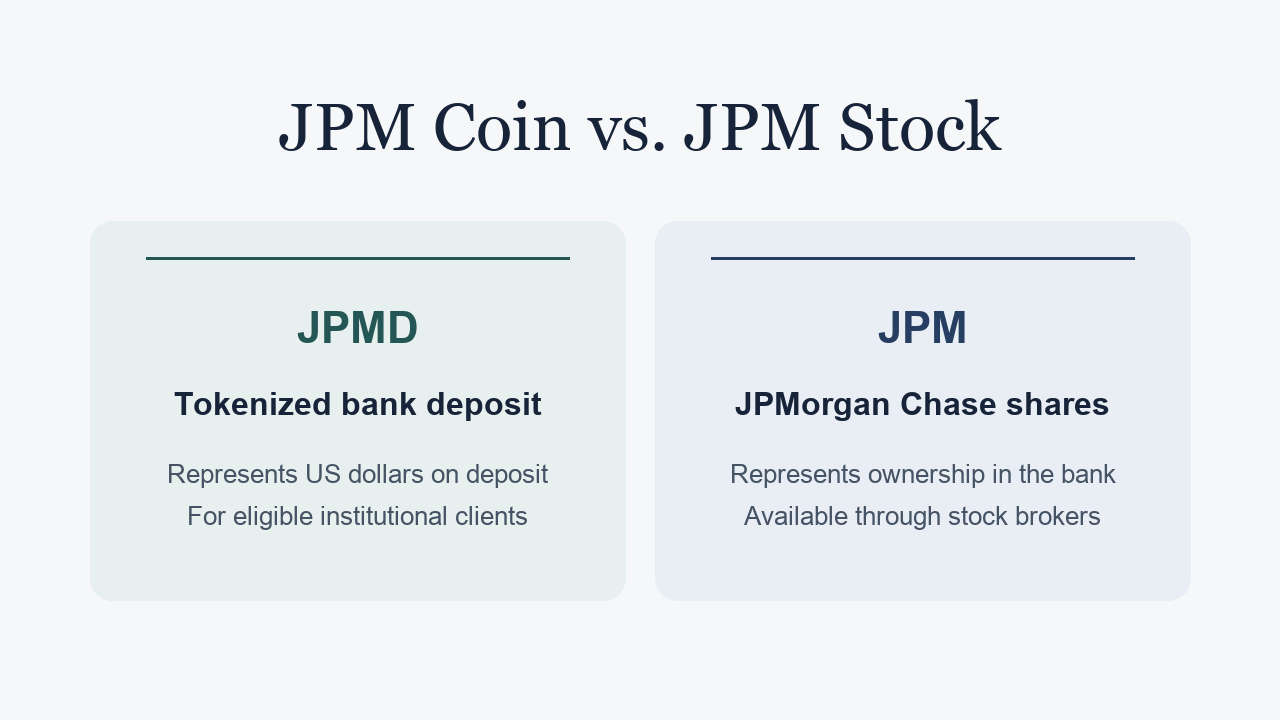
| Question | JPM Coin (JPMD) | JPMorgan Chase stock (NYSE: JPM) |
|---|---|---|
| What do you hold? | A digital representation of a US dollar deposit at J.P. Morgan. | An ownership stake in JPMorgan Chase & Co. |
| Who can access it? | Eligible institutional clients through Kinexys. | Investors with a brokerage account that offers US stocks. |
| What determines its value? | The dollar deposit it represents. | The market price of the shares, influenced by earnings, risk and what investors are willing to pay. |
| What is it for? | Moving cash, posting collateral and settling transactions. | Investing in the bank’s business and receiving dividends if declared. |
My plan to build 100 shares and eventually sell a covered call is about the stock. As a shareholder, I’m interested in whether institutional clients adopt JPM Coin and whether that activity grows into a meaningful payments business. A blockchain launch tells me the bank can offer the service. I’d want to see recurring settlement activity and evidence that the service brings in revenue or reduces costs before giving it much weight in my valuation.
Is JPM Coin a stablecoin?
JPM Coin and a dollar stablecoin such as USDC can both move dollar-denominated value on a blockchain. The difference is what sits behind the token. JPMD represents a deposit at J.P. Morgan and moves within the bank’s approved client network. A reserve-backed stablecoin is issued under its own terms against reserves, and access can be much broader.
My reader raised a related question. Could some institutions be moving balances out of stablecoins and into tokenized deposits? It’s plausible for settlement or treasury cash. I’d look for stablecoin redemptions and growth in outstanding deposit-token balances over the same period, then try to find evidence that the same institutions were behind both. A change in stablecoin market cap alone leaves that question open.