When I look at German stocks, I start with names I already know. BMW makes cars. Siemens sells industrial equipment and software. Allianz writes insurance. You’ll find all three in the DAX, Germany’s main stock market index. The DAX tracks 40 large companies listed on the Frankfurt Stock Exchange. Germany has plenty of smaller listed companies too, but the DAX is a useful place to start if you want to compare its biggest businesses.
There’s another name you’ll see when you look up a German share price. Xetra is the electronic trading venue run by Deutsche Börse. It’s where I took the closing prices for this article, so each dividend yield uses a price from the same market and the same day.
Here’s where it gets interesting. On the list below, the German automakers yield around 8% or more based on their last annual dividends. Allianz and Munich Re offer roughly half that. Yet Mercedes-Benz and Volkswagen cut their payouts, while the two insurers raised theirs. If I’m buying for income, that’s the comparison I want to make before I decide what price I’d pay.
German dividend stocks and DAX yields
The table is a shortlist from the 40-member DAX, sorted by gross dividend yield. I divide the ordinary cash dividend for fiscal 2025, paid in 2026, by the November 18, 2026 Xetra close. That gives me a comparable historical payout at the same price date, before taxes and fees. Future payouts will depend on what each company earns and decides to distribute. Dividend amounts come from the companies’ own payout disclosures.
| Company | Xetra ticker | Nov. 18 price | 2026 cash dividend | Gross yield | Yield in my 2020 table |
|---|---|---|---|---|---|
| Mercedes-Benz Group | MBG | €38.96 | €3.50 | 8.98% | 2.56% (Daimler) |
| Volkswagen preferred | VOW3 | €65.28 | €5.26 | 8.06% | 4.53% |
| BMW ordinary | BMW | €55.00 | €4.40 | 8.00% | 4.54% |
| BASF | BAS | €51.19 | €2.25 | 4.40% | 6.66% |
| Hannover Re | HNR1 | €294.00 | €12.50 | 4.25% | Outside the 2020 DAX |
| Munich Re | MUV2 | €582.00 | €24.00 | 4.12% | 4.59% |
| Allianz | ALV | €461.60 | €17.10 | 3.70% | 5.64% |
| Deutsche Bank | DBK | €29.995 | €1.00 | 3.33% | 1.41% |
| DHL Group | DHL | €59.94 | €1.90 | 3.17% | 4.31% (Deutsche Post) |
| E.ON | EOAN | €18.725 | €0.57 | 3.04% | 4.65% |
| Commerzbank | CBK | €37.71 | €1.10 | 2.92% | Outside the 2020 DAX |
The 2020 yields are the figures I recorded at the time. I’ve left them as published, and the previous table may use a different payout basis. Xetra market data.
Where the payouts look more durable
Allianz and Munich Re. Allianz raised its dividend from €15.40 to €17.10 and reported a 219% Solvency II ratio in its third-quarter update. Munich Re raised its dividend from €20 to €24 and reported a 301% solvency ratio. Those figures give me a starting point. I’d watch how much capital each can generate after a difficult claims year and how much management chooses to keep in the business.
E.ON. The €0.57 dividend implies a gross yield of 3.04%. It adds a utility to a shortlist otherwise heavy on financials and automakers. The main number I’d follow is cash left after network investment. A growing regulated asset base can support earnings over time, but the spending still needs to be financed.
Autos and chemicals. Mercedes-Benz, Volkswagen preferred, and BMW ordinary shares all yield about 8% or more using their last payouts. Mercedes’ dividend fell from €4.30 to €3.50. BASF’s price is close to where I recorded it in 2020, yet its last dividend was €2.25 versus €3.30 paid in 2020. For these companies, I’d judge the payout against cash flow after capital spending over several years. A yield table shows what I’d collect if the payout repeats. The business has to earn it again.
Deutsche Bank and its discount to tangible book
Deutsche Bank’s €1.00 dividend implies a gross yield of 3.33% at the €29.995 Xetra close. At that price, the shares traded at about 0.94 times September tangible book value of €31.87. A discount to book can be an opportunity if the bank earns a durable return on that equity. It can also persist if credit costs rise or profitability falls.
The bank reported a 14.0% CET1 capital ratio as quarterly credit-loss provisions rose 20% to €501 million. For me, the question is whether earnings can cover both the dividend and higher provisions without weakening capital. That’s the same test I applied in my JPMorgan review. Deutsche Bank Q3 earnings report and my JPMorgan analysis.
Who joined the DAX and who left?
The DAX expanded from 30 to 40 members in September 2021. Airbus and Siemens Healthineers joined in that expansion. Hannover Re and Daimler Truck entered in 2022. Linde left in 2023, and Commerzbank took its place. More recently, GEA and Scout24 joined in September 2025, while HOCHTIEF replaced Porsche Automobil Holding SE in June 2026. Lufthansa dropped out in June 2020, followed by Wirecard that August. The membership changes matter when comparing the two snapshots, since the companies in the index today represent a different mix of industries and businesses. STOXX index history.
Big winners and losers since 2020
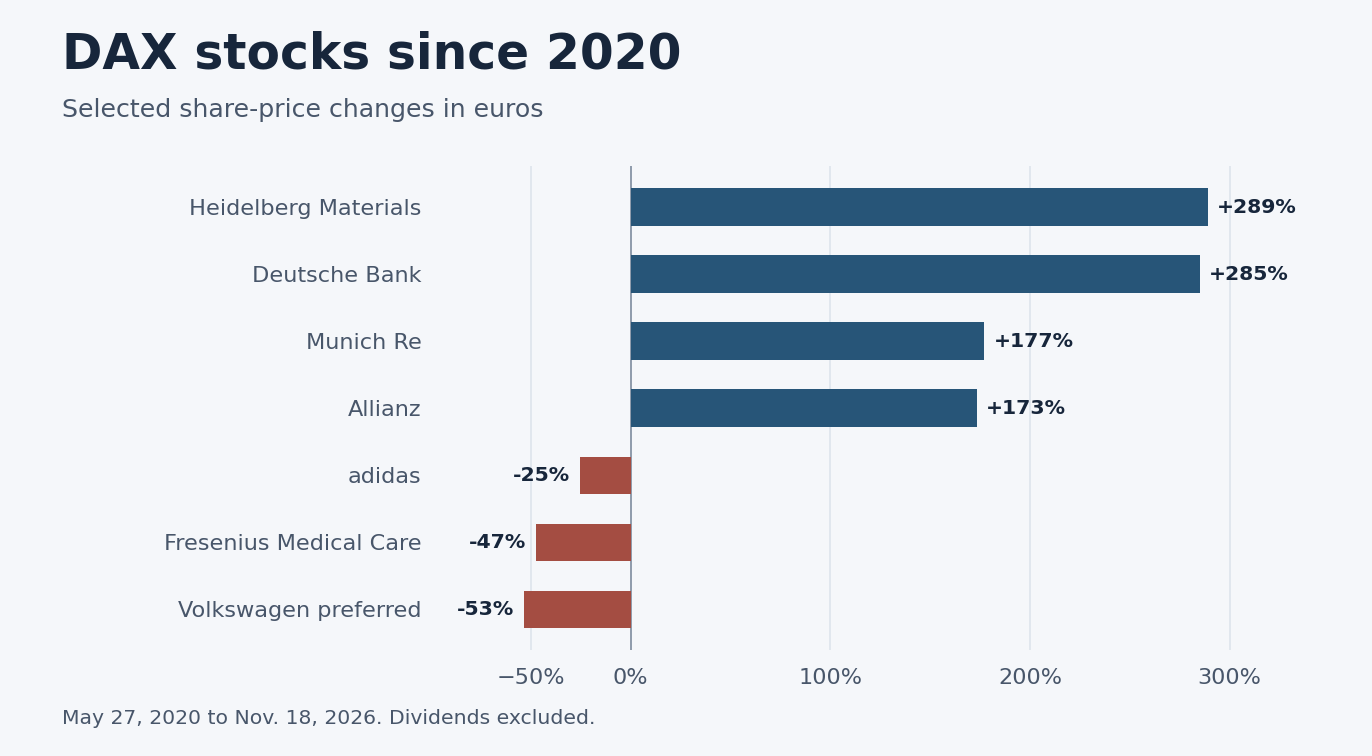
These are selected standouts from my original DAX dividend list, comparing the May 27, 2020 prices in that article with the November 18, 2026 Xetra closes. The percentages show the move in the euro share price alone. Dividends, taxes, currency changes, and the value of any separately distributed securities are outside the calculation.
| Company | May 27, 2020 | Nov. 18, 2026 | Price move |
|---|---|---|---|
| Heidelberg Materials (formerly HeidelbergCement) | €45.40 | €176.60 | +289.0% |
| Deutsche Bank | €7.79 | €29.995 | +285.0% |
| Munich Re | €210.00 | €582.00 | +177.1% |
| Allianz | €168.90 | €461.60 | +173.3% |
| adidas | €233.00 | €173.80 | -25.4% |
| Fresenius Medical Care | €73.16 | €38.56 | -47.3% |
| Volkswagen preferred | €140.12 | €65.28 | -53.4% |
Heidelberg Materials and Deutsche Bank are the biggest gains shown. Heidelberg’s result from current operations rose 9% in the latest quarter, and management kept its full-year outlook. After a move of nearly 289%, I’d be much more interested in what the business can generate from here than in how cheap it once looked. Munich Re and Allianz also show why I don’t start with the highest yield. A lower yield today can coexist with a higher dividend per share when the stock price has risen.
Volkswagen and Fresenius Medical Care are the largest declines shown. Volkswagen’s preferred shares fell about 53% across the two snapshots, while its latest dividend fell from €6.36 to €5.26. The current yield looks high partly because the share price is low. Volkswagen reported €4.4 billion in automotive net cash flow through September, up from €1.8 billion, but reported group operating profit fell to €0.1 billion from €5.4 billion. I’d want to understand what drove the swing and how repeatable that cash generation is before buying for the payout.
Two other names need different treatment. Wirecard collapsed and was removed from the DAX, so I’ve kept it outside the price table. Vonovia’s quoted share price also fell sharply, but it had a rights issue in 2021. Comparing two unadjusted prices misses what a shareholder could have received or paid for those rights. The same caution applies to the old Daimler name after Daimler Truck was spun off.
What I’d watch from here
I’d follow underwriting profits and capital at Allianz and Munich Re, spending on the grid at E.ON, and credit costs at Deutsche Bank. For the high-yield automakers, I’d want to see cash flow hold up through a weaker year before relying on that income.
The €7 Lufthansa cash-secured put in my November journal and the €8.40 put I previously sold on E.ON both started with the same question. Would I be happy owning the shares at that price? Lufthansa journal entry and E.ON trade notes.
Disclosure. I’ve been adding Deutsche Bank to my dividend stock portfolio through its New York listing (NYSE: DB). The table uses DBK on Xetra so every yield is measured from a euro share price.