A bear call spread is an options trade where you sell one call and buy another at a higher strike on the same stock, with both calls expiring on the same date. It’s also called a call credit spread because you collect the difference between the two premiums up front.
I sell these occasionally, mostly on stocks where I hold fewer than the 100 shares needed to write a standard covered call. The higher-strike call limits the spread’s loss at expiration when both legs settle as expected. The spread is a neutral-to-bearish trade with its own upside risk. A covered call pairs a short call with shares and leaves me exposed to a drop in the stock.
In Week 85 of my trading journal, I sold the $75 Netflix (NFLX) call and bought the $85 call, both expiring February 19, 2027. I already had a separate $64 short put expiring December 17, 2027. The spread gave me a way to collect more premium while the put was open. It also gave me a second price move to plan for. A sharp rebound could help the put and hurt the call spread at the same time.
How a bear call spread makes money
If the stock finishes at or below the short strike, the spread earns its maximum profit, the opening credit before fees. Between the strikes, each dollar the stock rises costs a standard spread $100 in expiration value. At or above the long strike, the spread reaches its maximum loss at expiration, equal to the strike width minus the opening credit, times 100, before fees. A stock can rise a little and the spread can still make money if it finishes below the expiration break-even.
My Netflix bear call spread example
I sold the $75 call and bought the $85 call. That makes the spread $10 wide, or $1,000 in maximum settlement value for one standard 100-share spread. Week 85 reports the strikes and expiration but gives no separate fill price for this trade. To show the math, I’m using an illustrative $2.00 credit per share.
| At expiration | Calculation | Per spread, before fees |
|---|---|---|
| Maximum profit at $75 or below | $2.00 × 100 | $200 |
| Break-even | $75 + $2.00 | $77 NFLX share price |
| Maximum loss at $85 or above | ($10.00 − $2.00) × 100 | $800 loss |
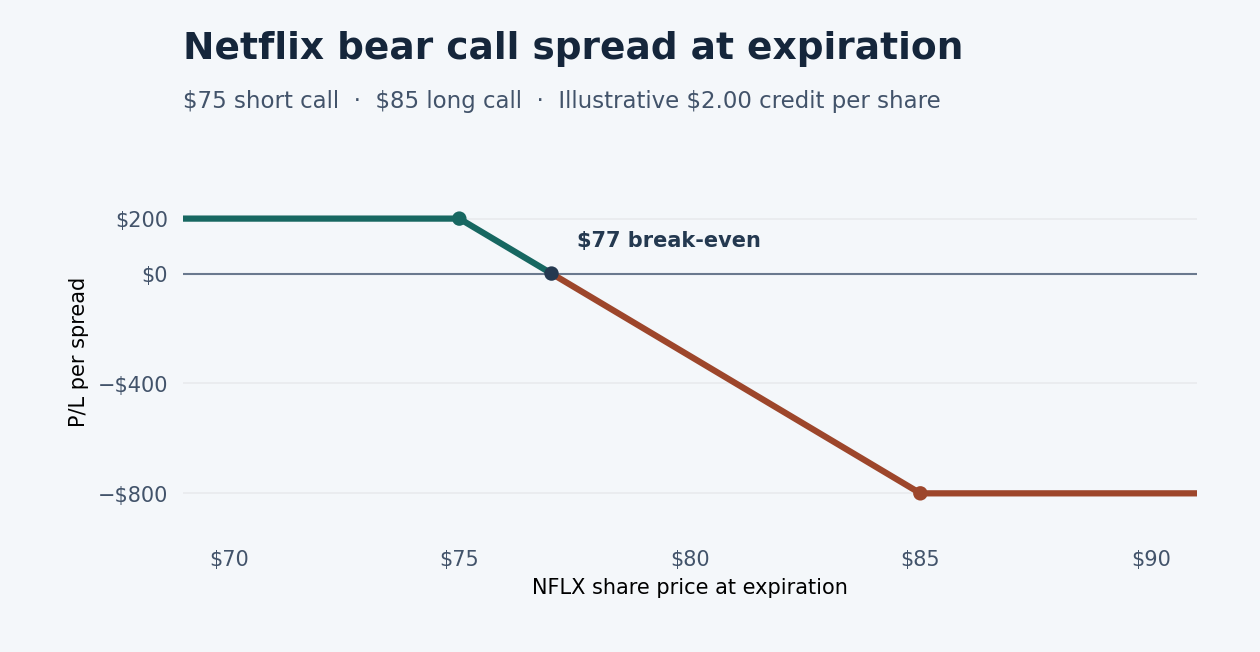
At $80 at expiration, the $75 call is $5 in the money and the $85 call has no intrinsic value. The spread costs $500 to settle against the $200 illustrative opening credit, for a $300 loss before fees. Before expiration the buyback price also reflects remaining time, implied volatility and the bid–ask spread. I use the payoff chart to understand the risk and the option chain to price my exit.
How I would choose the strikes and expiration
I start with a price that would make me reconsider my outlook. That gives me a reference point when I look at short strikes. A farther-out strike gives the stock more room to rise and generally pays less. I then look at the long call and compare the extra credit from a wider spread with the additional dollars I’d stand to lose. A wider spread can still be a worse trade even if it pays more.
I check the earnings calendar before picking an expiration. If the trade runs through earnings, a gap can take the stock through both strikes before I have a chance to adjust. I also check the bid and ask on both calls and price a two-leg limit order. The quoted midpoint is a starting point. If the available credit is small and I’d give much of it back crossing the spread to exit, I can pass.
I also look at the spread’s net delta, which estimates how much the position’s value changes for a small move in the stock. If the call I sell has a delta of 0.30 and the call I buy has a delta of 0.15, the spread starts at about −0.15 delta, or roughly the directional exposure of being short 15 shares per standard spread at that moment. Those numbers are illustrative. Delta can change as the stock approaches the short strike, especially near expiration. The short call’s delta alone tells me very little about the risk of the spread and my existing put together.
I like to translate the credit into dollars I can still earn. Using the illustrative NFLX example, if the spread I sold for $2.00 costs $0.20 to close, I can lock in $180 before fees. Holding it can earn at most another $20, while a reversal to the $10 maximum settlement value would cost $980 more than closing at $0.20. That comparison helps me make the exit decision even when the original trade still looks good.
When I’d close, hold or roll a bear call spread
- Close. If there’s little premium left to earn, I compare the cost of buying back both calls with the risk of keeping the trade open. I’d also consider closing if the thesis changed or if I’d be uncomfortable with assignment near expiration.
- Hold. I may hold if the original reason for the trade still makes sense and there’s enough premium left to justify the risk. A move through the short strike is a reason to review the trade. The strike, expiration break-even and current buyback cost each tell me something different.
- Roll. A roll closes the old spread and opens another one. I price those two trades separately, then ask whether I’d open the new spread on its own. Moving the strikes higher can give the stock more room. Moving the expiration out adds time for the stock to move and can bring a new earnings date into play.
For example, if I collected $2.00 and bought the spread back for $3.20, I’d realize a $120 loss before fees. Selling a later spread for $3.50 would make the roll a $30 net credit at the time of the adjustment. I’d still have the $120 loss on the first trade and a new spread to manage. I’ve had to roll an NFLX call spread higher and farther out before, as I explain in my Netflix case study.
Mistakes I try to avoid
- Adding a spread just because the put is losing. The credit only offsets a limited amount of downside. The $64 NFLX put in Week 85 still carries the obligation to buy shares if assigned. A sharp rebound can help the put while hurting the call spread. I made a similar trade in Bank of America, selling a $60/$62.50 call spread while the $55 short put was still open. I walk through both positions in my Bank of America bear call spread case study.
- Counting the credit as profit on day one. I track what I took in and what it actually costs to get out. I also size the trade against the spread’s potential loss and the exposure I already have in the stock.
- Taking off the long call first. If I sell the higher-strike call and keep the short call open without shares to cover it, I can be left with an uncovered short call. I plan to exit both legs together while they’re still open.
- Assuming both legs will settle together. A short U.S. equity call can be assigned early, especially when it is in the money before an ex-dividend date and has little time value left. The long call can remain open. At expiration between $75 and $85, the $75 call can be assigned while the $85 call expires worthless, leaving me short 100 shares per spread if I don’t own shares to deliver. Near either strike, I check my broker’s exercise deadline and decide whether I’m willing to carry any share exposure.
Before I open a bear call spread, I want three answers. How much can this trade lose? What would make me close it? Would I still want it if my other position in the stock disappeared tomorrow? That last question helps me decide whether I’m putting on a trade I actually want or just trying to collect another credit.