On November 24, 2026, while my daughter was at her jiu-jitsu lesson, I spent some time coding and looking through the S&P 500 options chain. A few years ago I was a huge enthusiast for 0DTE SPX trades. I eventually stepped away because I realized I prefer trading options on assets I can actually own. Watching her train gave me a chance to revisit the idea. I wanted the same S&P 500 exposure in a smaller contract, so this time I chose XSP and opened a 705/700 put credit spread for $20.
XSP vs. SPX options
XSP is Cboe’s Mini-SPX index option. It follows the same S&P 500 index as SPX at one-tenth the index level. If SPX is at 7,200, XSP is around 720. Both contracts use a $100 multiplier, so an XSP contract has about one-tenth the notional exposure of an SPX contract. With spreads, the distance between the strikes still determines how much cash is at risk.
XSP is European-style and cash-settled. It can be exercised only at expiration, and any amount due is settled in cash. That matters to me because when I sell a cash-secured put on a stock I want to own, assignment can leave me with shares. An XSP put spread gives me a cash result tied to the index level at settlement. I think of it as a separate trade from my stock accumulation. Cboe XSP contract specifications
How the 705/700 XSP put credit spread works
Zero days to expiration means I opened the trade on the same day the options expired. I sold the higher-strike put and bought the lower-strike put to cap the loss. Both legs had a November 24, 2026 expiration.
- Sold: 1 XSP 705 put at 0.41 ($41 received).
- Bought: 1 XSP 700 put at 0.21 ($21 paid).
- Opening credit: 0.20 points, or $20 before fees.
- Breakeven at expiration: 704.80 before fees.
- Maximum profit: $20 at a settlement of 705 or higher.
- Maximum loss: $480 at a settlement of 700 or lower, before fees.
The five-point gap between the strikes represents $500. The $20 credit reduces that to $480 of maximum loss. If XSP settled at 704, for example, the short put would cost $100 at settlement and the 700 put would expire worthless. That would leave me down $80 after the opening credit, before fees. More credit spread examples from my trading journal.
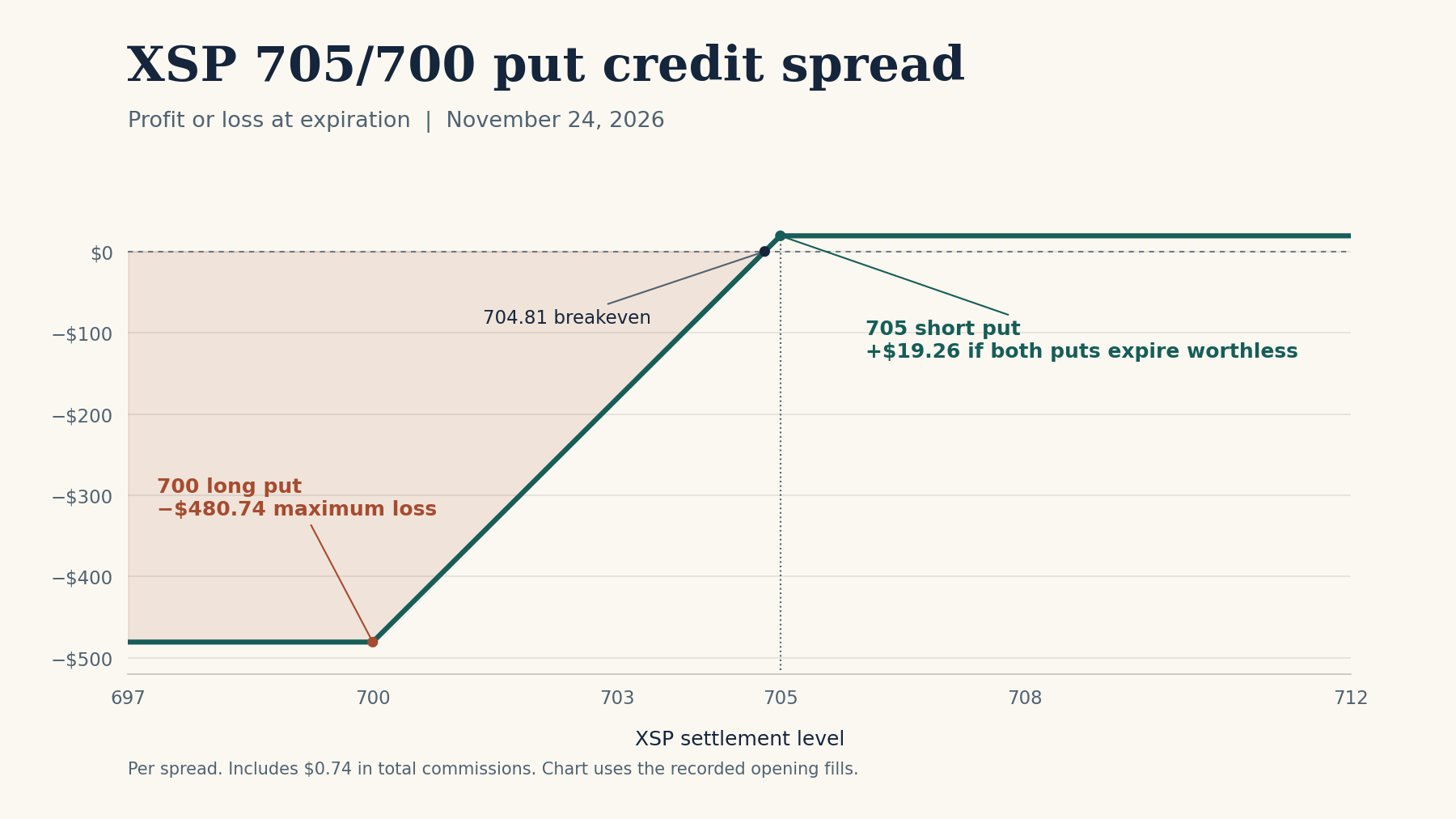
Expiration payoff for my XSP 705/700 spread, including $0.74 in total commissions.
What I’m tracking in the ledger
I like the idea of tracking these trades the same way I track and roll short-dated crypto options. The first entry in the ledger is the credit I received. The line I care about comes when I close or settle the trade, after any buyback and fees. If I ever roll a spread, I want to see the cost of closing the old position and the credit from opening the new one. One full $480 loss would offset 24 trades that each kept the full $20, even before fees.
I think 0DTE index spreads could be an interesting addition to a larger portfolio. What puts me off is the idea of having 19 profitable trades and giving it all back on the 20th. At $20 each, 19 full winners would make $380. One max loss on this spread would leave the series down $100 before fees.
My plan if a short put comes under pressure is to look for a roll down and out for a net credit. That means buying back the current spread and opening a new one at lower strikes with a later expiration. The new spread has to bring in more than it costs to close the old one. A roll can extend the time I have to manage the trade, and it also carries the risk overnight. The lower strikes and the credit may be unavailable at the same width. I would need room in the portfolio to take the loss on the first trade and still carry the new spread without increasing my size just to get a credit.
With XSP around 710, the $100 multiplier puts one contract's notional exposure around $71,000. The dollar risk on my spread was $480 before fees because I owned the 700 put. Even with that limit, I would want a bigger cash cushion to absorb a string of losses or carry an adjustment.
Why I still find the S&P 500 interesting
I’m more comfortable making a long-term case for the S&P 500 than I am for many of the crypto assets I trade. It represents a broad group of operating businesses, and the index has a long record of positive total returns over extended periods. S&P Dow Jones Indices reports positive annualized total returns over its latest five- and ten-year periods. The index has also had sharp drawdowns, and a recovery over months or years offers little help to a spread that settles tonight. S&P Dow Jones Indices total return data
Smaller alternatives for 0DTE options
After opening the trade, I spent the rest of the evening watching it. I found that interesting, even exciting, and it also brought more stress than I wanted for a $20 credit. I still think the trade is interesting and doable. For the size of my portfolio, I would prefer a smaller exposure.
My first thought was to look for a ticker around $100 to $200. With a standard $100 multiplier, that is about $10,000 to $20,000 of notional exposure. For a credit spread, I would still check the actual strike width and the credit before deciding how much I was willing to risk.
- NVDA traded in the $150s on November 24 and fits that price range. It has same-day opportunities on listed expirations, typically Monday, Wednesday, and Friday. I already follow the stock, though the trade would be tied to one company and an in-the-money option can settle into shares. My NVDA credit spread example shows how I’ve traded the stock before.
- Cboe Nanos (NANOS) follow the same Mini-S&P 500 index as XSP but use a $1 multiplier. Cboe lists Monday, Wednesday, and Friday expirations on its regular schedule. I’d check the chain and bid-ask spread in my broker before considering one.
- Financially settled Micro E-mini S&P 500 options are another way to keep the S&P 500 exposure. CME lists weekday expirations with a $5 multiplier. They settle against a futures-based price, and I’d confirm my broker carries that specific series and check the available strike widths. CME Micro E-mini options specifications
I could also stay with XSP and look at one-point spreads. The gross spread width would be $100 before credit, compared with the $500 width on this first trade. I’d want to see a workable premium after fees and spend less of the evening watching it before putting it into my regular routine.
Trade result
Both puts expired worthless, so I kept the full $20 premium. After $0.74 in total commissions for both legs, my net profit was $19.26.
I wouldn’t recommend this trade. I spent most of the evening monitoring a position that could lose $480 before fees. Keeping $19.26 on this one trade didn’t make that risk or the time I spent watching it worthwhile for me.
More trades and adjustments are in my trading journal.