NVIDIA (NVDA) 0DTE options are contracts that expire the same trading day you trade them. On November 25, with NVIDIA around $142 shortly after the open, I sold one $133 put expiring that afternoon. I received $0.24 per share, or $24 before commission. If assigned, I’d have to buy 100 shares at $133, a $13,300 purchase.
The day before, I used a 0DTE put credit spread on XSP. On NVIDIA, I wanted to keep the full premium from the short put, so I chose a cash-secured put and left out the protective leg. That changed the trade completely. With XSP, I could define the downside with the second strike. With NVDA, I had to be willing to own the stock through a much bigger move.
When can you trade NVDA 0DTE options?
NVIDIA has Monday, Wednesday and Friday expirations when those series are listed. Friday was the usual weekly expiration. In January 2026, exchanges added Monday and Wednesday expirations for a select group of actively traded stocks, including NVDA. The listing program uses criteria such as market capitalization, options activity, position limits and eligibility for penny pricing. More expiration dates give traders more control over how long they carry exposure and whether a contract includes a particular event. Nasdaq’s explanation of the listing program.
I use the date on the broker’s option chain as the final check. The contract has to expire on that U.S. trading day to be 0DTE. Holidays and listing exceptions can change the calendar, and early closes leave less time to manage the position. I also check NVIDIA’s earnings calendar and the day’s macro announcements before looking at strikes or premium.
My NVIDIA 0DTE cash-secured put
| Trade detail | Value |
|---|---|
| NVIDIA near entry | About $142 |
| Position | Short one November 25 $133 put |
| Put delta around entry | About −0.07 (absolute delta 0.07) |
| Opening fill | $0.24 per share, $24 gross |
| Cash reserved for assignment | $13,300 |
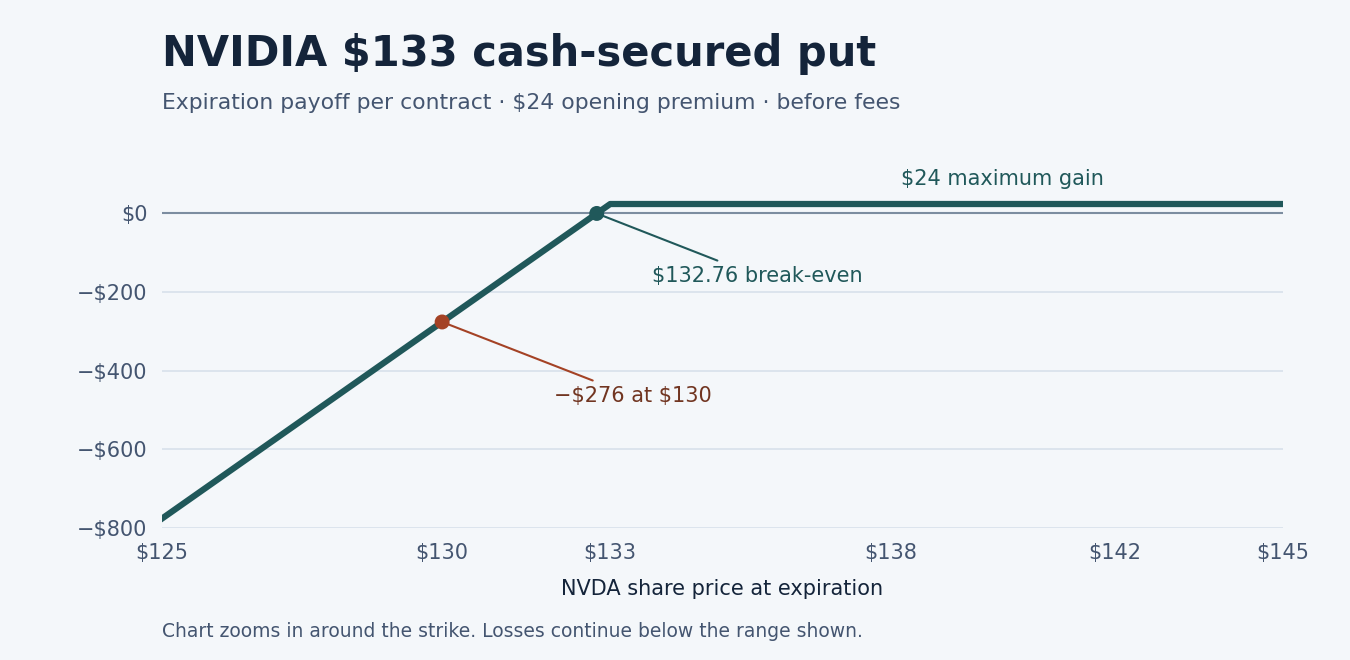
| Expiration break-even | $132.76 before fees |
| Maximum gain / theoretical maximum loss | $24 / $13,276 before fees |
The strike was about $9 below the opening stock price, roughly 6.3%. The opening credit was about 0.18% of the full cash commitment. If the put expired worthless, I’d keep the $24 before fees. At a $130 stock price at expiration, the position would be down $276 before fees. That one outcome is equivalent to eleven and a half $24 wins. The theoretical maximum loss assumes the stock goes to zero.
Why I waited for the stock market to open
NVDA closed Tuesday’s regular session at $155.38. The stock weakened after hours, then traded more than 6% below that close in Wednesday’s premarket. It was around $142 when I opened the put during the regular session. That sequence mattered to me. I got to see the selloff and the options chain reprice before I chose my strike. The overnight gap was already on the screen, and the stock could still have kept falling.
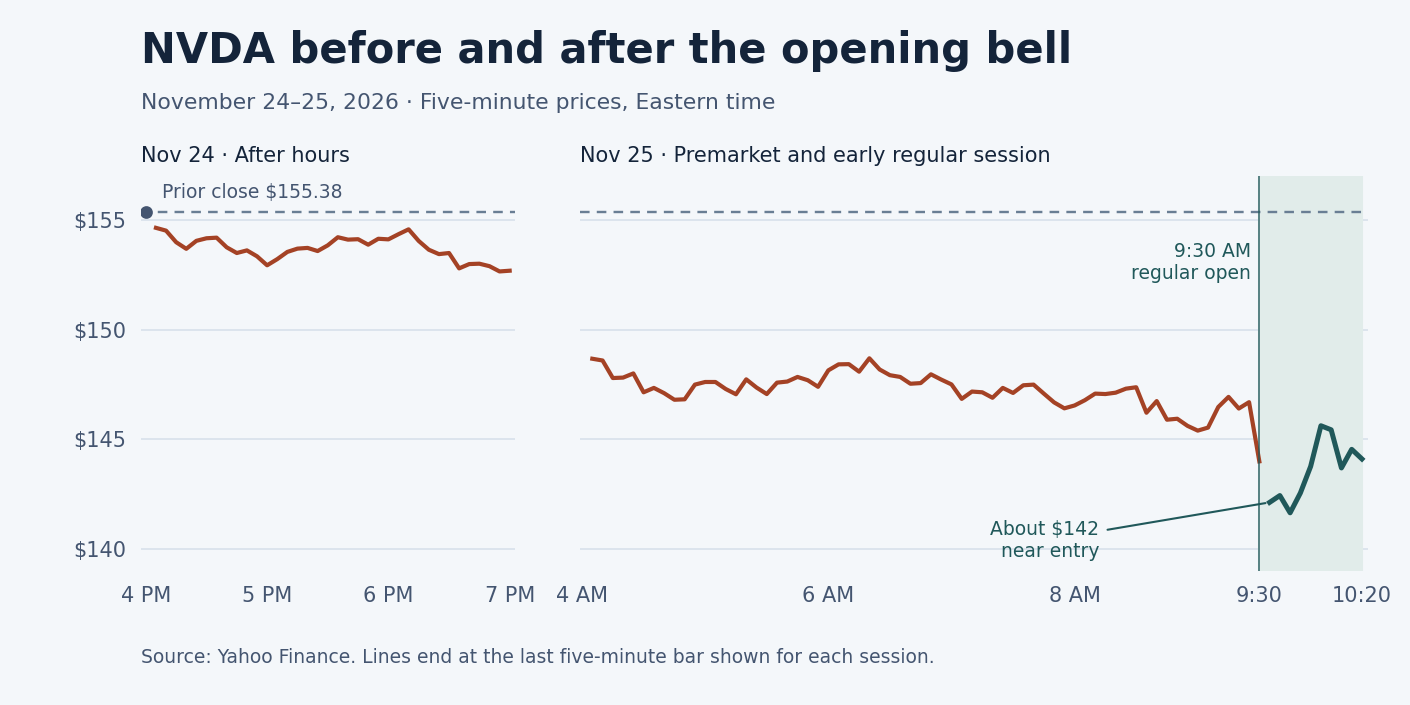
With crypto, I sometimes open an expiry-day trade the night before because the market is already trading. On NVIDIA, I waited until U.S. regular hours to see where the shares and options were trading after the bell. An evening stock quote gives me context. The bid and ask I can actually trade the next morning are what I use to size the position.
What a 0.07 delta tells me on expiration day
A long put at −0.07 delta suggests its price would initially rise by about $0.07 per share for a $1 decline in NVIDIA, all else equal. My short put had the opposite exposure, roughly the initial directional exposure of owning seven shares for one contract. Delta is a snapshot. I wouldn’t read 0.07 as a reliable 7% chance of assignment.
The number I watch as NVDA approaches the strike is how quickly delta changes. That’s gamma. A same-day put can be quiet well outside the strike, then pick up directional exposure quickly as the stock falls toward it. Time decay helps while the stock stays far enough away. A fast selloff can overwhelm that decay, and a wide bid–ask spread can make my actual exit worse than the mark on the screen. A $0.05 difference in the fill costs $5 per contract, more than a fifth of my opening credit. Options Industry Council’s guide to gamma.
Why I sold the put without a credit spread
Buying a lower-strike put with the same expiration would have used part of my $24 premium. In return, I’d have capped the expiration loss of the spread at the difference between the strikes times 100, less the net credit, before fees. I chose the extra premium because I was prepared to set aside enough cash for the shares. The toughest part of that decision is putting a $13,300 purchase into the context of the rest of my portfolio. If 100 more NVIDIA shares would make the position too large, I’d pass on the cash-secured put.
There’s also a settlement difference from my XSP trade. XSP is European-style and cash-settled. Standard NVDA equity options are American-style and physically settled. Assignment on this put would leave me with 100 NVIDIA shares and the risk of owning them into the next session. A stock trading close to $133 near the bell deserves particular attention. After-hours moves can affect a holder’s exercise decision, and brokers have their own cutoffs. If I don’t want the shares, I need to close in time and confirm the fill. Options Industry Council’s assignment FAQ.
My plan if NVIDIA challenges the $133 strike
If the stock moves toward $133, I’ll check what changed and price my choices while there’s still time to trade. I can buy the put back and take the result, leave it open if I’m comfortable with an assignment, or look for a roll down and out. My preferred roll would buy back the $133 put and sell a later-expiring put at a lower strike for a net credit. I’d price both legs as one order and judge the new position on the strike, expiration, net fill, upcoming events and cash it would tie up. If a sensible roll doesn’t trade, I still have a decision to make before the close.
Here’s how I’d record a roll, using hypothetical prices. Buying back the original put for $0.85 would close it at a $61 loss before fees. Selling a later $131 put for $1.05 would bring in $105, leaving a $20 credit on the roll ticket. The running cash flow would be $44 before fees, with the new $131 put still open and another period of downside exposure ahead. I’d be committing $13,100 to a potential share purchase on that new contract. I’ve written more about sizing and assignment in my cash-secured puts guide.
Would I rather sell weeklies?
I didn’t find this especially exciting. I found it stressful to keep checking the screen while the market was open. On expiration day, a move toward my strike can force a decision within minutes. For my routine, a weekly put would probably feel less stressful because I’d have more time to decide whether to close, roll or take the shares. That comes with more nights of gap exposure and potentially more events to trade through. Another trader may be comfortable watching one session closely. I’m weighing the attention the trade takes alongside what it pays.
Trade result
The $133 NVDA put expired worthless on November 25. I kept the full $24 opening premium before commission, the maximum gross profit on the trade. I wasn’t assigned any shares.
I prefer trading 0DTE on NVIDIA to trading it on SPX. With NVDA, I can decide what to do with the underlying shares if the trade goes against me. If I’m assigned on one $133 put, I buy 100 NVIDIA shares at $133. I can hold them, sell them, or sell a covered call if I still want to own the stock and I’m comfortable letting it go at the call strike. SPX settles in cash, so there are no shares to manage afterward. That flexibility is what I like about NVDA. The call premium only offsets part of any drop in the shares, and the call can cap my upside if NVIDIA rebounds.
Before opening a trade like this, I ask myself if I’d still want 100 shares at the strike after a sharp selloff. That’s the decision the $24 is paying me to take.