The idea of regional crypto arbitrage isn’t new. The most famous example remains the Kimchi Premium — a persistent price gap where Bitcoin and stablecoins traded at a premium on Korean exchanges due to capital controls, retail demand, and limited outbound liquidity.
India occasionally shows similar characteristics. During a recent vacation in Palolem Beach, Goa, I found myself regularly exchanging USD to INR at beach shack money changers. That on-the-ground exposure, combined with crypto P2P observations, sparked an idea worth examining — even if it ultimately proves impractical at scale.
The Observed Spread
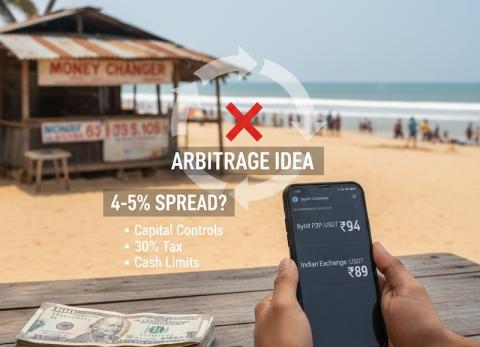
What caught my attention was a USDT price discrepancy (as of January 2026)
Bybit P2P: USDT selling around ₹94
Indian exchanges (spot): USDT priced around ₹89–90
On paper, this suggests a potential 4–5% round-trip spread:
Sell USDT via P2P for INR at a premium
Buy USDT back cheaper on an exchange
Repeat
In theory, that’s a hefty edge — especially compared to traditional FX or crypto arbitrage spreads.
Why This Isn’t the Next Kimchi Trade
Once you move past the spreadsheet, reality kicks in.
1. Capital Controls Are the Core Constraint
India has strict controls on capital movement. Moving INR out of the country — or even converting it back to USD at scale — is not frictionless. This alone breaks most clean arbitrage loops.
2. You Need Trusted Local Infrastructure
Any serious attempt would require:
A trusted Indian contact
Or a fully functional Indian bank account
Or both
Without local banking access, you’re stuck in P2P limbo. That’s manageable for small sums, but it doesn’t scale.
3. Cash-Based Routes Don’t Scale
Yes, cash INR can sometimes be converted back to USD at attractive rates — especially in tourist-heavy areas. But:
Cash handling introduces security and compliance risks
Large volumes are impractical
You quickly hit informal limits
A strategy that relies on backpacks of cash is not a strategy — it’s a liability.
4. The 30% Crypto Tax Is a Hard Stop
India’s 30% flat tax on crypto profits, with no loss offsetting, is a structural killer. Even if you capture a 4–5% spread, taxation can wipe out the edge unless you operate in a gray zone — which introduces its own risks.
Mapping the Potential Routes (and Their Issues)
| Route | Looks Good On Paper | Breaks In Practice |
|---|---|---|
| P2P → Exchange → P2P | Yes | Banking + tax friction |
| Cash INR → USD | Sometimes | Doesn’t scale |
| Indian exchange arbitrage | Marginal | Capital controls |
| Offshore recycling | Complex | Compliance risk |
Verdict: Interesting, But Not Worth Pushing (Yet)
This is an interesting inefficiency to explore, not a trade I’d aggressively pursue.
Unless you are:
Physically in India
Have local banking
Have trusted on-the-ground partners
And are comfortable navigating regulatory gray zones
…this spread is more of a curiosity than a deployable strategy.
Like the Kimchi Premium, the price gap exists because it’s hard to exploit. And in India’s case, the combination of capital controls, taxation, and operational friction makes the edge largely theoretical for outsiders.
Still, spotting these inefficiencies matters. Markets reveal their constraints through price — and sometimes, even a beach shack exchange rate can tell you more than a trading terminal ever will.