Back in 2020, I wrote an article about making $200 a month by selling puts. I was figuring out how the trade worked in practice. I took three dividend stocks I either owned or was considering buying at the time, AT&T, Pfizer, and Cisco, looked up the strikes and premiums, and added them up. The three examples came to $238 in potential premium. That answered the question I was asking then.
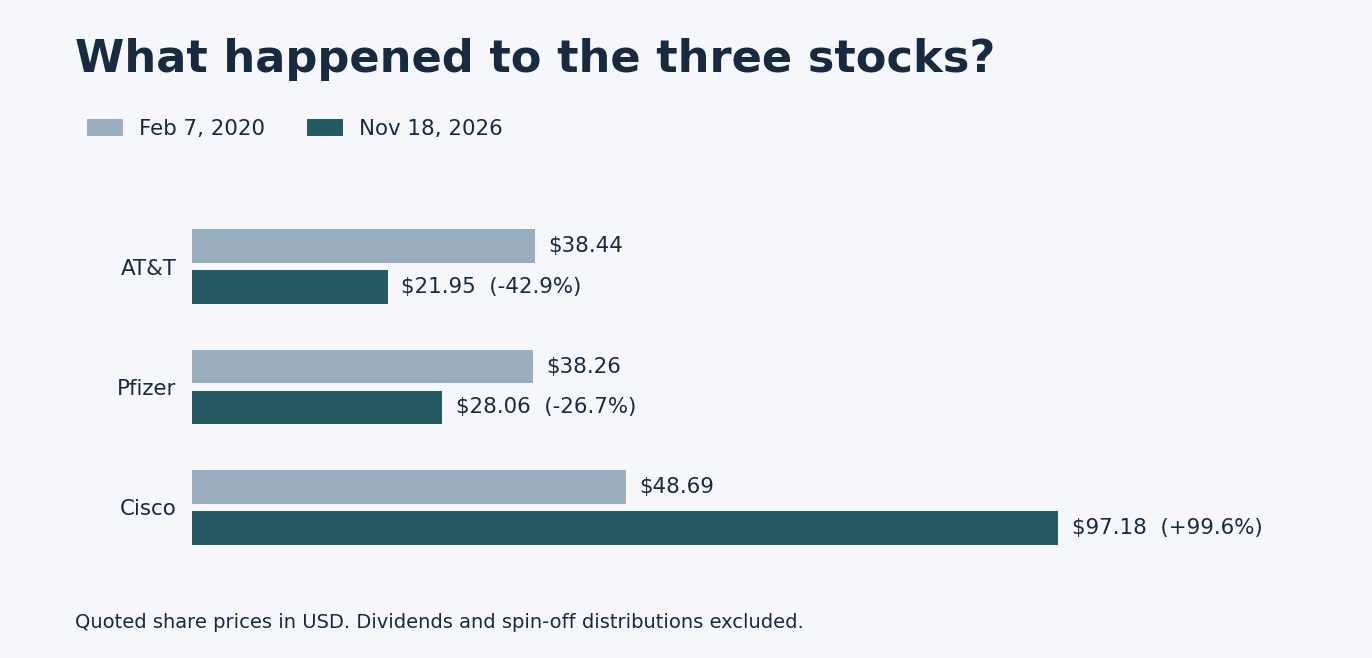
Fast-forward to 2026. Cisco nearly doubled from the price in that article, while AT&T and Pfizer were both quoted lower. That’s before dividends and spin-offs. What interests me now is how I’d make the decision today. I’d still look at the share price and what I’d pay for the business. I’d also look at delta, how much of my portfolio I’d be committing, and what I’d do if the stock fell toward my strike.
Selling a put is easy once you know how the order works. The harder part is choosing an obligation you’re willing and able to take on. That’s what I mean by a safer way to sell puts. For a monthly trade, I’d start near 0.20 delta, set aside the cash for the shares, and be ready to price a roll if the trade is challenged. A stock can still fall far enough to cost me much more than I collected.
How I pick dividend stocks for cash-secured puts
I start with the company. If I’m assigned a standard U.S. equity put, I’ll generally buy 100 shares at the strike. On a $50 put that means setting aside $5,000. If I collect $0.60 per share, my effective entry is $49.40 before fees. I want to be comfortable with the business and that entry price on a day when the market is giving me reasons to worry about both.
- Check the dividend and the business behind it. I look for a regular dividend and read the latest earnings. What pays for the dividend, what could put it at risk, and would I still want the stock if the payout were cut?
- Look about a month out, near 0.20 delta. On the chain, a put typically shows a negative delta, so I’m looking for something around −0.20. For this comparison I used roughly 0.15 to 0.25 in absolute value. Delta estimates how sensitive the option price is to the stock at that moment. Some traders also use it as a rough guide to finishing in the money. Delta changes as the stock, volatility, and time to expiration change. Assignment can happen earlier.
- Check liquidity and the calendar. I use the bid to estimate the opening credit and check the ask because I may need to buy the put back. I also check open interest, trading volume, earnings dates, and other known events before choosing a strike.
- Add up the cash before adding up the premium. I assume every put could be assigned at once. If I can’t comfortably buy all the shares at their strikes, I need fewer contracts or different stocks.
I’ve taken assignment on other trades. Sometimes I’m happy to own the shares and sell covered calls as part of the wheel strategy. Repeatedly rolling a challenged put can tie up cash for months. That’s why I try to choose the stock carefully. A business that looks fine when I sell the put can look very different after a bad earnings report.
Why I look for dividend stocks for the wheel strategy
If a put is assigned and I end up holding the shares for a while, a dividend-paying business can pay me while I own it. That’s the appeal of what some traders call “triple income.” Over a full turn of the wheel, the cash can come from three places.
- Put premium. I sell a cash-secured put at a strike where I’d be willing to buy the shares.
- Dividends. If I’m assigned, I can collect any declared dividend for which I qualify as a shareholder. I earn no dividend from holding the short put alone.
- Covered-call premium. Once I own the shares, I can sell a call at a price where I’d be happy to let them go. If the call is assigned, I can go back to looking for a put.
The amounts can come at different times and are never guaranteed to show up together. The company can cut the dividend, the stock can fall by more than I’ve collected, and a covered call caps my upside while it’s open. If my shares are called away before the ex-dividend date, I can miss the payout. I want a business I’d be comfortable holding through a difficult quarter, even if the next covered call offers very little.
Can selling cash-secured puts bring in $200 a month?
Two hundred dollars means something different in every account. If I have $10,000 in cash I can actually set aside for puts, $200 is 2% of that cash for one month. With $25,000 available it’s 0.8%. The amount I can set aside matters more to me than the headline portfolio value, especially when much of the portfolio is already invested.
With a cash-secured put, I reserve the full purchase amount. If my broker lets me sell puts on margin without setting aside the full cash amount, the same contract can use less buying power up front. The quoted premium and the obligation to buy the shares at the strike are the same. If the position moves against me, the broker can require more collateral when I have less room to maneuver. For the examples below, I size each trade using the full cash needed for assignment.
I ran an AI-assisted search for dividend-paying stocks with monthly options, then checked the dividends and the option chains myself. ExxonMobil was the one that made me stop and look. I still remember XOM trading around $80. In this screen it was above $160.
I used the November 18, 2026 snapshot for puts expiring December 18, 30 calendar days later. I compared one standard contract per stock at the displayed bid. The three companies paid regular dividends, and the strikes below traded on the snapshot date. A higher dividend yield didn’t necessarily come with more put premium.
| Dividend stock | Share price | Put strike | Put delta | Bid / ask | Gross premium at bid | Cash for assignment | Break-even at bid |
|---|---|---|---|---|---|---|---|
| ExxonMobil (XOM) | $160.58 | $150.00 | −0.205 | $1.75 / $1.92 | $175 | $15,000 | $148.25 |
| Coca-Cola (KO) | $98.09 | $92.50 | −0.188 | $0.68 / $0.74 | $68 | $9,250 | $91.82 |
| Verizon (VZ) | $46.13 | $43.00 | −0.158 | $0.20 / $0.32 | $20 | $4,300 | $42.80 |
Historical quotes and deltas from Optionistics. The bid and ask are per share. The premium and cash columns are per 100-share contract. These are examples based on quoted prices, before fees and taxes.
ExxonMobil brought in the most premium. The $150 put showed $175 at the bid and $15,000 in collateral. There were 277 contracts traded that day and 6,032 in open interest. Exxon had declared a $1.07 quarterly dividend. If I were considering the shares at $148.25 after premium, I’d ask how the dividend and spending plans would hold up with lower oil prices.
Coca-Cola added a different business. The $92.50 strike showed $68 at the bid, with a six-cent bid–ask spread. The company had declared a $0.53 quarterly dividend. At the $91.82 effective entry, that payout annualizes to about 2.3% at the same dividend rate. I’d need to be comfortable with the valuation at that price, including how much future growth depends on consumers accepting higher prices.
Verizon took less cash and showed why the spread matters. Verizon had declared a $0.7075 quarterly dividend, but at the $43 strike the bid was only $0.20 against a $0.32 ask. Selling at the bid and instantly buying back at the ask would cost $12 per contract at those prices, before fees. I’d weigh that against the $20 credit and look at cash flow after network investment and debt payments before deciding whether I wanted the shares.
Exxon and Coca-Cola together showed $243 in gross premium on $24,250 in collateral, about 1% for that 30-day cycle. Exxon and Verizon showed $195 on $19,300. On the same Exxon and Coca-Cola strikes one day earlier, the combined bid was $161. The price of that Exxon put moved enough in one day to take the basket from below $200 to above it.
In 2020, the three puts would have required $12,400 if all were assigned. The Exxon and Coca-Cola pair would require $24,250, nearly twice as much. It’s possible to collect $200 with less cash. If I force the target by using more margin, selling strikes closer to the share price, or reaching for more volatile stocks, I can take on substantially more risk. Even with the full cash set aside and deltas near 0.20, I can still be challenged and spend months rolling. I’ve been there with Bank of America and Netflix.
What rolling BAC and NFLX taught me
Bank of America. In Week 76, I turned a BAC credit spread into a $57.50 cash-secured put expiring November 20, 2026. By Week 77, BAC had fallen below that strike. I rolled to $55 and collected additional premium, but the new expiration was March 19, 2027. That bought me another four months beyond the original expiry and still left me with a $5,500 purchase obligation. Week 78 shows how the lower strike and longer expiry still left the position under pressure.
Netflix. This one started as a weekly credit spread, turned into a short put, and kept getting pushed out. In Week 63, I rolled it to January 2027. By Week 64, I’d rolled it to a $66 strike expiring in June 2027. That was a year out from when I wrote the update. A trade that started on a weekly clock had become a long commitment. Netflix pays no dividend. I include it here because the same lesson about rolling applies to dividend stocks.
If the stock drifts toward my strike, I check whether I’d still buy the shares. Then I compare the cost of closing, accepting assignment if it comes, or buying back the put and selling another at a lower strike and later expiry. A roll can bring in a net credit while the original put closes at a loss. I ask whether I’d open the replacement put on its own and how long I’m willing to tie up the cash.
For a sense of scale, if Exxon and Coca-Cola in the example both finished 20% below their strikes, the pair would lose about $4,607 at expiration after the quoted premium, before fees. That’s the kind of number I want to see before I sell the puts.
These days I’d use $200 to plan the month. In the trading journal I’d track the credit, what it cost to close or roll, and what I paid for any shares I took home. If the stocks, strikes, and cash commitment make sense, I’ll see what the market is offering. Some months I’d be happy to collect less and keep some cash free.