The other day I spent about an hour on Google Meet with a long-time acquaintance, Jon. We exchanged ideas around options trading. Jon walked me through his preferred structure - the Double Diagonal.
I’m primarily a put seller and covered call trader. That’s my core. But I keep my eyes and ears open. When something makes conceptual sense, I test it - small size, controlled risk, real market conditions.
So I decided to run a small experiment inside the Terramatris Ethereum Strategy.
On Bybit we can trade as little as 0.1 ETH, which makes this perfect for structural experiments.
After a few hours revisiting everything we already know - puts, calls, credit spreads, iron condors - the mechanics finally clicked.
This is not a simple set-and-forget structure. It’s for advanced traders who understand term structure and rolling mechanics.
Here’s the trade.
The Structure
Underlying: ETH
Spot at entry: $1,913
Position size: 0.1 ETH
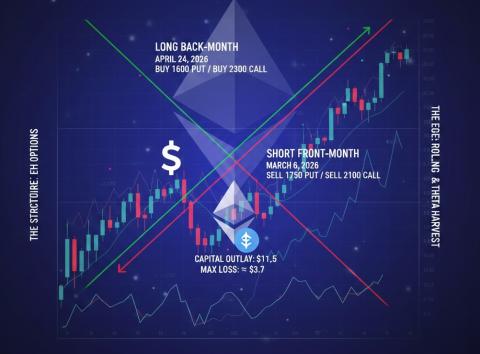
Long Back-Month Options (April 24, 2026 – 58 DTE)
- Buy 1600 Put @ 76.1
- Buy 2300 Call @ 74.7
Short Front-Month Options (March 6, 2026 – 9 DTE)
- Sell 1750 Put @ 23
- Sell 2100 Call @ 14.7
This creates a time-spread iron condor - a double diagonal.
Capital Outlay
Premium paid (per 1 ETH):
Longs:
- 76.1 + 74.7 = 150.8
Shorts:
- 23 + 14.7 = 37.7
Net debit per 1 ETH:
150.8 − 37.7 = 113.1
Since we traded 0.1 ETH, actual capital deployed:
113.1 × 0.1 = $11.31
With fees included, total was about:
≈ $11.5
That matches the sheet.
This is our initial defined capital exposure.
What Is the Maximum Loss?
This is where most people misunderstand diagonals.
Worst case scenario:
- ETH collapses far below 1600 before March 6.
Front-month put (1750) goes deep ITM.
Back-month put (1600) protects us.
The intrinsic width of that vertical is:
1750 − 1600 = 150
Ignoring residual time value, the position could temporarily mark around –150 per 1 ETH.
We paid 113.1 debit.
So theoretical additional downside:
150 − 113.1 = 36.9 per 1 ETH
For 0.1 ETH:
36.9 × 0.1 = $3.69
So approximate worst-case loss:
≈ $3.7
Not $11.5.
Not unlimited.
Defined.
The call side works symmetrically on a violent upside move.
Risk is capped by strike width minus net debit.
Where Is Maximum Profit?
Maximum profit occurs if:
- ETH stays between 1750 and 2100
- Front-month options expire worthless
- Back-month options retain most of their time value
In that scenario:
We keep full short premium:
37.7 × 0.1 = $3.77
Meanwhile the April long strangle still has substantial time value (about 50 days remaining).
Even assuming modest time decay (say ~10–15% over 9 days), the back-month structure could still be worth ~130 per 1 ETH.
Rough estimation:
Value ≈ 130
Cost = 113.1
That’s ≈ 16.9 per 1 ETH
= $1.69 on 0.1 ETH
Add short premium already embedded in pricing and realistic peak P/L could land around:
$2–4 on a $11.5 debit
So we’re looking at roughly 20–35% return per cycle if things behave.
But that depends on:
- IV behavior
- Spot location
- How quickly we close
The Real Edge: Rolling
This is not an expiry trade.
Plan:
- Roll the short options weekly
- Potentially close at 50% profit
- Manage deltas actively
The long April options act as structural protection and vega exposure.
The weekly short legs generate income.
It’s a theta harvest layered over a long volatility frame.
Why I Like Testing This
As a put seller, I’m used to:
- Short volatility
- Directional bias
- Margin usage
This structure is different:
- Positive theta (from shorts)
- Positive vega (from longs)
- Defined tail risk
- Complex P/L path
It forces you to understand:
- Term structure
- Calendar decay
- Gamma differences between expiries
You can’t wing this.
Conclusion
Is this better than iron condors?
Not necessarily.
It’s more nuanced.
It’s an advanced structure requiring:
- Active management
- Awareness of IV regime
- Willingness to roll
But as an educational experiment inside Terramatris — risking under $12 — the learning value alone justifies it. We’ll see how the first weekly roll performs. If this becomes repeatable with controlled risk, it might earn a permanent spot in the Ethereum playbook. If not, it stays what it is: A well-structured experiment.
If you’d like to learn more about double diagonals or other options trading techniques, feel free to book a coaching session.