Back in April 2025, I had 100 shares of NVIDIA at an average purchase price of $118.22. Part of the position was financed on margin. My idea was to hold the shares, sell covered calls, and use some of the premium to chip away at the margin balance. In the first week of my trading journal, I bought back a $104 call and sold a $105 call expiring six days later. A dollar higher on the strike, a little more premium, and another week to think about it.
What I didn’t fully appreciate then was how long I’d be willing to keep doing it. I rolled up and out, then did it again. By September 2026 I had a $130 call expiring in January 2028, with NVDA trading above $220 at the time. I still had exposure to NVIDIA, but the call shaped how much of the next rally I could keep. That’s the part of my NVDA covered call strategy I’d spend more time thinking about if I were starting with those 100 shares again.
Why I chose NVIDIA for my covered calls
I wanted to own NVIDIA because I saw a business with room to grow in AI and data centers, alongside its established gaming business. NVIDIA’s fiscal 2025 results backed up the data-center part of the story. The company reported $115.2 billion of data-center revenue for the year, more than double the prior year. That was my reason to own the stock. The active options market gave me a way to sell calls against the shares.
There was a tension in that plan from the start. I owned NVDA because I thought it could rise a lot, then I sold someone else the right to buy it from me at a fixed price. A stock that can move sharply can offer attractive premium. That same move can make the call expensive to buy back. And if the stock drops, the premium cushions only a small part of the loss. Financing part of the shares on margin added interest and made the whole position more sensitive to a drawdown.
How an NVDA covered call works
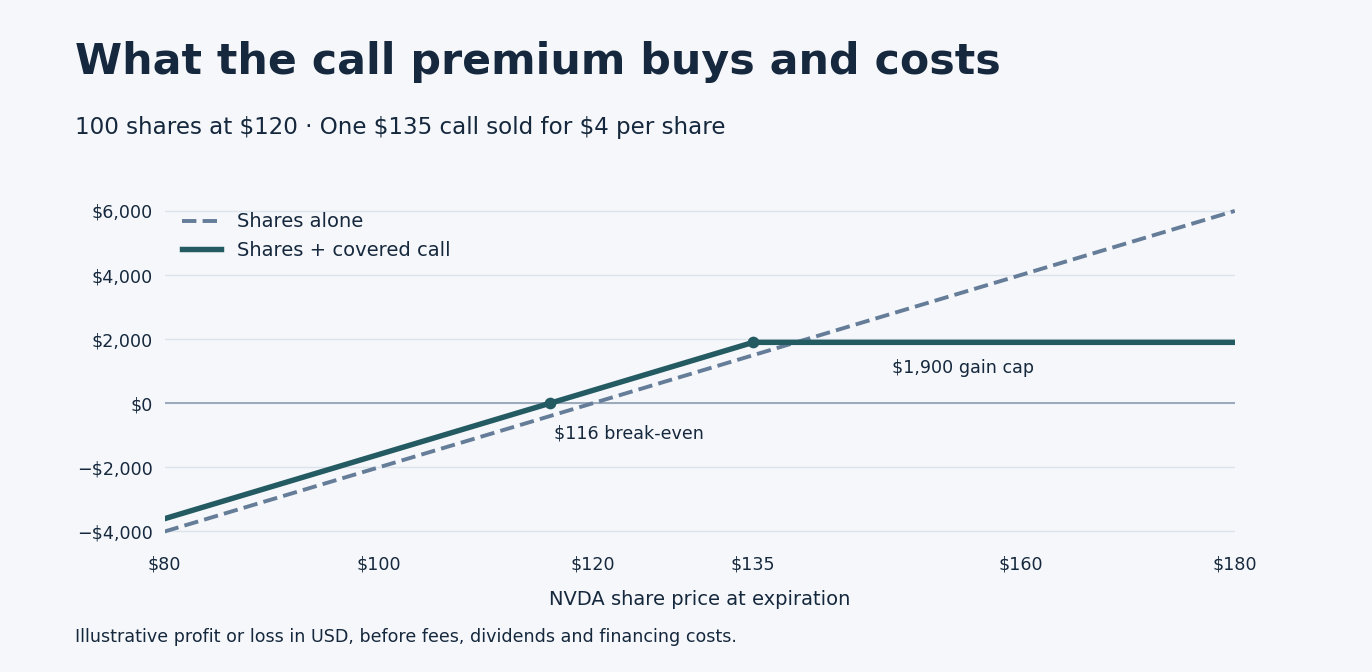
With 100 shares, I can generally sell one standard call. I receive a premium and agree to sell those shares at the strike if I’m assigned. Suppose I buy 100 shares at $120 and sell one $135 call for $4 per share. I receive $400 before fees. If I hold the trade through expiration and the shares finish below $135, the call would generally expire worthless and I’d still own the shares. If they finish above $135 and I’m assigned, the shares sell for $135 each. Assignment can also happen before expiration.
At $160 at expiration, the shares alone would be up $4,000. The covered-call position would make $1,900 before fees, dividends and financing costs, made up of $1,500 in stock gains and $400 in premium. At $100, the covered-call position would still be down $1,600. The strike caps the upside while the call is open, and the premium lowers the expiration break-even to $116 in this example.
What determines the NVDA covered call premium?
The premium changes with the strike, time left, share price and expected volatility. When a call is already in the money, part of the premium is intrinsic value. For instance, if NVDA trades at $150, a $135 call already has $15 per share of intrinsic value. If the call trades at $18, just $3 is time value. That split matters when I’m comparing two expirations or looking at the cost of buying back a deeply in-the-money call.
How I kept rolling my NVDA calls up and out
“Up” means a higher strike. “Out” means a later expiration. I buy to close the existing call and sell to open a new one. When the second sale brings in more than I paid to close the old call, the roll brings in a net credit before fees. That’s the cash flow from the two orders. To find the result on the old call, I still have to compare its closing cost with the premium I originally received for it.
| Journal entry | Strike change | Expiration change | Cash from the roll |
|---|---|---|---|
| April 2025 · Week 1 | $104 to $105 | April 11 to April 17 | $135 before costs from the quoted legs. My journal recorded $133. |
| May 2025 · Week 5 | $107 to $108 | May 9 to May 23 | $41 from the two legs |
| July 2025 · Week 16 | $110 to $113 | August 15 to December 19 | $60 reported |
| September 2026 · Week 77 | $125 to $130 | June 2027 to January 21, 2028 | About $160 reported |
Selected rolls from my trading journal, one standard contract each. These are historical trades. The amounts reflect cash from the rolls and do not add up to the profit on the full position.
In May 2025 I paid $10.62 per share to close the $107 call and received $11.03 to open the $108 call. The $41 difference was barely enough to cover my monthly margin interest at the time. Raising the strike by a dollar also raised the amount I could receive if assigned by $100. I got something for those extra two weeks. In July I got $60 and a $3 higher strike, but the expiration moved from August to December. By then I was committing the shares for months at a time.
The September 2026 roll made the trade-off even clearer. Raising the strike from $125 to $130 increased the contractual proceeds if assigned by $500 on 100 shares, and the roll brought in about $160. I also extended the call roughly seven months. At the time, the stock was more than $90 above the new strike, so much of the value of my shares above $130 was offset by the short call. The $130 January 2028 call was still listed in my November 13 journal update. That’s where this case study leaves the trade.
When I’d roll a covered call, close it, or let the shares go
Today I’d ask one question before opening another NVDA covered call. At what price would I actually be happy to sell these 100 shares? I’d choose the strike from that answer, then look at expiration, premium, liquidity, and whether earnings land inside the trade. A high bid can look good on the day I sell. The real test is how I feel about that price when the stock gets there.
- Let the shares be called away if the strike is a sale price I still like. I agreed to that price when I sold the option. The shares can also be called away before expiration.
- Buy back the call if I want the full upside again and can justify the cost of removing it. A deep in-the-money call can be expensive to close. I’d calculate what I paid in total, including what each earlier call cost to buy back.
- Roll up and out if I’d sell the replacement call as a new trade today. I’d compare the increase in the strike and the net cash flow with the extra time I’m committing the shares for. If I need an extra seven months to get a modest improvement, I’d seriously consider the other two choices.
When I review the results, I want three numbers in front of me. What did the shares do, what did the options make or lose after closing costs, and what did margin and commissions cost me? I’d compare that total with simply holding the same 100 NVDA shares over the same period. When the call is still open, its market value belongs in the comparison too. That’s how I can tell whether selling the calls was worth the upside I gave away.
I still see a place for covered calls when I’m willing to sell the shares at a specific price. After rolling up and out as many times as I did, I’m much more interested in that price and how long I’ll commit to it than I am in whether the next order shows a credit.
Sources for the mechanics and business background are the Options Industry Council’s covered call guide and NVIDIA’s fiscal 2025 results. Trade amounts and dates come from the journal entries linked above.