I’ve been selling covered calls on our 100 Nvidia (NVDA) shares since April 2025. We bought the shares at an average of $118.22, using margin. My trade log shows 16 covered-call sales from April 2025 through November 23, 2026, including the replacement contracts I sold when I rolled. Nvidia rallied from the mid-$90s in early April to about $135 by late May. My call strike was still $108 when the stock got there, so my upside was capped early in the rally. My first NVDA covered-call update
I actually enjoyed rolling the calls up and out. As long as Nvidia looked healthy and traded comfortably above my strike, I was happy to go out another six months or even a year if I could raise the strike and the pricing made sense.
By September 2026, I’d rolled from a June 2027 $125 call to a January 21, 2028 $130 call. The roll brought in about $160 after commissions and raised the price we’d get for the shares by $500 if assigned. I was comfortable with that trade. Week 77 trading journal
Where I started to feel uncomfortable
While holding those shares and the covered call, I was also selling weekly NVDA put credit spreads for extra premium. When the stock held up, those trades brought in a little more cash. When it fell, the shares and the put spreads could lose money together. The long put capped the loss on each spread at expiration, while the 100 shares still exposed the portfolio to further declines.
I paused the spreads in October and returned in November when the premiums looked attractive again. I closed the $120/$115 put spread at a loss during the selloff. I still wanted to own Nvidia, but adding more downside exposure while the account carried margin debt felt uncomfortable. Week 79 pause · Week 85 trading journal
The selloff gave me a chance to shorten the call
On November 20, 2026, Nvidia closed at $125.53, below our $130 strike. I was still holding the shares and watching what a further decline could do to the account. The drop also gave me a chance to buy back the January 2028 call and get back to a weekly expiration. I paid $2,930 to close the old call and received $552 for selling the November 27 $130 call. After commissions, those two trades took $2,379.82 out of the account. November 20 market recap
IBKR showed a $7,765.32 realized gain on the January 2028 call itself, reflecting what I’d received when I opened that contract. The $2,930 was the cash I paid to close it. The result for the covered-call strategy since 2025 would also include the earlier rolls, the shares and financing costs.
The rebound gave me room to raise the strike
Nvidia’s board reinstated Jensen Huang on November 22, and the company announced his return the next day. The stock jumped and my trade log had NVDA around $166 when I made the next adjustment. The weekly $130 call had gone from out of the money to deep in the money in one trading session. Nvidia’s SEC filing
I bought back the weekly call for $3,545 and sold the February 19, 2027 $135 call for $3,635. That roll brought in $88.83 after commissions. Across both adjustments, the calls cost me $2,290.99 in net cash. In exchange, I ended up with a strike $5 higher and an expiration about eleven months earlier than January 2028.
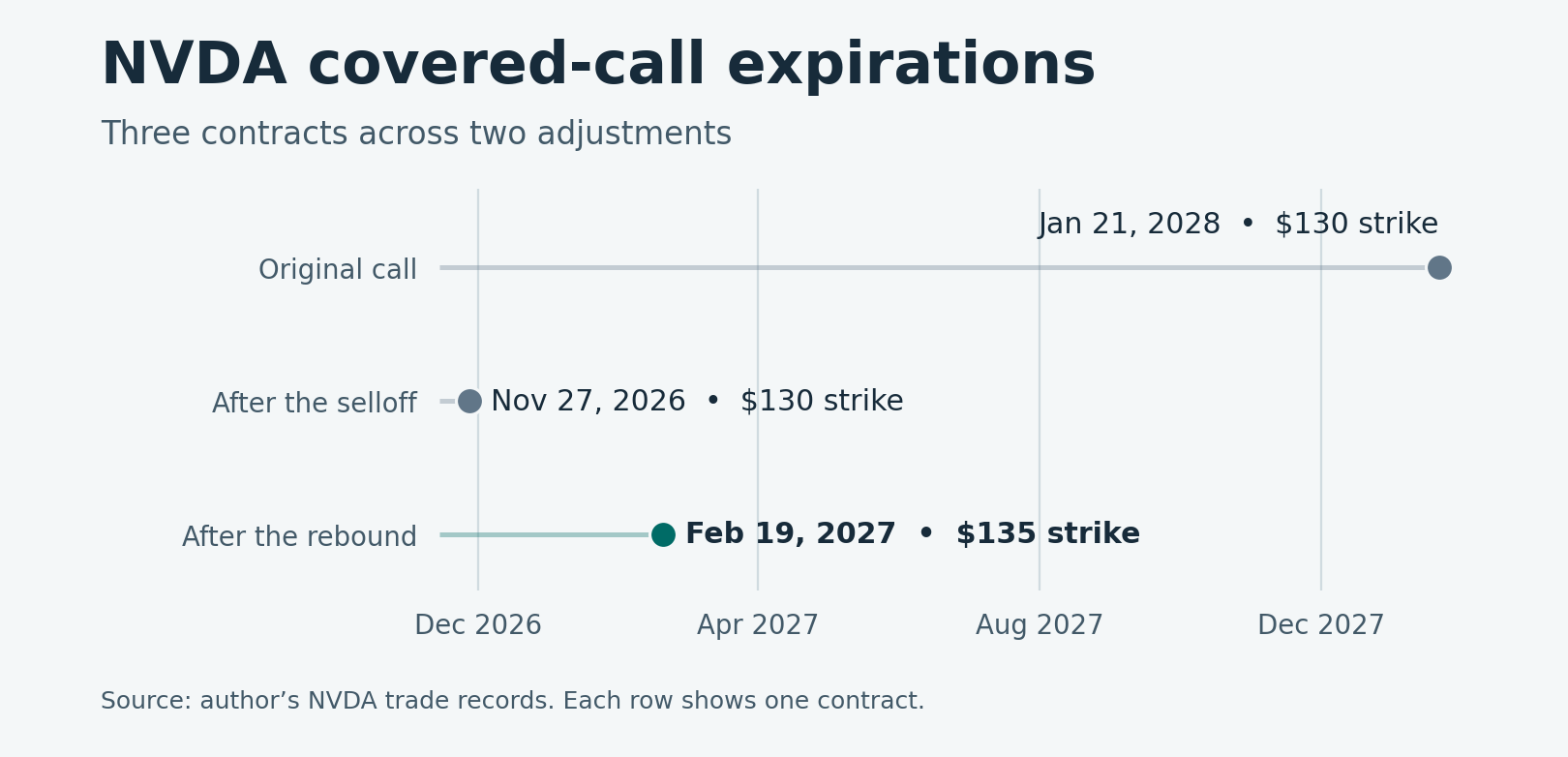
If the shares are called away at $135, we’ll receive $13,500 for the 100 shares. That’s $1,678 above our original purchase cost on the stock alone, before accounting for the option trades, commissions, margin interest or taxes.
Should I have rolled the covered call or let the shares go?
I enjoyed keeping the Nvidia shares, and I’m still in a better position with the stock than when I started in April 2025. The February call gives us a potential sale price of $135 against our original $118.22 purchase price. The trade-off is that our margin debt has increased significantly. I’m still carrying the downside on 100 shares and paying interest while I wait.
If my priority was reducing margin debt, I probably should have let the weekly $130 call run. If it had been assigned, we’d have received $13,000 for the shares and could have used the proceeds to pay down the borrowing. Rolling kept the position open and raised our potential sale price by $500. I can see why I chose to stay in the trade, and I can also see why taking assignment might have been the better decision for the account.
If Nvidia’s rally continues, I’ll see whether I can roll the $135 call toward a $150 strike. That would give the 100 shares another $1,500 of room to participate in the rally before the new strike caps the upside. I’d weigh that against the cost of the roll, the extra time I’d have to commit and the interest we’d keep paying. If the terms don’t make sense, I’m willing to let the shares go at $135 if assigned.
Disclosure: This article documents my personal options trading experience and is not investment advice.