Our dividend stock portfolio recovered $286 to $11,597 on November 27, up 2.53% from Week 85. It was a welcome bounce after the biggest weekly drop in this journal. I also brought our NVIDIA covered call forward by eleven months and raised the strike to $135. Unfortunately, margin debt rose to $4,626 after the roll. If the shares are called away in February, the proceeds could clear the debit.
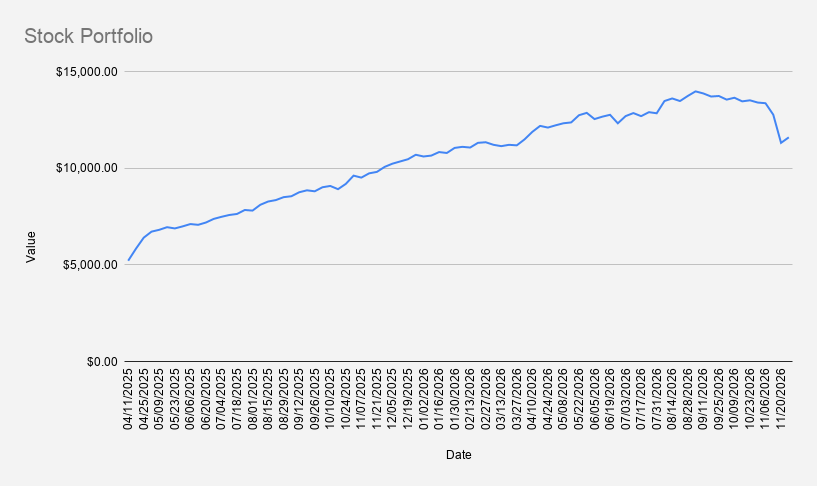
How much ground did we recover?
We regained about one-fifth of the $1,465 we lost last week. The portfolio is still $2,376 below its September 4 high of $13,973, a drawdown of 17.00% versus 19.05% last week. From $11,597, we’d need a 20.49% gain to get back to the peak and a 29.34% gain to reach the $15,000 year-end target. I’m treating that target as a milestone. My priority now is making the account less dependent on a rally.
At the journal’s tracking snapshot, the portfolio was up 18.78% year to date, against +6.40% for the S&P 500 and −20.31% for NVIDIA. Those figures come from my portfolio tracker. The market figures below use regular-session closes.
What drove the Thanksgiving-week rebound?
On Monday, NVIDIA disclosed that its board had reinstated Jensen Huang as CEO and a director on November 22. NVDA jumped about 31% on Monday and closed at $165.05. It closed Tuesday at $155.38, then traded around $142 when I opened my Wednesday put. That sequence mattered more to my options book than the week’s closing print. A stock can rally sharply and still give back a large part of the move before a position expires.
By Friday’s early close, the S&P 500 had gained 5.6% on the week to 7,297.49 and the Nasdaq Composite had gained 6.7% to 24,129.50. Both surrendered part of Monday’s rally before rising again Friday. The Thanksgiving holiday schedule shortened the week to four sessions, with U.S. equities closing at 1 p.m. Eastern on Friday.
Wednesday’s data gave the market two reasons to keep watching rates. The BEA’s second GDP estimate raised third-quarter real growth from 3.4% to 4.3% annualized. In the October PCE report, headline inflation reached 3.8% year over year and core PCE reached 3.3%. The Fed’s Beige Book reported at least slight growth across eight of its twelve districts, with input costs generally rising faster than selling prices. For the chip trade, solid growth can support demand. Persistent inflation can also keep yields elevated and put pressure on the multiples investors will pay.
NVIDIA earnings and valuation after the bounce
NVIDIA’s fiscal third-quarter results put numbers behind the AI spending story. Revenue increased 103% year over year to $115.8 billion. Data Center contributed $107.6 billion, about 93% of the total. Management guided to $130 billion of revenue, plus or minus 3%, in fiscal Q4 and a 71%–72% GAAP gross margin, down from 74.8% in Q3. At $130 billion of sales, the 71.5% margin midpoint implies about $4.3 billion less gross profit than the same sales at 74.8%. That’s the sensitivity I’m watching as the company scales.
At a $150 reference price, NVIDIA trades at about 16 times trailing GAAP earnings. The $9.31 per diluted share combines the first nine months of fiscal 2027 and the last quarter of fiscal 2026. NVIDIA’s annual report shows how much sales depend on a few large customers. The operating case depends on the pace of AI infrastructure spending and how much gross profit NVIDIA can retain as its product mix changes. At the next earnings release I’ll look for higher gross profit and evidence that margin can stabilize.
Case study. Resetting the NVIDIA covered call
- November 20. Near the close, I bought back the January 21, 2028 $130 call for about $2,931 and sold a new $130 call expiring November 27. That removed the long commitment to the old strike. I still had a $130 sale obligation going into the weekend.
- November 23. After NVIDIA rallied on Huang’s return, I bought back the November 27 call and sold the February 19, 2027 $135 call. Monday’s $165.05 close illustrates the speed of the move. At that share price, a $130 call would carry $3,505 of intrinsic value per standard contract, before any time value.
I started writing covered calls on NVIDIA at a $104 strike in April 2025. Compared with the original January 2028 call, the position now expires 336 days earlier and would deliver $500 more in gross share proceeds if the same 100 shares are called away. Closing the earlier calls realized an options loss. For the week as a whole, the journal recorded −$2,383 in net options cash flow. Once the roughly $2,931 January buyback is set aside, the other options entries net to about $550 in cash. To measure realized P&L, I match each closing debit with its own opening credit and fees, then mark the February call as an open position.
Margin debt rose from $2,209 to $4,626, an increase of $2,417. Roughly $1,100 of the February call’s value was intrinsic at my mark, consistent with a share price near $146. At that price, the $11 per share above the strike is already reflected in the value of the shares and in the liability on the call. If NVDA holds steady, only the call’s remaining time value can decay. A drop below $135 leaves the covered shares exposed dollar for dollar at expiration.
| NVDA at February expiry | What happens to the covered lot | Cash effect |
|---|---|---|
| $120 | The call generally expires worthless. I keep 100 shares worth $12,000 at that price. | The existing cash debit still needs funding. |
| Near $135 | Assignment is uncertain near the strike. I’ll check exercise and broker cutoffs. | Cash depends on whether the shares are delivered. |
| $150 or higher | If assigned, I deliver 100 shares at $135. At $150, the stock alone would be worth $1,500 more. | $13,500 gross sale proceeds would leave about $8,874 in cash after the current debit. |
The cash example holds the $4,626 debit fixed and excludes intervening trades, interest, fees and taxes. Any cash freed up still has to support the remaining puts and satisfy the broker’s margin requirements. I’m comfortable considering assignment at $135 because it gives the account a path back to positive cash. The call could also be assigned before expiration, particularly if its remaining time value falls below an upcoming dividend.
Case study. The XSP and NVIDIA 0DTE trades
Zero days to expiration, or 0DTE, means the contract expires the day I open it. As the stock or index approaches the strike, the option can become much more sensitive to price moves just as time to manage it runs out.
- On November 24, I opened a Mini-S&P 500 (XSP) put spread. I sold the 705 put and bought the 700 put for a $20 gross credit. The five-point width limited the expiration loss to $480 before fees, assuming both legs were held through cash settlement. Both expired worthless and I kept $19.26 after commissions.
- On November 25, with NVDA around $142, I sold one same-day $133 put for $0.24 per share. It expired worthless and I kept $24 before commission. Assignment on a standard equity option like this would have required buying 100 shares for $13,300, more than this journal’s $11,597 of equity at the weekly snapshot. At $130 at expiry, the put would have lost $276 before fees, equivalent to eleven and a half full $24 credits.
I still prefer exploring same-day NVIDIA options on listed expirations while the February call is open. The sizing question comes first. If I sold a put and was assigned, I could end up adding 100 NVDA shares into a selloff while the covered lot was still in the account. For the next trade, I’ll check how I’d fund that assignment and compare the cost of adding a protective put.
What else changed in the portfolio?
I added 0.1 NVIDIA, 0.1 Main Street Capital, 1 Micron and 2 NIO shares. MAIN adds to the income sleeve. The Micron purchase adds exposure to memory and storage, including demand from data centers. That broadens the holdings by company while keeping some exposure to the same AI spending cycle as NVIDIA. The weekly $120/$115 NVDA put spread carried over from Week 85 was due November 27. The table shows the positions still open in the weekly journal.
| Expiration | Open position | What I’m watching, per contract |
|---|---|---|
| Dec. 18, 2026 | BAC $57.50/$60 bear call spread | $250 gross strike width before the opening credit. A rally through $57.50 puts the short call in the money. |
| Dec. 18, 2026 | Lufthansa (LHA, Frankfurt) €7 cash-secured put | Potential share purchase at €7 per share. |
| Feb. 19, 2027 | NVDA $135 covered call | 100 shares delivered for $13,500 if assigned on one contract. |
| Feb. 19, 2027 | NFLX $75/$85 bear call spread | $1,000 gross strike width before the opening credit. Upside risk is separate from the long-dated short put. |
| Mar. 19, 2027 | BAC $55 short put | $5,500 gross purchase obligation if assigned. |
| Mar. 19, 2027 | BMY $55 cash-secured put | $5,500 gross purchase obligation at the lower strike after last week’s roll from $60. |
| Dec. 17, 2027 | NFLX $64 short put | $6,400 gross purchase obligation if assigned. |
Assuming one standard contract each, the three U.S. short puts represent $17,400 in potential share purchases across their expirations, before premiums and separate from the euro put. That’s about 1.5 times the account’s equity. The February Netflix bear call spread shows how small the credit can be next to the downside on a short put. A falling stock can make the put more expensive to buy back while the spread earns only its capped credit. A rally can improve the put and pressure the spread. I worked through similar positions in earlier Netflix and Bank of America trades. I want to be able to explain both trades on their own, especially if more than one ticker moves against me.
What I’m watching November 30–December 4
- On Tuesday, December 1, ISM manufacturing and October job openings will help frame demand and hiring. Marvell reports later that day. I’m listening for what it says about custom silicon and data-center demand.
- On Wednesday, December 2, NVIDIA shares go ex-dividend for the $0.25 quarterly payment, worth $25 on 100 shares. I’ll check the $135 call’s remaining time value before the ex-date because a deeply in-the-money call can be exercised early to capture the payment.
- ISM services comes Thursday, December 3, followed by November payrolls at 8:30 a.m. Eastern on Friday, December 4. I’ll watch Treasury yields and whether other chip stocks confirm NVIDIA’s move. Heading into the December 8–9 Fed meeting, strong wages paired with higher yields would make me more cautious about adding exposure.
My first check next week is the cash balance. If NVIDIA stays above $135, I can weigh letting the existing call run against the cost of buying it back. If it falls below the strike, the February sale is less likely and I still need a way to reduce the debit. I’d count a smaller cash shortfall and more room to handle assignment as a good week.