In this article I will share how we adjusted an in-the-money covered call on Ethereum, using a rolling and laddering technique that allows us to keep our ETH while continuing to collect option premium.
This approach was used in our Ethereum strategy run by Terramatris crypto hedge fund, where the goal is both short-term premium income, and long-term ETH exposure combined with systematic options selling.
Many traders sell covered calls and simply let their assets get called away when the strike is breached. Our approach is different: we try to keep the underlying asset whenever possible by rolling the option forward.
Below is a practical example of how this adjustment works.
The Situation: Covered Calls Move In The Money
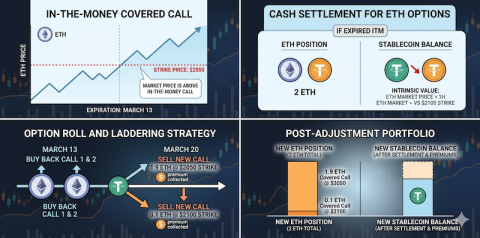
On March 13, 2026, we had the following position:
2 ETH covered calls
Strike price: $2050
Expiration: March 13
ETH market price: around $2100
This meant the calls were in the money, making expiration above the strike very likely.
Unlike stock options, crypto options are typically settled in crypto or stablecoins rather than through traditional share assignment. This means there is no classical assignment process like in equity markets.
Instead, if the option expires in the money, the settlement simply results in a negative USDT balance equal to the intrinsic value of the option, reflecting the difference between the strike price and the market price. The underlying ETH position remains in the account, while the settlement adjusts the stablecoin balance accordingly.
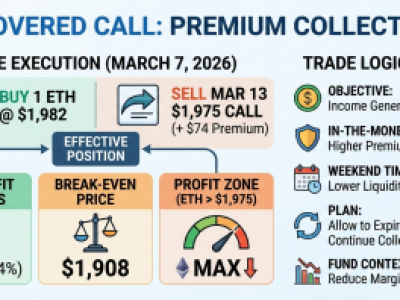
In this case, the ETH was originally purchased at $1980 a few weeks earlier. During the holding period we had already collected more than $250 in option premium, which pushed our effective break-even price down to about $1730.
At this point we could simply allow assignment and sell the ETH at $2050. The trade would still be profitable.
However, the core idea of our Ethereum strategy is to keep the Ethereum position whenever possible and continue generating income from it.
Instead of letting the ETH go, we adjust the position.
Step 1 — Buy Back the Existing Call
When a covered call moves into the money, the traditional adjustment step is to buy back the existing option.
Since the strike price is below the market price, the option contains intrinsic value, meaning closing it requires paying the difference between the strike and the current market price.
At first this may seem counterintuitive — paying to close a position you originally sold — but the cost is typically partially or fully offset by selling a new option further out in time.
However, with crypto-settled options, the mechanics are slightly different. Because settlement does not involve classical assignment like in stock markets, and because we actively manage positions, we usually do not buy back the option right before expiry.
Instead, we often let the option expire either in the money or worthless, and then immediately proceed to the next step: selling a new option further out in time. This effectively achieves the same outcome as a roll, while simplifying execution around expiration,
Step 2 — Sell a New Call Further Out in Time
After closing the current option, we sell a new covered call with a later expiration.
This process is called rolling the option forward.
Example:
New strike: $2050
New expiry: March 20 (one week later)
Premium collected: about $110
Because the previous option had intrinsic value, part of the premium from the new sale compensates for the cost of buying back the old contract.
In our example the roll produced roughly $60 per ETH in additional premium.
Rolling allows us to:
Keep the ETH position
Continue collecting premium
Delay assignment
Step 3 — Use a Laddered Strike Structure
Instead of rolling the entire position into identical contracts, we sometimes use a laddered structure.
In this example the new calls were split as follows:
1.9 ETH covered call at $2050 strike
0.1 ETH covered call at $2100 strike
Both options were sold for premium, but the slightly higher strike allows some additional upside participation if ETH continues to rise.
This creates a more flexible position for the next adjustment.
Why Ladder Covered Calls?
Laddering strikes can make future adjustments easier.
Scenario 1: ETH falls below $2050
If the price drops below the strike:
The options move out of the money
We keep the premium
The position can be rolled again from a stronger position
This is usually the easiest outcome.
Scenario 2: ETH continues rising
If ETH keeps climbing higher, the $2050 contracts become harder to roll, because their intrinsic value increases.
However, the $2100 contract remains closer to the market price, which often means it still contains more extrinsic value and can be rolled more easily.
Even a small laddered portion can make future adjustments smoother.
The Key Idea: Roll Forward, Not Out
The philosophy behind this strategy is simple:
Hold Ethereum long term
Sell covered calls repeatedly
Roll options forward when they move in the money
Instead of treating assignment as the default outcome, the strategy focuses on continuously managing the position.
This approach allows us to generate ongoing income from ETH holdings while maintaining exposure to the asset.
Part of the Terramatris Ethereum Strategy
Rolling and laddering covered calls are core components of the Terramatris Ethereum options strategy.
The objective is to balance three factors:
Premium income
Maintaining long ETH exposure
Keeping some upside potential
Depending on where ETH trades, we may repeat the same process again — buy back the current option and roll it forward using a laddered structure.
Over time, this technique allows us to compound option income while staying invested in Ethereum.
If you’d like to learn more about covered calls, options adjustments or other options trading techniques, feel free to book a coaching session.