Pfizer (PFE) is not a new name in my investing history. I was investing in PFE well before Covid, with fairly high expectations for the stock as a stable pharmaceutical blue-chip with strong cash flows and a reliable dividend profile. During the Covid years, Pfizer became a market favorite, but paradoxically that period also marked the beginning of my loss of interest in the stock.
Once PFE was excluded from the Dow Jones Industrial Average, the broader market narrative around the company changed. Momentum faded, expectations were reset lower, and the stock gradually lost attention. During one of my early margin liquidation events (2020), I let the position go entirely not because of fundamentals, but because of portfolio mechanics and capital pressure at the time.
Over the following years, Pfizer stayed on my radar in a mostly passive way. I occasionally looked at it from an options-trading perspective and sometimes as a dividend-income candidate, but it was never a priority allocation.
That changed on February 9, 2026.
After closing a short put position on Shell, I was looking for a replacement trade that offered liquidity, depressed or sideways price action, and usable options premium. Pfizer stood out as a reasonable candidate. Instead of buying shares outright, I initiated the position through a bull put credit spread with 11 days to expiration. The intent was straightforward: generate premium first and only commit capital indirectly.
From the collected options premium, I bought 0.5 shares of PFE for the dividend stock portfolio. This was done deliberately. The ultimate goal is not to get assigned on puts, but to slowly grow a Pfizer position using options income generated from the stock itself. Fractional shares are acceptable, and there is no fixed timeline.
The long-term objective is to reach 100 shares of PFE, at which point selling covered calls becomes possible. I expect to sell options on a bi-weekly basis once the position is large enough, although if trades become challenged, I am comfortable rolling further out in time. In such cases, share accumulation may pause entirely. Capital discipline takes priority over speed.
Unlike NVDA or BMY, Pfizer is not a core holding or a top-priority asset in my portfolio. That distinction matters. It means I am not forcing trades, not averaging aggressively, and not chasing assignment simply to accelerate reaching 100 shares. This position is best described as a slow, options-funded compounding experiment rather than a conviction growth bet.
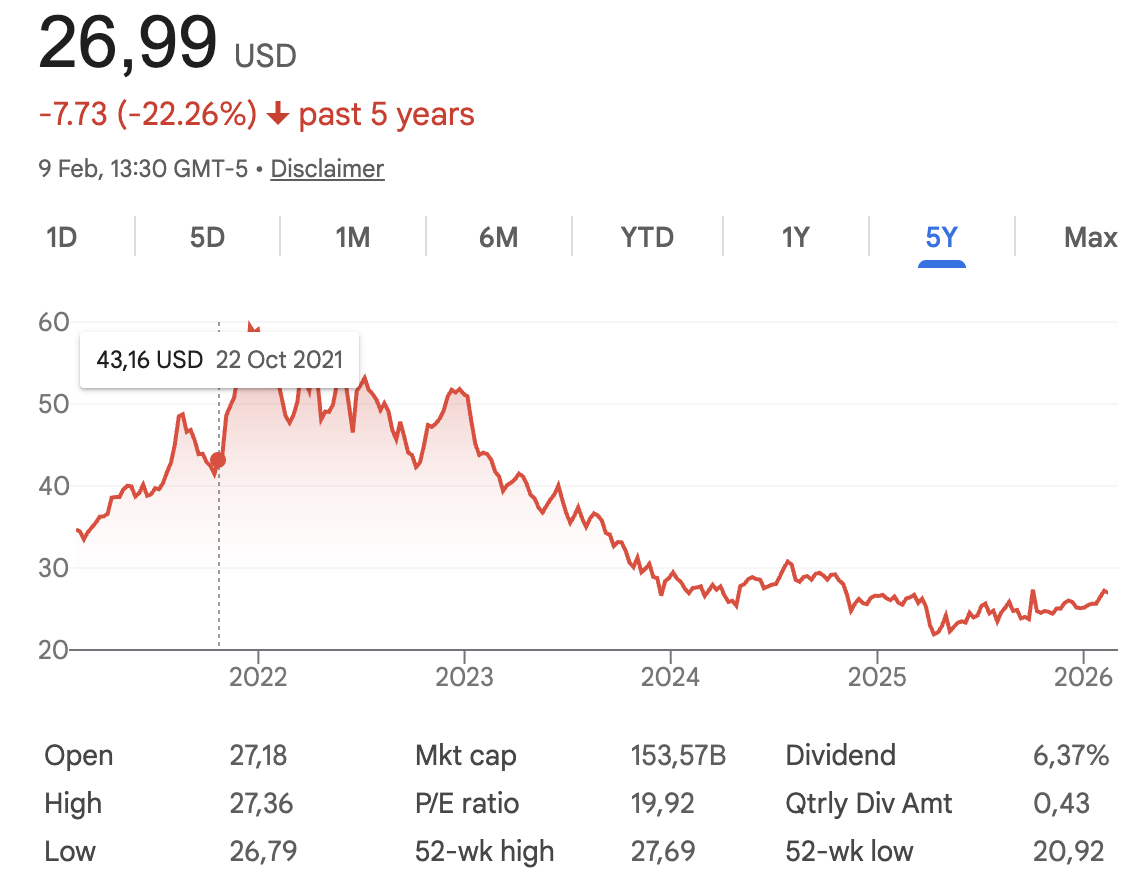
Pfizer also offers a dividend yield above 6% annually, currently paying around $0.41 per share per quarter. With only 0.5 shares in the portfolio, the dividend contribution is negligible and will remain so for a long time. That is acceptable. Every position starts somewhere, and in this case dividends are a long-term bonus rather than a primary driver.
From my perspective, Pfizer’s strengths are clear. It remains a globally recognized pharmaceutical company with strong liquidity and a very usable options market. The dividend yield is attractive, valuation is reasonable compared to historical levels, and management appears focused on post-Covid cost discipline.
For options traders, PFE offers relatively steady implied volatility and consistent premium without the gap risk associated with high-growth technology stocks.
At the same time, the weaknesses are equally obvious. Revenue has declined following the wind-down of Covid-related products, the growth narrative is weak, and market confidence remains low. The stock has effectively been dead money for several years. While the dividend looks sustainable in the near term, long-term confidence depends heavily on pipeline execution.
The main risks include further earnings compression, failed drug development efforts, potential long-term pressure on the dividend, and opportunity cost compared to faster-moving capital elsewhere. For these reasons, PFE is not a stock I would aggressively accumulate using fresh capital.
In summary, Pfizer re-entered my portfolio not as a high-conviction growth play, but as a controlled, capital-efficient options strategy. Options come first, stock accumulation second, and dividends last. If PFE performs well, the position benefits naturally. If it stagnates, premium collection continues. If it declines sharply, exposure remains limited and manageable. That is exactly how I want this position to behave.